

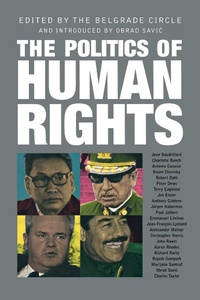
The Politics of Human Rights
Published on 5. May 2020
370 pages
978-1-78960-805-2 (ISBN)
Description

This volume sets out to describe the political and philosophical underpinnings of the idea of human rights by bringing together a collection of original essays by a group of highly distinguished theorists. Recognizing that Western insistence on the universality of the concept of human rights can also function as a diplomatic cover for post-colonial interventions, it insists that the campaign for human rights must take into account the varied social and economic environments in different nation states that affect the ways such demands can be implemented. This campaign is most effective when demonstrating international solidarity with those whose basic rights are jeopardized or denied.
More details
Edition
Ebook UK & RoW
Language
English
Place of publication
London
United Kingdom
Product notice
Reflowable
ISBN-13
978-1-78960-805-2 (9781789608052)
Copyright in bibliographic data and cover images is held by Nielsen Book Services Limited or by the publishers or by their respective licensors: all rights reserved.
Schweitzer Classification
Other editions
Additional editions
The Belgrade Circle
The Politics of Human Rights
Book
10/2002
Verso Books
€28.00
Shipment within 3-4 weeks
Persons
The Belgrade Circle, a non-governmental organization, was founded in February 1992 by a group of independent and dissident intellectuals. It gained an international reputation through its courageous struggle against the nationalism, xenophobia and politics of war which spread dramatically through Serbian society during the collapse of the Federal Republic of Yugoslavia between 1992 and 1999. Among many other activities it has published more than forty books, including titles by Jacques Derrida, J¿rgen Habermas and Charles Taylor. It also publishes regular editions of the Belgrade Circle Journal.
Obrad Savic teaches History of Social Sciences at the University of Belgrade. He is editor-in-chief of the Belgrade Circle Journal, and author and editor of numerous collections.
Jean Baudrillard (1929-2007) began teaching sociology at the Universit¿ de Paris-X in 1966. He retired from academia in 1987 to write books and travel until his death in 2007. His many works include Simulations and Simulacra, America, The Perfect Crime, The System of Objects, Passwords, The Transparency of Evil, The Spirit of Terrorism, and Fragments, among others.
Noam Chomsky is Institute Professor in the Department of Linguistics and Philosophy at the Massachusetts Institute of Technology. He is the author of American Power and the New Mandarins, Manufacturing Consent (with Ed Herman), Deterring Democracy, Year 501, World Orders Old and New, Powers and Prospects, Profit over People, The New Military Humanism and Rogue States.
Peter Dews is Professor of Philosophy at the University of Essex. He has published widely on contemporary French and German thought, and is the author of The Limits of Disenchantment.
Terry Eagleton is Professor of Cultural Theory and John Rylands Fellow, University of Manchester. His other books include Ideology; The Function of Criticism; Heathcliff and the Great Hunger; Against the Grain; Walter Benjamin; and Criticism and Ideology, all from Verso.
Anthony Giddens is a world-renowned social theorist who has written over thirty scholarly works, including Runaway World. He has written on just about every major topic in sociology and is known for his work on modernization theory and globalization.
Obrad Savic teaches History of Social Sciences at the University of Belgrade. He is editor-in-chief of the Belgrade Circle Journal, and author and editor of numerous collections.
Jean Baudrillard (1929-2007) began teaching sociology at the Universit¿ de Paris-X in 1966. He retired from academia in 1987 to write books and travel until his death in 2007. His many works include Simulations and Simulacra, America, The Perfect Crime, The System of Objects, Passwords, The Transparency of Evil, The Spirit of Terrorism, and Fragments, among others.
Noam Chomsky is Institute Professor in the Department of Linguistics and Philosophy at the Massachusetts Institute of Technology. He is the author of American Power and the New Mandarins, Manufacturing Consent (with Ed Herman), Deterring Democracy, Year 501, World Orders Old and New, Powers and Prospects, Profit over People, The New Military Humanism and Rogue States.
Peter Dews is Professor of Philosophy at the University of Essex. He has published widely on contemporary French and German thought, and is the author of The Limits of Disenchantment.
Terry Eagleton is Professor of Cultural Theory and John Rylands Fellow, University of Manchester. His other books include Ideology; The Function of Criticism; Heathcliff and the Great Hunger; Against the Grain; Walter Benjamin; and Criticism and Ideology, all from Verso.
Anthony Giddens is a world-renowned social theorist who has written over thirty scholarly works, including Runaway World. He has written on just about every major topic in sociology and is known for his work on modernization theory and globalization.
Content
- Cover Page
- Title Page
- Copyright Page
- Contents
- Preface
- Part I: The Politics of Human Rights
- Introduction: The Global and the Local in Human Rights
- 1. The Law of Peoples
- 2. The Rights of Man and Good Will
- 3. Private and Public Autonomy, Human Rights and Popular Sovereignty
- 4. Human Rights, Rationality and Sentimentality
- 5. Law, Solidarity and the Tasks of Philosophy
- 6. Conditions of an Unforced Consensus on Human Rights
- 7. Majority Rule and Individual Rights
- 8. Are Human Rights Truly Universal?
- 9. Democracy and Human Rights under Different Conditions of Development
- 10. The Other's Rights
- 11. Human Rights in the 'New Europe'
- 12. Hobbes, 'Fearful Discourse', and the Basic Right to Refuse to Bear Arms during Military Service
- 13. The Legal Status of National Minorities in the Federal Republic of Yugoslavia
- 14. Women's Rights as Human Rights
- Part II: Subversive Discourse
- 15. Political Theory and the Problem of Violence
- 16. Local and Global
- 17. Time of Consumption and the Consumption of Time
- 18. The Perfect Crime
- Part III: Inventory of Texts
- 19. 'A Painful Peace'
- 20. Critique and Analysis in Media Studies
- 21. Metaphor, Ontology and Scientific Truth
- Part IV: War in the Tribal Zone: Yugoslavia
- 22. Parallel Worlds
- 23. Speed Memories (III)
- Notes
- Bibliography
- Notes on Contributors
