

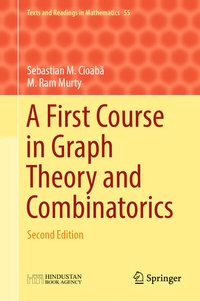
A First Course in Graph Theory and Combinatorics
Description

This book discusses the origin of graph theory from its humble beginnings in recreational mathematics to its modern setting or modeling communication networks, as is evidenced by the World Wide Web graph used by many Internet search engines. The second edition of the book includes recent developments in the theory of signed adjacency matrices involving the proof of sensitivity conjecture and the theory of Ramanujan graphs. In addition, the book discusses topics such as Pick's theorem on areas of lattice polygons and Graham-Pollak's work on addressing of graphs. The concept of graph is fundamental in mathematics and engineering, as it conveniently encodes diverse relations and facilitates combinatorial analysis of many theoretical and practical problems. The text is ideal for a one-semester course at the advanced undergraduate level or beginning graduate level.
More details
Other editions
Additional editions
Persons
Sebastian M. Cioaba is Professor at the Department of Mathematical Sciences, University of Delaware, Newark, USA. After his undergraduate studies in mathematics and computer science at the University of Bucharest, Romania, he obtained his Ph.D. in Mathematics at Queen's University at Kingston, Canada. Following postdocs at UC San Diego and the University of Toronto, Sebastian started his teaching position at the University of Delaware in 2009. His research interests are in spectral graph theory, algebraic combinatorics, and their connections and applications to other areas of mathematics and science. He is on the editorial board of several journals including Discrete Mathematics , Linear Algebra and its Applications , and Electronic Journal of Linear Algebra . He has organized several conferences in algebraic combinatorics and spectral graph theory. Sebastian has supervised 5 Ph.D. students, 2 M.Sc. students, 3 undergraduate senior theses, and over 20 summer research students. He has published more than 60 papers, and his research has been supported by NSF, NSA, NSERC, Simons Foundation, IDex Bordeaux, and Japan Society for Promotion of Science.
M. Ram Murty is Queen's Research Chair and A.V. Douglas Distinguished University Professor at Queen's University, in Kingston, Ontario, Canada. He obtained his Ph.D. from Massachusetts Institute of Technology, USA, in 1980 and subsequently held positions at the Institute for Advanced Study in Princeton, Tata Institute for Fundamental Research in Mumbai, and McGill University in Montreal. He has authored more than 250 research papers and written more than a dozen mathematical textbooks. His monograph, Non-vanishing of L-functions and Applications , written jointly with Prof. V. Kumar Murty, won the 1996 Balaguer Prize. Ram is Fellow of the Royal Society of Canada, Fellow of the American Mathematical Society, and Fellow of the Indian National Science Academy, India. He also teaches Indian philosophy at Queen's University and has authored Indian Philosophy: An Introduction , published by Broadview Press.
