

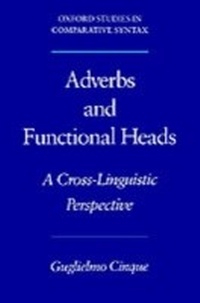
Adverbs and Functional Heads
A Cross-Linguistic Perspective
1st Edition
Published on 18. March 1999
288 pages
978-0-19-535405-8 (ISBN)
Description

One of the world's leading syntacticians presents evidence for locating Adverb Phrases in the specifiers of distinct functional projections within a novel and well articulated theory of the clause. In this theory, both adverbs and heads, which encode the functional notions of the clause, are ordered in a rigid sequence. Cinques cutting-edge proposal suggests that the structure of natural language sentences is much richer than previously assumed.
More details
Other editions
Additional editions
Book
05/1999
Oxford University Press Inc
€226.80
Shipment within 15-20 days

Book
03/1999
Oxford University Press Inc
€61.90
Article exhausted; check different version
Content
- Intro
- Contents
- Abbreviations
- 1 On the Relative Order of Adverb Phrases
- 1.1 "Lower" (pre-VP) AdvPs in Italian and French
- 1.2 "Higher" (sentence) AdvPs in Italian and French
- 1.3 "Lower" (pre-VP) AdvPs in VP-final position
- 1.4 Cases of AdvP movement and questions of scope
- 1.5 Circumstantial adverbials of place, time, manner, and the like
- 1.6 "Focusing" and "parenthetical" uses of AdvPs
- 1.7 Toward a universal hierarchy of AdvPs: some cross-linguistic evidence
- 2 A Case for Adverb Phrases in Spec
- 2.1 Active past participle movement in Italian
- 2.2 Finite V movement in Italian
- 3 On the Order of Clausal Functional Heads
- 3.1 Evidence from the order of "nonclosing" (agglutinating) suffixes
- 3.2 Evidence from the order of "closing'"(inflectional) suffixes and auxiliaries
- 3.3 Evidence from the order of functional particles
- 3.4 Evidence from mixed cases
- 3.5 Some remarks on prefixes, derivation, and inflection
- 3.6 Toward a universal hierarchy of functional heads (a first approximation)
- 4 Matching and Refining the Hierarchies of Adverb Phrases and Functional Heads
- 4.1 Moods and modals
- 4.2 Theories of tense: evidence for Vikner's (1985) three-relations theory
- 4.3 "Lexical" and "grammatical" aspect
- 4.4 Speech act adverbs and speech act mood
- 4.5 Evaluative adverbs and evaluative mood
- 4.6 Evidential adverbs and evidential mood
- 4.7 Epistemic adverbs and epistemic modals
- 4.8 Time adverbs and T(Past), T(Future)
- 4.9 "Perhaps" and irrealis mood
- 4.10 "(Not) necessarily/possibly" and alethic modals
- 4.11 Subject-oriented adverbs and root modals
- 4.12 Habitual adverbs and habitual aspect
- 4.13 Repetitive/frequentative adverbs and repetitive/frequentative aspects (I)
- 4.14 "Quickly/rapidly" and celerative aspect (I)
- 4.15 "Already" and T(anterior)
- 4.16 "No longer" and terminative aspect
- 4.17 "Still" and continuative aspect
- 4.18 "Always" and perfect/imperfect aspect (?)
- 4.19 "Just," "soon," and retrospective and proximative aspects
- 4.20 Durative adverbs and durative aspect
- 4.21 "?" and generic/progressive aspect
- 4.22 "Almost/imminently" and prospective aspect
- 4.23 Completely and tutto, and the two types of completive aspect
- 4.24 "Well" (manner adverbs) and voice
- 4.25 "Quickly/fast/early" and celerative aspect (II)
- 4.26 "Completely" and completive aspect (II)
- 4.27 Repetitive/frequentative adverbs and repetitive/frequentative aspect (II)
- 4.28 Speculative remarks on other aspects and adverb classes
- 4.29 Toward a universal hierarchy of clausal functional projections (a second approximation)
- 5 DP-Related Functional Projections and Negative Phrases
- 5.1 The positions of subject DPs
- 5.2 The positions of object DPs
- 5.3 Floating quantifiers
- 5.4 The positions of Neg(ative) P(hrase)s
- 6 Some Implications and Residual Questions
- 6.1 Default and marked values: simple and complex sentences
- 6.2 The hierarchy of functional projections and minimalist ideas
- 6.3 Semantics and the hierarchy of functional projections
- 6.4 Alleged parametric variation in the relative order of functional heads
- 6.5 Hierarchies of nonclausal functional projections
- 7 Conclusions
- Appendix 1 Some Remarks on Other Verbal Forms and Other Romance Varieties
- A.1 Infinitives in French and Italian
- A.2 Past participles in some Romance varieties
- A.3 Absolute past participles, present participles, and gerunds in Italian
- A.4 Finite verbs in some Romance varieties
- Appendix 2 A Synopsis of the Orders of Overt Functional Heads in Individual Languages
- Notes
- References
- Language Index
- A
- B
- C
- D
- E
- F
- G
- H
- I
- J
- K
- L
- M
- N
- O
- P
- Q
- R
- S
- T
- U
- V
- W
- X
- Y
- Z
- Name Index
- A
- B
- C
- D
- E
- F
- G
- H
- I
- J
- K
- L
- M
- N
- O
- P
- R
- S
- T
- V
- X
- Z
- Subject Index
- A
- B
- C
- D
- E
- F
- G
- H
- I
- J
- L
- M
- N
- O
- P
- Q
- R
- S
- T
- U
- V
- W
- X
- Y
