

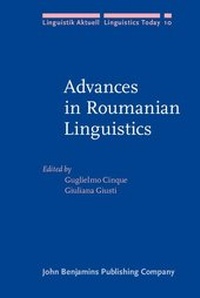
Advances in Roumanian Linguistics
1st Edition
Published on 13. April 1995
XI, 172 pages
978-90-272-8241-5 (ISBN)
Description

The aim of the book is to collect and make available to the public recent studies on Roumanian in the framework of Generative Grammar. All the studies can be considered as highly advanced from both the empirical and the theoretical point of view. In fact, they deal with many of the phenomena that differentiate this language from other well-studied ones, adopting and further improving recent developments in linguistic theory. In this respect the book contributes both to Roumanian studies and to theoretical linguistics.
These studies cover major areas of general syntactic investigation: the syntax of nominal expressions (Giusti on determiners, Grosu on free relative clauses), clausal structure (Motapanyane), clitic placement (Dobrovie-Sorin), and morpho-semantics (Farkas and Zec). In so doing, they address the problems of the definition and refinement of the theory of functional projections, contributing new ideas and evidence for their formulation.
These studies cover major areas of general syntactic investigation: the syntax of nominal expressions (Giusti on determiners, Grosu on free relative clauses), clausal structure (Motapanyane), clitic placement (Dobrovie-Sorin), and morpho-semantics (Farkas and Zec). In so doing, they address the problems of the definition and refinement of the theory of functional projections, contributing new ideas and evidence for their formulation.
More details
Other editions
Additional editions
Guglielmo Cinque | Giuliana Giusti
Advances in Roumanian Linguistics
Book
04/1995
John Benjamins Publishing Co
€104.94
Shipment within 10-15 days
Persons
Content
- ADVANCES IN ROUMANIAN LINGUISTICS
- Editorial page
- Title page
- Copyright page
- Table of contents
- Introduction
- Guglielmo Cinque and Giuliana Giusti
- References
- Rumanian Genitive Constructions
- 1. Introduction
- 2. The functional structure of the Rumanian DP.
- 2.1. The Agreement Area.
- 3. The Position of Gen assignment.
- 4. The Structure of Genitive Phrases
- 5. The Realization of Gen Case. The Distribution of AL XPs.
- 5.1. The postnominal Genitive.
- 5.2. The prehead Genitive construction.
- 5.3. The Pronominal use of AL
- 6. Rumanian Pronominal Genitives
- 6.1. Adjectives and the definite article
- 6.2. Postnominal Pronominal Genitives
- 6.3. The Postadjectival Pronominal Genitive construction
- 7. Concluding remarks.
- Footnotes
- References
- Clitic Clusters in Rumanian: Deriving Linear Order from Hierarchical Structure
- 1. Pronominal Clitics in Romance languages
- 1.1. Clitic Placement as adjunction to Infl
- 1.2. Clitic Placement as adjunction to IP
- 1.3. Two instances of Move Infl-to-Comp: V-second and V-preposing
- 1.4. The ECP and Merging
- 1.5. The adjacency condition on Merging
- Conclusions
- 2. Rumanian Clitic Clusters
- 2.1. Deriving linear order from hierarchical structure
- 2.2. A definition of clitics
- 2.3. Adverbial clitics and V-preposing
- 2.4. Proclisis, enclisis and Merging
- Conclusions
- 3. Move I-to-C (V-Preposing) in Auxiliary Structures
- 3.1. The Distribution of Clitics in Auxiliary Structures
- 3.2. Auxiliary inversion and endoclitic pronouns
- Footnotes
- References
- Agreement and Pronominal Reference
- 1. Introduction
- 2. Number and Person
- 2.1 Agreement Features of Pronominal Noun Phrases
- 2.2 Number and Person on Coordinate Noun Phrases
- 3. Gender
- 3.1 Gender of Lexical Noun Phrases and the Corresponding Pronouns
- 3.2 Gender features of coordinate noun phrases
- 3.3 Summary
- 4. Agreement as a Morphosyntactic Process
- Footnotes
- References:
- Heads and Modifiers among Determiners: Evidence from Rumanian
- 1. Introduction
- 2. Quantifiers.
- 2.1. Quantifiers vs. Adjectives
- 2.2. The Structural Position of Quantifiers.
- 3. Demonstratives
- 4. Possessives.
- 5. Articles.
- 5.1. German.
- 5.2. Enclitic articles in Rumanian.
- 5.3. Some contrasts with Mainland Scandinavian.
- 5.4. Conclusions
- Footnotes
- References
- Free Relatives with "Missing Prepositions" In Rumanian and Universal Grammar
- 1. The Structure of Nominal FRCs
- 2. The structure of Missing-P FRCs
- 2.1. Larson's Analysis
- 2.2. Missing-P FRCs are [+S].
- 2.2.1. Critique of Larson's conceptual objections
- 2.2.2. Empirical support for the [+S] property
- 2.3. Missing-P FRCs are [-H]
- 2.3.1. Critique of Larson's argument for [+H]
- 2.3.2. An empirical argument for [-H]
- 3. Null Categories in Missing-P FRCs and their Licensing
- 4. Summary of Results
- Footnotes
- Bibliography
- NP-Movement From Finite Clauses in Rumanian
- 1. Introduction
- 2. Case Theory
- 2.1. Unaccountable data
- 2.2. Problems for A-chain formation
- 3. Binding Principles and Subjunctive Infl
- 3.1. Control structures
- 4. The Empty Category Principle (ECP)
- 4.1. Subjunctive complements
- 4.2. Indicative complements
- 4.3. Infinitive complements
- Footnotes
- References
- Index
