

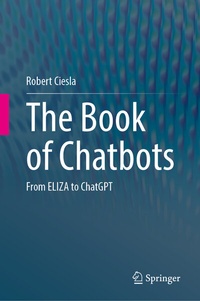
The Book of Chatbots
Description

Primitive software chatbots emerged in the 1960s, evolving swiftly through the decades and becoming able to provide engaging human-to-computer interactions sometime in the 1990s. Today, conversational technology is ubiquitous in many homes. Paired with web-searching abilities and neural networking, modern chatbots are capable of many tasks and are a major driving force behind machine learning and the quest for strong artificial intelligence, also known as artificial general intelligence (AGI).
Sophisticated artificial intelligence is changing the online world as advanced software chatbots can provide customer service, research duties, and assist in healthcare. Modern chatbots have indeed numerous applications - including those of a malicious nature. They can write our essays, conduct autonomous scams, and potentially influence politics.
The Book of Chatbots is both a retrospective and a review of current artificial intelligence-driven conversational solutions. It explores their appeal to businesses and individuals as well as their greater social aspects, including the impact on academia. The book explains all relevant concepts for readers with no previous knowledge in these topics. Unearthing the secrets of virtual assistants such as the (in)famous ChatGPT and many other exciting technologies, The Book of Chatbots is meant for anyone interested in the topic, laypeople and IT-enthusiasts alike.
Reviews / Votes
"The book of chatbots is a valuable resource for anyone interested in the development and application of chatbots. Ciesla's thorough research and clear writing style make this book a compelling read for those looking to understand the past, present, and future of chatbot technology." (Gulustan Dogan, Computing Reviews, July 16, 2024)
"The relatively sudden emergence of chatbots and artificial intelligence (AI) tools accessible to the general public has caused no little interest in their variety, how they work . and the potential risks in using them. This relatively short book attempts to answer these questions with different degrees of success. . the most positive aspects of it are its history of chatbots, overview of linguistics . and the reflection on AGI. . There is enough to tantalize readers . ." (Anthony J. Duben, Computing Reviews, May 13, 2024)
More details
Other editions
Additional editions
Person
Content
Preface.- About the Author.- 1. The Challenge of the Turing test.- 2. Developments in Artificial Intelligence and Linguistics.- 3. The Classic Era of Chatbots.- 4. The Current Era of Chatbots.- 5. AI and Chatbots in Healthcare.- 6. Chatbots in eCommerce.- 7. Chatbots as Villains - The Antisocial Uses of AI.- 8. Towards an Artificial General Intelligence.
