

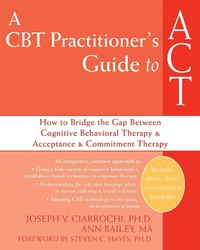
CBT Practitioner's Guide to ACT
Description

Interest in acceptance and commitment therapy (ACT) is expanding rapidly. Many of those who are interested in ACT are trained using a mechanistic cognitive behavioral therapy model (or MCBT). Utilizing both ACT and MCBT together can be difficult, because the approaches make different philosophical assumptions and have different theoretical models. The core purpose of the book is to help provide a bridge between ACT and MCBT.
The emphasis of this book will be applied psychology, but it will also have important theoretical implications. The book will highlight where ACT and MCBT differ in their predictions, and will suggest directions for future research. It will be grounded in current research and will make clear to the reader what is known and what has yet to be tested.
The core theme of A CBT-Practitioner's Guide to ACT is that ACT and CBT can be unified if they share the same philosophical underpinnings (functional contextualism) and theoretical...
More details
Other editions
Additional editions
Person
Ann Bailey, MA, is an experienced acceptance and commitment therapy (ACT) practitioner and supervisor who developed an award winning public mental health service for the treatment of borderline personality disorder and anxiety disorders. The therapeutic models used in this service integrate ACT, cognitive behavioral therapy (CBT), and dialectical behavior therapy (DBT).
Content
- Intro
- Contents
- A Letter from the Series Editor
- The First CBT Travel Guide to ACT
- Acknowledgments
- Part 1: Overcoming Cognitive Barriers to Valued Living
- Chapter 1: Toward an Integration of ACT and CBT
- Chapter 2: Escaping the Traps of Language
- Chapter 3: Supercharging Traditional CBT Techniques
- Chapter 4: Letting Go of the Self to Discover the Self
- Part 2: Moving Toward Acceptance and Action
- Chapter 5: How Philosophical Assumptions Shape Our Lives
- Chapter 6: The Possibility of Radical Acceptance
- Chapter 7: Values and Commiment
- Chapter 8: Promoting Emotional Intelligence
- Afterward
- Appendix A: Therapist Self-Exploration Workbook
- Appendix B: The Behavioral Foundations of ACT and CBT
- References
- Index
