

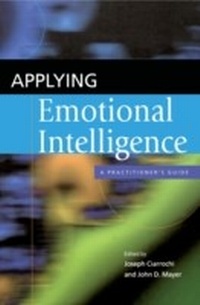
Applying Emotional Intelligence
A Practitioner's Guide
1st Edition
Published on 16. December 2013
184 pages
978-1-317-71000-4 (ISBN)
Description

The explosion of research on emotional intelligence (EI) in the past decade has provided increasing evidence that EI can be measured reliably and can be useful in predicting important outcomes, such as managerial effectiveness and relationship quality.
Naturally, people are now asking, "So, how does one improve EI?". Applying Emotional Intelligence collects the most important programs focused on that idea, and enquires of their originators, "What do you do?", "Why do you do it?", and, "What is the evidence for your approach?".
The emphasis of the book is applied, in that it provides and contrasts concrete examples of what we do in our interventions in a wide variety of situations. The chapters present descriptions of programs, including specific activities and exercises that influence emotional knowledge and social effectiveness more generally. While practical in its focus, this book also discusses the theoretical bases for these approaches.
These are new programs with outcomes that are now beginning to be studied. The book presents the most important and recent research findings that examine the efficacy of these programs. Applying Emotional Intelligence is a "must-read" for anyone interested in EI and its application. This book will be of interest to researchers conducting EI intervention research, as well as a wide variety of practitioners, including those interested in developing EI in organizations, health areas, clinical populations, and school-age settings. Finally, the book is designed to be relevant to the reader's own life, encouraging the reader to consider how the programs and the exercises might impact his or her personality and outlook, as well as contribute to the development of those who have themselves participated in the programs.
Naturally, people are now asking, "So, how does one improve EI?". Applying Emotional Intelligence collects the most important programs focused on that idea, and enquires of their originators, "What do you do?", "Why do you do it?", and, "What is the evidence for your approach?".
The emphasis of the book is applied, in that it provides and contrasts concrete examples of what we do in our interventions in a wide variety of situations. The chapters present descriptions of programs, including specific activities and exercises that influence emotional knowledge and social effectiveness more generally. While practical in its focus, this book also discusses the theoretical bases for these approaches.
These are new programs with outcomes that are now beginning to be studied. The book presents the most important and recent research findings that examine the efficacy of these programs. Applying Emotional Intelligence is a "must-read" for anyone interested in EI and its application. This book will be of interest to researchers conducting EI intervention research, as well as a wide variety of practitioners, including those interested in developing EI in organizations, health areas, clinical populations, and school-age settings. Finally, the book is designed to be relevant to the reader's own life, encouraging the reader to consider how the programs and the exercises might impact his or her personality and outlook, as well as contribute to the development of those who have themselves participated in the programs.
Reviews / Votes
'Applying Emotional Intelligence is a clearly organized and succinct attempt to bring the intellectual ideas underlying emotional intelligence into the real world. I strongly recommend it to scholars as an exemplary exercise in applied psychology, and to laypeople as a toolbox for negotiating the often-treacherous emotional waters of the social world.' - Glenn Geher, Ph.D., Department of Psychology, State University of New York at New Paltz'Joseph Ciarrochi and John D. Mayer bring together a small group of experts in the field of emotional intelligence who offer innovative and doable plans for improving the emotional self, carefully crafted from evidence based theory and research. This book is a must read for interested scholars and practitioners alike.' - Neal M. Ashkanasy, Ph.D., Faculty of Business, Economics & Law, The University of Queensland
'Regardless of which school of emotional intelligence you adhere to, Ciarrochi and Mayer present a convincing case that emotional intelligence can be enhanced. Combining hard data with practical tools, this book provides useful interventions for the workplace and the classroom.' - Steven Stein, Ph.D., co-author of "The EQ Edge: Emotional Intelligence and Your Success" 'Improving Emotional Intelligence is a clearly organized and succinct attempt to bring the intellectual ideas underlying emotional intelligence into the real world. I strongly recommend it to scholars as an exemplary exercise in applied psychology, and to laypeople as a toolbox for negotiating the often-treacherous emotional waters of the social world.' - Glenn Geher, Department of Psychology, State University of New York at New Paltz
'Joseph Ciarrochi and John D. Mayer bring together a small group of experts in the field of emotional intelligence who offer innovative and doable plans for improving the emotional self, carefully crafted from evidence based theory and research. This book is a must read for interested scholars and practitioners alike.' - Neal M. Ashkanasy, Faculty of Business, Economics & Law, The University of Queensland
"Clearly this book would benefit anyone interested in learning in considerable detail about specific training program activities and exercises that promise to influence emotional knowledge and social effectiveness in school-age settings, clinical populations, and organizations." - David D. Simpson, PsycCritiques
More details
Language
English
Place of publication
London
United Kingdom
Publishing group
Taylor & Francis Ltd
Target group
College/higher education
Illustrations
3 Tables, black and white; 25 Line drawings, black and white; 5 Halftones, black and white; 30 Illustrations, black and white
File size
3,46 MB
ISBN-13
978-1-317-71000-4 (9781317710004)
Copyright in bibliographic data and cover images is held by Nielsen Book Services Limited or by the publishers or by their respective licensors: all rights reserved.
Schweitzer Classification
Other editions
Additional editions
Book
01/2007
1st Edition
Psychology Press Ltd
€206.00
Shipment within 3-4 weeks
Book
01/2007
1st Edition
Psychology Press Ltd
€71.00
Shipment within 3-4 weeks
Persons
Joseph Ciarrochi received his Ph.D. degree from the University of Pittsburgh, a postdoctoral fellowship in emotion research from the University of New South Wales, and currently has a position as lecturer in psychology at the University of Wollongong. He has been conducting cutting-edge research in how emotions influence thinking and behavior and how emotional intelligence can best be measured and used. His findings have been published in the top journals in psychology and have been presented at numerous international conferences. Dr. Ciarrochi is currently evaluating training programs that are designed to increase people's social and emotional intelligence.
John (Jack) D. Mayer received his B.A. degree from the University of Michigan, his M.A. and Ph.D. in psychology at Case Western Reserve University, and then attended Stanford University as a National Institute of Mental Health Post-doctoral Scholar. Dr. Mayer has served on the editorial boards of Psychological Bulletin and Journal of Personality. He has published numerous scientific articles, book chapters, psychological tests, and books. His articles, with Salovey, in the early 1990s are often credited with beginning research on emotional intelligence.
John (Jack) D. Mayer received his B.A. degree from the University of Michigan, his M.A. and Ph.D. in psychology at Case Western Reserve University, and then attended Stanford University as a National Institute of Mental Health Post-doctoral Scholar. Dr. Mayer has served on the editorial boards of Psychological Bulletin and Journal of Personality. He has published numerous scientific articles, book chapters, psychological tests, and books. His articles, with Salovey, in the early 1990s are often credited with beginning research on emotional intelligence.
Content
Introduction. Joseph Ciarrochi and John D. Mayer. 1. Emotional Intelligence in the Classroom: Skill-Based Training for Teachers and Students. Marc A. Brackett and Nicole A. Katulak. 2. Developing Emotional Intelligence Competencies. Richard E. Boyatzis. 3. A Theory-Based, Practical Approach to Emotional Intelligence Training: Ten Ways to Increase Emotional Skills. Susan A. Kornacki, David R. Caruso. 4. Improving Emotional Intelligence: A Guide to Mindfulness-Based Emotional Intelligence Training. Joseph Ciarrochi, John Blackledge, Linda Bilich, Virginia Bayliss. 5. Personality Function and Personality Change. John D. Mayer. 6. The Key Ingredients of Emotional Intelligence Interventions: Similarities and Differences. Joseph Ciarrochi, John D. Mayer.
