

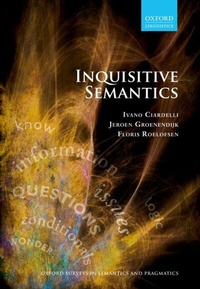
Inquisitive Semantics
1st Edition
Published on 3. January 2019
224 pages
978-0-19-254638-8 (ISBN)
Description

This is an open access title available under the terms of a CC BY-NC-ND 4.0 International licence. It is free to read at Oxford Scholarship Online and offered as a free PDF download from OUP and selected open access locations.
This book presents a new logical framework to capture the meaning of sentences in conversation. The traditional approach equates meaning with truth-conditions: to know the meaning of a sentence is to know under which circumstances it is true. The reason for this is that linguistic and philosophical investigations are usually carried out in a logical framework that was originally designed to characterize valid argumentation. However, argumentation is neither the sole, nor the primary function of language. One task that language more widely and ordinarily fulfils is to enable the exchange of information between conversational participants. In the framework outlined in this volume, inquisitive semantics, information exchange is seen as a process of raising and resolving issues. Inquisitive semantics provides a new formal notion of meaning, which makes it possible to model various concepts that are crucial for the analysis of linguistic information exchange in a more refined and more principled way than has been possible in previous frameworks. Importantly, it also allows an integrated treatment of statements and questions.
The first part of the book presents the framework in detail, while the second demonstrates its benefits in the semantic analysis of questions, coordination, modals, conditionals, and intonation. The book will be of interest to researchers and students from advanced undergraduate level upwards in the fields of semantics, pragmatics, philosophy of language, and logic.
More details
Other editions
Additional editions
Ivano Ciardelli | Jeroen Groenendijk | Floris Roelofsen
Inquisitive Semantics
Book
11/2018
Oxford University Press
€119.50
Shipment within 15-20 days
Ivano Ciardelli | Jeroen Groenendijk | Floris Roelofsen
Inquisitive Semantics
Book
11/2018
Oxford University Press
€51.70
Shipment within 15-20 days
Persons
Ivano Ciardelli is Assistant Professor at the Munich Center for Mathematical Philosophy at Ludwig-Maximilian University. He conducts research in both logic and natural language semantics. Within logic, his work is devoted to bringing out the importance of questions as tools for inference, and to the mathematical investigation of logic extended with questions. Within linguistics, he works mostly on the semantics of conditionals, questions, connectives, modals, and imperatives. He has published on these topics in various journals, including Synthese, Linguistics and Philosophy, Journal of Philosophical Logic, and Natural Language Semantics.
Jeroen Groenendijk is Emeritus Professor in the Philosophy Department and the Institute for Logic, Language, and Computation at the University of Amsterdam. His main research fields are logic and philosophy of language, in particular formal semantics and pragmatics. He focuses primarily on the semantics and pragmatics of questions and answers and dynamic semantics and his work has appeared in journals and edited volumes such as Linguistics and Philosophy, The Handbook of Logic and Language, and The Handbook of Contemporary Semantic Theory, among others.
Floris Roelofsen is Associate Professor at the Institute for Logic, Language, and Computation at the University of Amsterdam. His main areas of research are formal semantics and pragmatics and the syntax-semantics interface. He has worked on the semantics of questions, modals, quantifiers, disjunction, negation, and anaphora, as well as foundational issues in semantics and pragmatics. His work has been published in journals such as Language, Linguistics and Philosophy, Semantics and Pragmatics, Natural Language Semantics, Journal of Semantics, Linguistic Inquiry, and Journal of Philosophical Logic.
Content
- Cover
- Inquisitive Semantics
- Copyright
- Contents
- General preface
- Acknowledgments
- Sources
- 1: Introduction
- 1.1 Motivation
- 1.1.1 Why do we need a formal notion of issues?
- Reason 1: To represent the content of interrogative sentences
- Reason 2: To model conversational contexts
- Reason 3: Tomodel issue-directed propositional attitudes and capture the meaning of verbs that report such attitudes
- 1.1.2 Declaratives and interrogatives cannot be treated separately
- Reason 1: Mutualembedding
- Reason 2: Interpretational dependencies
- 1.1.3 Why do we need an integrated notion of semantic content?
- Reason 1: Common building blocks
- Reason 2: Entailment
- Reason 3: Logical operations
- 1.2 Main aims and outline of the book
- 2: Basic notions
- 2.1 The standard picture
- 2.2 Information states
- 2.3 Issues
- 2.4 Propositions
- 2.4.1 Truth and support
- 2.4.2 Informative and inquisitive propositions
- 2.4.3 Entailment
- 2.4.4 Some linguistic examples
- 2.5 Contexts
- 2.5.1 Informed and inquisitive contexts
- 2.5.2 Context extension
- 2.5.3 Updating contexts
- 2.6 Summary and pointers to possible refinements
- 2.7 Exercises
- Exercise 2.1 Contexts
- Exercise 2.2 Propositions
- Exercise 2.3 Update
- Exercise 2.4 Informational and inquisitive triviality
- 3: Basic operations on propositions
- 3.1 Algebraic operations
- 3.1.1 The algebraic perspective on classical logic
- 3.1.2 Algebraic operations on inquisitive propositions
- 3.2 Projection operators
- 3.3 Linguistic relevance
- 3.4 Exercises
- Exercise 3.1 Working through some examples
- Exercise 3.2 Meets and joins
- Exercise 3.3 Relative pseudo-complementation
- Exercise 3.4 Projection operators
- Exercise 3.5 Projection operators
- Exercise 3.6 Division
- 4: A first-order inquisitive semantics
- 4.1 Logical language and models
- 4.2 Semantics
- 4.3 Semantic categories and projection operators
- 4.4 Examples
- 4.5 Informative content, truth, and support
- 4.6 Syntactic properties of non-hybrid sentences
- 4.7 Sources of inquisitiveness
- 4.8 Comparison with alternative semantics
- 4.9 Exercises
- Exercise 4.1 Propositions in InqB
- Exercise 4.2 DeMorgan's laws
- Exercise 4.3 The law of double negation
- 5: Questions
- 5.1 Polar questions
- 5.2 Alternative questions
- 5.3 Open disjunctive questions
- 5.4 Wh-questions
- 5.4.1 Mention-all wh-questions
- 5.4.2 Mention-some wh-questions
- 5.4.3 Single-match wh-questions
- 5.4.4 Questions with multiple wh-phrases
- 5.4.5 Explicit domain restriction
- 5.5 Question coordination and conditionalization
- 5.5.1 Conjoined questions
- 5.5.2 Disjoined questions
- 5.5.3 Conditional questions
- 5.6 Limitations and extensions
- 5.6.1 Beyond resolution conditions: anaphora and bias
- 5.6.2 Contextual parameters
- 5.7 Exercises
- Exercise 5.1 Disjunctive questions
- Exercise 5.2 Quantifying into questions
- Exercise 5.3 Which questions
- 6: Disjunction, clause typing, and intonation
- 6.1 List structures
- 6.2 Logical forms
- 6.3 Interpreting logical forms
- 6.4 Unmarked cases
- 6.5 Marked cases
- 6.6 Exercises
- Exercise 6.1
- Exercise 6.2
- 7: Conditionals
- 7.1 Evidence for truth-conditional effects
- 7.1.1 The experiment
- 7.1.2 A problem for the truth-conditional view on meaning
- 7.1.3 Ruling out alternative explanations
- 7.2 Conditionals in inquisitive semantics
- 7.2.1 Breaking de Morgan's law in inquisitive semantics
- 7.2.2 Lifting conditionals to inquisitive semantics
- 7.2.3 Background semantics for counterfactuals
- 7.3 Further benefits
- 7.3.1 Simplification of disjunctive antecedents
- 7.3.2 Unconditionals
- 7.3.3 Conditional questions
- 7.4 Summary
- 7.5 Exercises
- Exercise 7.1 Lifting material implication
- Exercise 7.2 Background semantics
- Exercise 7.3 Quantification in the antecedent of a counterfactual
- Exercise 7.4 Conditional questions with disjunctive antecedents
- 8: Propositional attitudes
- 8.1 Propositional attitudes: the standard account
- 8.2 Inquisitive epistemic logic
- 8.2.1 Inquisitive epistemic models
- 8.2.2 Knowledge
- 8.2.3 Wondering
- 8.3 Beyond know and wonder
- 8.4 Pointers to further work
- 8.5 Exercises
- Exercise 8.1 Truth conditions of knowledge and wonder attributions
- Exercise 8.2 Reasoning about knowledge and wondering
- Exercise 8.3 Inquisitive epistemic logic
- Exercise 8.4 Ignorance
- 9: Comparison to alternative approaches
- 9.1 Alternative semantics
- 9.1.1 First problem: Possible answers
- 9.1.2 Second problem: Entailment
- 9.1.3 Third problem: Overgeneration
- 9.2 Partition semantics
- 9.2.1 Problem: Undergeneration
- 9.2.2 A possible concern: disjunctions of questions
- 9.2.3 Dynamic partition semantics
- 9.3 Inquisitive indifference semantics
- 9.4 Division of labor
- 9.4.1 The received view
- 9.4.2 The inquisitive perspective
- 9.5 Exercises
- Exercise 9.1 Inquisitive semantics and alternative semantics
- Exercise 9.2 Conjunction in alternative semantics
- Exercise 9.3 Inquisitive semantics and partition semantics
- Exercise 9.4 Approximate value questions
- Exercise 9.5 Inquisitive semantics versus indifference semantics
- 10: Conclusion
- 10.1 Overview of main concepts
- 10.2 Mission accomplished?
- References
- Further reading
- Extensions of InqB and IEL
- Generalizations and refinements of InqB
- Logical investigations
- Applications in linguistics
- Applications in cognitive science
- Applications in philosophical logic and epistemology
- Related frameworks
- Index
