

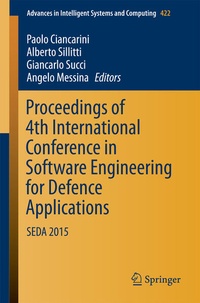
Proceedings of 4th International Conference in Software Engineering for Defence Applications
SEDA 2015
Published on 25. January 2016
XI, 330 pages
978-3-319-27896-4 (ISBN)
Description

This book presents
high-quality original contributions on new software engineering models,
approaches, methods, and tools and their evaluation in the context of defence
and security applications. In addition, important business and economic aspects
are discussed, with a particular focus on cost/benefit analysis, new business
models, organizational evolution, and business intelligence systems. The
contents are based on presentations delivered at SEDA 2015, the 4th
International Conference in Software Engineering for Defence Applications,
which was held in Rome, Italy, in May 2015. This conference series represents a
targeted response to the growing need for research that reports and debates the
practical implications of software engineering within the defence environment
and also for software performance evaluation in real settings through
controlled experiments as well as case and field studies. The book will appeal
to all with an interest in modeling, managing, and implementing defence-related
software development products and processes in a structured and supportable way.
More details
Series
Edition
1st ed. 2016
Language
English
Place of publication
Cham
Switzerland
Publishing group
Springer International Publishing
Target group
Professional and scholarly
Product notice
Reflowable
Illustrations
XI, 330 p. 120 illus. in color.
File size
9,19 MB
ISBN-13
978-3-319-27896-4 (9783319278964)
DOI
10.1007/978-3-319-27896-4
Schweitzer Classification
Other editions
Additional editions
Paolo Ciancarini | Alberto Sillitti | Giancarlo Succi
Proceedings of 4th International Conference in Software Engineering for Defence Applications
SEDA 2015
Book
01/2016
Springer
€160.49
Shipment within 10-15 days
Content
- Intro
- Preface
- Contents
- 1 Managing Increasing User Needs Complexity Within the ITA Army Agile Framework
- Abstract
- 1 Introduction
- 2 Command and Control
- 3 ITA Army Agile---The First Team
- 4 ITA Army Agile---TP2S (Team--Product--Portfolio--Strategy)
- 4.1 Strategy Team
- 4.2 Portfolio Owner---Scrum of Scrum (POSoS)
- 4.3 Product Team (PT)
- 5 Conclusions
- References
- 2 How Agile Development Can Transform Defense IT Acquisition
- Abstract
- 1 Introduction
- 2 Agile in the Italian Army Environment
- 3 Italian Army Culture and Processes
- 4 Agile in the DoD Environment
- 5 Prerequisites for Agile Adoption
- 6 Agile Requirements Process
- 7 Structuring and Tailoring for Agile
- 8 Contracting for Agile Development
- 9 Summary
- References
- 3 AMINSEP-Agile Methodology Implementation for a New Software Engineering Paradigm Definition. A Research Project Proposal
- Abstract
- 1 Introduction
- 2 The Research Area
- 2.1 Collection and Management of ``User Stories''
- 2.2 Monitoring and Measuring
- 2.3 ``Scrum'' Adaptation
- 2.4 New SW Engineering Paradigm
- 3 Horizon 2020 Opportunities
- 4 Aminsep
- 5 Conclusions
- References
- 4 Ita Army Agile Software Implementation of the LC2EVO Army Infrastructure Strategic Management Tool
- Abstract
- 1 Introduction
- 2 The Development of the Project Seen by the ``User Community''
- 3 Conclusions
- References
- 5 Consumer Electronics Augmented Reality in Defense Applications
- Abstract
- 1 Introduction
- 2 Consumer Augmented Reality
- 3 Operational Considerations
- 4 Software Engineering Approach
- 5 Conclusions
- References
- 6 Agile: The Human Factors as the Weakest Link in the Chain
- Abstract
- 1 The Contest Today
- 1.1 Chaos Report 2014
- 1.2 Boehm and Turner Study
- 1.2.1 Staffing
- 1.2.2 Culture
- 1.2.3 Value
- 1.2.4 Communications
- 1.3 The Question on the Table
- 2 A First Response
- 2.1 MBIT Model
- 2.2 What Can We Learn with MBTI?
- 2.2.1 Energy
- 2.2.2 Information Gathering
- 2.2.3 Decision Making
- 2.2.4 Lifestyle
- 2.2.5 Summary of the Four Preferences
- 3 Why Psychology in Software Development?
- 3.1 MBTI Within Agile Projects
- 3.2 How MBTI Can Benefit Teams
- 3.3 Specific MBTI Benefits
- 3.3.1 Communicating Effectively
- 3.3.2 Building an Effective Team
- 3.3.3 Sharing Leadership
- 3.3.4 Effective Problem Solving
- 3.3.5 Managing Stress and Critical Situations
- 4 Conclusion
- References
- 7 Rapid Prototyping
- Abstract
- 1 Introduction
- 2 Development Process
- 3 MathWorks Toolset
- 4 Utility
- 4.1 Automatic Build Process
- 4.2 Use of Serial Port
- 4.3 Sending and Receiving of a Simulink2122 Bus Object
- 5 Applications
- 5.1 WandBoard
- 5.2 Equipment Management: IMU
- 5.3 Guidance, Navigation, and Control Algorithms' Evaluation: Open-Loop Test
- 6 Conclusion
- References
- 8 Pair Programming and Other Agile Techniques: An Overview and a Hands-on Experience
- Abstract
- 1 Introduction
- 1.1 Prehistory
- 1.2 The Waterfall Method
- 1.3 The Rise of Agile Methodologies
- 2 Agile Methodologies
- 2.1 Agile Manifesto
- 2.2 Principles of Agile Programming
- 2.3 eXtreme Programming
- 2.4 Test-Driven Development
- 3 Pair Programming
- 3.1 Theory
- 3.2 Application
- 4 XP and Pair Programming in Daily Routine
- 5 Conclusions
- References
- 9 Expressing, Managing, and Validating User Stories: Experiences from the Market
- Abstract
- 1 Introduction
- 2 Background
- 3 Introducing ``User Stories''
- 3.1 The Process ``Induced'' by User Stories
- 3.2 Evaluating User Story
- 4 Testing User Stories
- 5 Differences from Requirements and from Use Cases
- 6 Managing Complexity
- 7 Conclusion
- References
- 10 Supplementing Agile Practices with Decision Support Methods for Military Software Development
- Abstract
- 1 Introduction
- 2 Background
- 3 Framework Architecture
- 4 Conclusions
- Acknowledgments
- References
- 11 Benefits of Open Source Software in Defense Environments
- Abstract
- 1 Introduction
- 2 Background
- 3 Benefits of OTD
- 3.1 Security Issues
- 3.2 Cost Issues
- 3.3 Innovation Issues
- 3.3.1 Cloning
- 4 Sustainable Software Development
- 5 Conclusions
- Acknowledgments
- References
- 12 Agile Software Development: A Modeling and Simulation Showcase in Military Logistics
- Abstract
- 1 Introduction
- 2 Agile Software Development: A State of the Art
- 3 Military Logistics
- 4 LASM---Logistic Analysis Simulation Model
- 5 Agile Methods and M&S Principles Along the LASM Life Cycle
- 6 Conclusion
- References
- 13 Software Characteristics for Program Forza NEC Main Systems
- Abstract
- 1 Introduction
- 2 Background
- 3 Main Characteristics of the Program
- 4 Organization and Procurement Aspects
- 5 The Main Projects
- 5.1 C2 Systems
- 5.1.1 SIACCON
- 5.1.2 SICCONA
- 5.1.3 Soldier C2 System
- 5.1.4 Integrated Test Bed (ITB)
- 5.1.5 Software Defined Radio (SDR)
- 5.1.6 Multiple Independent Levels of Security (MILS) Gateway
- 6 The Importance of the Software for the Program Forza NEC
- 7 Main Software Characteristics
- 8 Conclusions
- 14 Agile Plus New Army Diffused and Shared Leadership
- Abstract
- 1 Introduction
- 2 Foreword---The MAJIIC2 Program and the Need of a New Development Methodology
- 3 The LC2EVO Opportunity
- 4 The Onset of the ITD4
- 5 The Progress of the ITD6
- 6 The Launch of the ITD7
- 7 The Human Factor Perspective: Capturing the User Needs on the Field
- 8 The Military Doctrine Translated into Engineering: Methods and Support Tools
- 8.1 The JISR Case
- 8.2 The So-Called ``C3 Approach,'' (Keywords: Collaboration, Coaching, Continuous Change)
- 9 Conclusion
- References
- 15 Role of the Design Authority in Large Scrum of Scrum Multi-team-based Programs
- Abstract
- 1 Introduction
- 2 ITA Army Agile
- 3 Software Architecture and Documentation
- 4 Design Authority Concepts
- 4.1 The Design Authority
- 4.2 Definition
- 5 Being Agile While Still Be Compliant: The Role of Design Authority in IAA
- References
- 16 Make Your Enterprise Agile Transformation Initiative an Awesome Success
- Abstract
- 1 Introduction
- 2 What Does Agile Look like for an Enterprise?
- 3 Becoming an Agile Organization at Enterprise Level
- 4 Agile Transformation Is ``Leading Change''
- 5 Agile Leadership Development in Practice
- 5.1 Why it Matters?
- 6 Building an Agile Culture
- 7 Enterprise Agile Techniques
- 7.1 What Is a Business Experiment?
- 7.2 What Makes the Experiment Agile?
- 8 Conclusions
- References
- 17 DevOps Movement of Enterprise Agile Breakdown Silos, Create Collaboration, Increase Quality, and Application Speed
- Abstract
- 1 DevOps Definition
- 2 A Brief History
- 3 Who Is Adopting DevOps
- 3.1 Where Do They Work?
- 3.2 How Do They Think?
- 3.3 How Do They Like to Work?
- 3.4 What Motivates Them?
- 3.5 What Worries Them?
- 4 Practices Adopted by Enterprise
- 4.1 Developers Operations
- 4.2 What Are the DevOps Myths
- 5 The Challenge: Keeping Efficiency in the New High Velocity
- 6 Driving Collaboration Across the Development and IT Operations
- 7 An Holistic Approach to DevOps Implementation
- 8 Get on the Path to DevOps with Four Key Steps
- Bibliography
- 18 MBDA Extendible C2 Weapon System in Collaboration Environment
- Abstract
- 1 Introduction
- 2 Why Do We Need to Innovate?
- 3 A Component-Based Product Line Approach
- 3.1 Goals and Approach of the Product Line
- 3.2 Server-Side Components
- 3.2.1 Preliminary Analysis
- 3.2.2 Component Taxonomy
- 3.3 HMI Components in the Product Line
- 3.4 Usage of the Components
- 3.4.1 Case Studies
- 3.4.2 Experimental Phases and Risk Reduction
- 4 The CEM Description
- 5 The Export Licence
- 6 The CEM Security
- 7 The CEM Benefits
- 8 Conclusions
- References
- 19 Shu-ha-ri: How to Break the Rules and Still Be Agile
- Abstract
- 1 Introduction
- 2 Agile Framework Adoption
- 3 The Team
- 4 The Roadmap
- 5 Evaluation
- 6 Spike
- 7 Iteration
- 8 Iteration Review
- 9 Conclusions
- 20 A New Device for High-Accuracy Measurements of the Hardness Depth Profile in Steels
- Abstract
- 1 Introduction
- 2 New Approach for NDE and Testing
- 3 Experimental Results
- References
- 21 AGILE Methodology in Progesi MDA Model (Meta--Dynamic--Agile)
- Abstract
- 1 Introduction
- 2 Background: Progesi
- 3 What Is Agile
- 3.1 The Scrum Method
- 4 What Is CMMI
- 4.1 A Model, Not a Process Standard
- 5 Comparing CMMI and Agile
- 5.1 Gap Analysis from CMMI Perspective
- 5.2 Criticism from Agile Perspective
- 5.3 Analysis Result
- 6 Our Solution: Competence Centers Board
- 6.1 Agile Approach
- 6.2 Meta Approach
- 6.3 Dynamic Approach
- 7 Conclusion
- References
- 22 Data Breaches, Data Leaks, Web Defacements: Why Secure Coding Is Important
- Abstract
- 1 Introduction
- 2 Cyber Intelligence (from Open Sources)
- 3 Cyber Intelligence (from Closed Sources)
- 4 Secure Coding (or Secure Programming)
- 5 Conclusions
- References
- 23 Self-validating Bundles for Flexible Data Access Control
- Abstract
- 1 Introduction
- 2 Related Works
- 2.1 Security in the Cloud
- 2.2 DRM Systems
- 2.3 Right to Be Forgotten
- 3 Self-validation Approach
- 4 S-Bundle Architecture
- 4.1 S-Bundle Workflow
- 5 Our Implementation
- 6 Conclusions
- Acknowledgment
- References
- 24 Improving Bug Predictions in Multicore Cyber-Physical Systems
- Abstract
- 1 Introduction
- 2 State of the Art
- 2.1 Bug Prediction
- 2.2 Bug Prediction and Concurrency
- 3 Our Approach
- 4 Conclusions
- References
- 25 Predicting the Fate of Requirements in Embedded Domains
- Abstract
- 1 Introduction
- 2 State of Art on Empirical Studies on Requirements
- 3 Methodology
- 3.1 Prediction Method
- 3.2 Evaluation of Performance of Predicting Models
- 4 Case Study
- 4.1 Data Description and Processing
- 4.2 Learning of the Model and Evaluation of Performance
- 5 Limitations and Future Work
- 6 Conclusions
- References
- 26 Capturing User Needs for Agile Software Development
- Abstract
- 1 Introduction
- 2 The Legacy Software Production Cycle
- 3 Adapting ``Agile'' to ``Mission-Critical'' SW Production
- 4 User Stories Instead of Requirements
- 4.1 Use of Natural Language (Italian)
- 4.2 Semantic Uncertainty
- 5 Automated Link Discovery Between User-Relevant Entities with Semantic Tools
- 6 Conclusion
- References
- 27 A Course on Software Architecture for Defense Applications
- Abstract
- 1 Introduction
- 2 The Context
- 3 Designing the Course
- 4 Teaching the Course
- 5 Results
- 6 Lessons Learnt and Conclusions
- Acknowledgments
- References
