

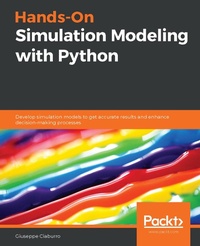
Hands-On Simulation Modeling with Python
Develop simulation models to get accurate results and enhance decision-making processes
Published on 23. September 2024
346 pages
978-1-83898-865-4 (ISBN)
Description

Enhance your simulation modeling skills by creating and analyzing digital prototypes of a physical model using Python programming with this comprehensive guide
Key Features
Learn to create a digital prototype of a real model using hands-on examples
Evaluate the performance and output of your prototype using simulation modeling techniques
Understand various statistical and physical simulations to improve systems using Python
Book DescriptionSimulation modeling helps you to create digital prototypes of physical models to analyze how they work and predict their performance in the real world. With this comprehensive guide, you'll understand various computational statistical simulations using Python. Starting with the fundamentals of simulation modeling, you'll understand concepts such as randomness and explore data generating processes, resampling methods, and bootstrapping techniques. You'll then cover key algorithms such as Monte Carlo simulations and Markov decision processes, which are used to develop numerical simulation models, and discover how they can be used to solve real-world problems. As you advance, you'll develop simulation models to help you get accurate results and enhance decision-making processes. Using optimization techniques, you'll learn to modify the performance of a model to improve results and make optimal use of resources. The book will guide you in creating a digital prototype using practical use cases for financial engineering, prototyping project management to improve planning, and simulating physical phenomena using neural networks. By the end of this book, you'll have learned how to construct and deploy simulation models of your own to overcome real-world challenges.What you will learn
Gain an overview of the different types of simulation models
Get to grips with the concepts of randomness and data generation process
Understand how to work with discrete and continuous distributions
Work with Monte Carlo simulations to calculate a definite integral
Find out how to simulate random walks using Markov chains
Obtain robust estimates of confidence intervals and standard errors of population parameters
Discover how to use optimization methods in real-life applications
Run efficient simulations to analyze real-world systems
Who this book is forHands-On Simulation Modeling with Python is for simulation developers and engineers, model designers, and anyone already familiar with the basic computational methods that are used to study the behavior of systems. This book will help you explore advanced simulation techniques such as Monte Carlo methods, statistical simulations, and much more using Python. Working knowledge of Python programming language is required.
Key Features
Learn to create a digital prototype of a real model using hands-on examples
Evaluate the performance and output of your prototype using simulation modeling techniques
Understand various statistical and physical simulations to improve systems using Python
Book DescriptionSimulation modeling helps you to create digital prototypes of physical models to analyze how they work and predict their performance in the real world. With this comprehensive guide, you'll understand various computational statistical simulations using Python. Starting with the fundamentals of simulation modeling, you'll understand concepts such as randomness and explore data generating processes, resampling methods, and bootstrapping techniques. You'll then cover key algorithms such as Monte Carlo simulations and Markov decision processes, which are used to develop numerical simulation models, and discover how they can be used to solve real-world problems. As you advance, you'll develop simulation models to help you get accurate results and enhance decision-making processes. Using optimization techniques, you'll learn to modify the performance of a model to improve results and make optimal use of resources. The book will guide you in creating a digital prototype using practical use cases for financial engineering, prototyping project management to improve planning, and simulating physical phenomena using neural networks. By the end of this book, you'll have learned how to construct and deploy simulation models of your own to overcome real-world challenges.What you will learn
Gain an overview of the different types of simulation models
Get to grips with the concepts of randomness and data generation process
Understand how to work with discrete and continuous distributions
Work with Monte Carlo simulations to calculate a definite integral
Find out how to simulate random walks using Markov chains
Obtain robust estimates of confidence intervals and standard errors of population parameters
Discover how to use optimization methods in real-life applications
Run efficient simulations to analyze real-world systems
Who this book is forHands-On Simulation Modeling with Python is for simulation developers and engineers, model designers, and anyone already familiar with the basic computational methods that are used to study the behavior of systems. This book will help you explore advanced simulation techniques such as Monte Carlo methods, statistical simulations, and much more using Python. Working knowledge of Python programming language is required.
More details
Edition
Digital original
Language
English
Place of publication
Birmingham
United Kingdom
Target group
Professional and scholarly
US School Grade: College Graduate Student
Edition type
Digital original
File size
10,19 MB
ISBN-13
978-1-83898-865-4 (9781838988654)
Copyright in bibliographic data and cover images is held by Nielsen Book Services Limited or by the publishers or by their respective licensors: all rights reserved.
Schweitzer Classification
Other editions
Additional editions
Giuseppe Ciaburro
Hands-On Simulation Modeling with Python
Develop simulation models to get accurate results and enhance decision-making processes
Book
07/2020
Packt Publishing
€73.20
Shipment within 3-4 weeks
Person
Ciaburro Giuseppe :
Giuseppe Ciaburro holds a PhD and two master's degrees. He works at the Built Environment Control Laboratory - Universita degli Studi della Campania "Luigi Vanvitelli". He has over 25 years of work experience in programming, first in the field of combustion and then in acoustics and noise control. His core programming knowledge is in MATLAB, Python and R. As an expert in AI applications to acoustics and noise control problems, Giuseppe has wide experience in researching and teaching. He has several publications to his credit: monographs, scientific journals, and thematic conferences. He was recently included in the world's top 2% scientists list by Stanford University (2022).
Giuseppe Ciaburro holds a PhD and two master's degrees. He works at the Built Environment Control Laboratory - Universita degli Studi della Campania "Luigi Vanvitelli". He has over 25 years of work experience in programming, first in the field of combustion and then in acoustics and noise control. His core programming knowledge is in MATLAB, Python and R. As an expert in AI applications to acoustics and noise control problems, Giuseppe has wide experience in researching and teaching. He has several publications to his credit: monographs, scientific journals, and thematic conferences. He was recently included in the world's top 2% scientists list by Stanford University (2022).
Content
Table of Contents
Introducing Simulation Models
Understanding Randomness and Random Numbers
Probability and Data Generating Processes
Exploring Monte Carlo Simulations
Simulation-Based Markov Decision Process
Resampling Methods
Using Simulations to Improve and Optimize Systems
Using Simulation Models for Financial Engineering
Simulating Physical Phenomena Using Neural Networks
Modeling and Simulation for Project Management
What's Next?
Introducing Simulation Models
Understanding Randomness and Random Numbers
Probability and Data Generating Processes
Exploring Monte Carlo Simulations
Simulation-Based Markov Decision Process
Resampling Methods
Using Simulations to Improve and Optimize Systems
Using Simulation Models for Financial Engineering
Simulating Physical Phenomena Using Neural Networks
Modeling and Simulation for Project Management
What's Next?
