

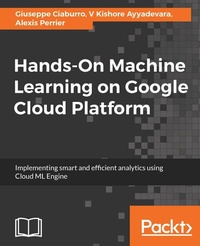
Hands-On Machine Learning on Google Cloud Platform
Implementing smart and efficient analytics using Cloud ML Engine
1st Edition
Published on 23. September 2024
500 pages
978-1-78839-887-9 (ISBN)
Description

Unleash Google\'s Cloud Platform to build, train and optimize machine learning modelsKey Features - Get well versed in GCP pre-existing services to build your own smart models
- A comprehensive guide covering aspects from data processing, analyzing to building and training ML models
- A practical approach to produce your trained ML models and port them to your mobile for easy access
Book DescriptionGoogle Cloud Machine Learning Engine combines the services of Google Cloud Platform with the power and flexibility of TensorFlow. With this book, you will not only learn to build and train different complexities of machine learning models at scale but also host them in the cloud to make predictions. This book is focused on making the most of the Google Machine Learning Platform for large datasets and complex problems. You will learn from scratch how to create powerful machine learning based applications for a wide variety of problems by leveraging different data services from the Google Cloud Platform. Applications include NLP, Speech to text, Reinforcement learning, Time series, recommender systems, image classification, video content inference and many other. We will implement a wide variety of deep learning use cases and also make extensive use of data related services comprising the Google Cloud Platform ecosystem such as Firebase, Storage APIs, Datalab and so forth. This will enable you to integrate Machine Learning and data processing features into your web and mobile applications. By the end of this book, you will know the main difficulties that you may encounter and get appropriate strategies to overcome these difficulties and build efficient systems.What you will learn - Use Google Cloud Platform to build data-based applications for dashboards, web, and mobile
- Create, train and optimize deep learning models for various data science problems on big data
- Learn how to leverage BigQuery to explore big datasets
- Use Google's pre-trained TensorFlow models for NLP, image, video and much more
- Create models and architectures for Time series, Reinforcement Learning, and generative models
- Create, evaluate, and optimize TensorFlow and Keras models for a wide range of applications
Who this book is forThis book is for data scientists, machine learning developers and AI developers who want to learn Google Cloud Platform services to build machine learning applications. Since the interaction with the Google ML platform is mostly done via the command line, the reader is supposed to have some familiarity with the bash shell and Python scripting. Some understanding of machine learning and data science concepts will be handy
- A comprehensive guide covering aspects from data processing, analyzing to building and training ML models
- A practical approach to produce your trained ML models and port them to your mobile for easy access
Book DescriptionGoogle Cloud Machine Learning Engine combines the services of Google Cloud Platform with the power and flexibility of TensorFlow. With this book, you will not only learn to build and train different complexities of machine learning models at scale but also host them in the cloud to make predictions. This book is focused on making the most of the Google Machine Learning Platform for large datasets and complex problems. You will learn from scratch how to create powerful machine learning based applications for a wide variety of problems by leveraging different data services from the Google Cloud Platform. Applications include NLP, Speech to text, Reinforcement learning, Time series, recommender systems, image classification, video content inference and many other. We will implement a wide variety of deep learning use cases and also make extensive use of data related services comprising the Google Cloud Platform ecosystem such as Firebase, Storage APIs, Datalab and so forth. This will enable you to integrate Machine Learning and data processing features into your web and mobile applications. By the end of this book, you will know the main difficulties that you may encounter and get appropriate strategies to overcome these difficulties and build efficient systems.What you will learn - Use Google Cloud Platform to build data-based applications for dashboards, web, and mobile
- Create, train and optimize deep learning models for various data science problems on big data
- Learn how to leverage BigQuery to explore big datasets
- Use Google's pre-trained TensorFlow models for NLP, image, video and much more
- Create models and architectures for Time series, Reinforcement Learning, and generative models
- Create, evaluate, and optimize TensorFlow and Keras models for a wide range of applications
Who this book is forThis book is for data scientists, machine learning developers and AI developers who want to learn Google Cloud Platform services to build machine learning applications. Since the interaction with the Google ML platform is mostly done via the command line, the reader is supposed to have some familiarity with the bash shell and Python scripting. Some understanding of machine learning and data science concepts will be handy
More details
Other editions
Additional editions
Alexis Perrier | Kishore Ayyadevara | Giuseppe Ciaburro
Hands-On Machine Learning on Google Cloud Platform
Implementing smart and efficient analytics using Cloud ML Engine
Book
04/2018
Packt Publishing
€57.60
Shipment within 3-4 weeks
Persons
Ciaburro Giuseppe :
Giuseppe Ciaburro holds a PhD and two master's degrees. He works at the Built Environment Control Laboratory - Università degli Studi della Campania "Luigi Vanvitelli". He has over 25 years of work experience in programming, first in the field of combustion and then in acoustics and noise control. His core programming knowledge is in MATLAB, Python and R. As an expert in AI applications to acoustics and noise control problems, Giuseppe has wide experience in researching and teaching. He has several publications to his credit: monographs, scientific journals, and thematic conferences. He was recently included in the world's top 2% scientists list by Stanford University (2022).Ayyadevara V Kishore :
Kishore Ayyadevara is an entrepreneur and a hands-on leader working at the intersection of technology, data, and AI to identify and solve business problems. With over a decade of experience in leadership roles, Kishore has established and grown successful applied data science teams at American Express and Amazon, as well as a top health insurance company. In his current role, he is building a start-up focused on making AI more accessible to healthcare organizations. Outside of work, Kishore has shared his knowledge through his five books on ML/AI, is an inventor with 12 patents, and has been a speaker at multiple AI conferences.Perrier Alexis :
Alexis Perrier is a data science consultant with experience in signal processing and stochastic algorithms. He holds a master's in mathematics from Universit Pierre et Marie Curie Paris VI and a PhD in signal processing from Tlcom ParisTech. He is actively involved in the DC data science community. He is also an avid book lover and proud owner of a real chalk blackboard, where he regularly shares his fascination of mathematical equations with his kids.
Giuseppe Ciaburro holds a PhD and two master's degrees. He works at the Built Environment Control Laboratory - Università degli Studi della Campania "Luigi Vanvitelli". He has over 25 years of work experience in programming, first in the field of combustion and then in acoustics and noise control. His core programming knowledge is in MATLAB, Python and R. As an expert in AI applications to acoustics and noise control problems, Giuseppe has wide experience in researching and teaching. He has several publications to his credit: monographs, scientific journals, and thematic conferences. He was recently included in the world's top 2% scientists list by Stanford University (2022).Ayyadevara V Kishore :
Kishore Ayyadevara is an entrepreneur and a hands-on leader working at the intersection of technology, data, and AI to identify and solve business problems. With over a decade of experience in leadership roles, Kishore has established and grown successful applied data science teams at American Express and Amazon, as well as a top health insurance company. In his current role, he is building a start-up focused on making AI more accessible to healthcare organizations. Outside of work, Kishore has shared his knowledge through his five books on ML/AI, is an inventor with 12 patents, and has been a speaker at multiple AI conferences.Perrier Alexis :
Alexis Perrier is a data science consultant with experience in signal processing and stochastic algorithms. He holds a master's in mathematics from Universit Pierre et Marie Curie Paris VI and a PhD in signal processing from Tlcom ParisTech. He is actively involved in the DC data science community. He is also an avid book lover and proud owner of a real chalk blackboard, where he regularly shares his fascination of mathematical equations with his kids.
Content
Table of Contents - Setting up and Securing the Google Cloud Platform
- Interacting with Google Cloud Platform
- Google Cloud Storage
- Querying your data with BigQuery
- Transforming your data
- Essential Machine Learning
- Google Machine Learning APIs
- Creating Machine Learning Applications with Firebase
- Implementing a Feedforward network with TensorFlow and Keras
- Evaluating results with TensorBoard
- Optimizing your model with HyperTune
- Preventing Overfitting with regularization
- Beyond Feedforward networks
- Time series with LSTMs
- Reinforcement Learning with Tensorflow
- Generative neural networks
- Chatbots
- Interacting with Google Cloud Platform
- Google Cloud Storage
- Querying your data with BigQuery
- Transforming your data
- Essential Machine Learning
- Google Machine Learning APIs
- Creating Machine Learning Applications with Firebase
- Implementing a Feedforward network with TensorFlow and Keras
- Evaluating results with TensorBoard
- Optimizing your model with HyperTune
- Preventing Overfitting with regularization
- Beyond Feedforward networks
- Time series with LSTMs
- Reinforcement Learning with Tensorflow
- Generative neural networks
- Chatbots
