

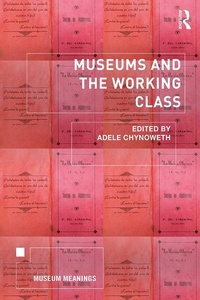
Museums and the Working Class
1st Edition
Published on 28. September 2021
256 pages
978-1-000-44094-2 (ISBN)
Description

Museums and the Working Class is the first book to take an intersectional and international approach to the issues of economic diversity and class within the field of museum studies.
Bringing together 16 contributors from eight countries, this book has emerged from the significant global dialogue concerning museums' obligation to be inclusive, participate in meaningful engagement and advocate for social change. As part of the push for museums to be more accessible and inclusive, museums have been challenged to critically examine their power relationships and how these are played out in what they collect, whose stories they exhibit and who is made to feel welcome in their halls. This volume will further this professional and academic debate through the discussion of class. Contributions to the book will also reinforce the importance of the working class - not only in collection and exhibition policy, but also for the organisational psychology of institutions.
Museums and the Working Class is essential reading for scholars and students of museum, gallery and heritage studies, cultural studies, sociology, labour studies and history. It will also serve as a source of honest and research-led inspiration to practitioners working in museums, galleries, libraries, archives and at heritage sites around the world.
Bringing together 16 contributors from eight countries, this book has emerged from the significant global dialogue concerning museums' obligation to be inclusive, participate in meaningful engagement and advocate for social change. As part of the push for museums to be more accessible and inclusive, museums have been challenged to critically examine their power relationships and how these are played out in what they collect, whose stories they exhibit and who is made to feel welcome in their halls. This volume will further this professional and academic debate through the discussion of class. Contributions to the book will also reinforce the importance of the working class - not only in collection and exhibition policy, but also for the organisational psychology of institutions.
Museums and the Working Class is essential reading for scholars and students of museum, gallery and heritage studies, cultural studies, sociology, labour studies and history. It will also serve as a source of honest and research-led inspiration to practitioners working in museums, galleries, libraries, archives and at heritage sites around the world.
Reviews / Votes
"This volume reveals what novelist Chimamanda Ngozi Adichie calls the "danger of a single story." By omitting the importance of class in the work of the museum, the museum presents its visitors with a one-sided story of society, which, as each chapter demonstrates, is compounded by the museum's treatment of gender, race, and ability. The international cases presented in the book also demonstrate the power and potential of museums to share a more genuine and accurate story by including the role of class and its intersection with other marginalized positionalities. For museums to answer the call to action to be for everyone, they must tell whole stories."Alia Carter, 'My Reflections on the Power and Potential of Class in the Museum: A Review of Museums and the Working Class', Fwd: Museums Journal (July 2024)
More details
Series
Edition
1. Auflage
Language
English
Place of publication
London
United Kingdom
Publishing group
Taylor & Francis Ltd
Target group
College/higher education
Professional and scholarly
Product notice
Reflowable
Illustrations
21 Halftones, black and white; 21 Illustrations, black and white
ISBN-13
978-1-000-44094-2 (9781000440942)
Copyright in bibliographic data and cover images is held by Nielsen Book Services Limited or by the publishers or by their respective licensors: all rights reserved.
Schweitzer Classification
Other editions
Additional editions
Book
10/2021
Routledge
Unfortunately, price unknown
Available (delivery time upon request)
Adele Chynoweth
Museums and the Working Class
Book
09/2021
1st Edition
Routledge
€205.70
Shipment within 15-20 days
Adele Chynoweth
Museums and the Working Class
Book
09/2021
1st Edition
Routledge
€61.40
Shipment within 15-20 days
Person
Adele Chynoweth has earned her living as a shop assistant, cabaret performer, night club DJ, call centre operator, union organiser, public servant, and teacher in secondary schools and adult vocational education. Adele also studied theatre direction at the Flinders University Drama Centre and completed her PhD with scholarship support. Adele was a Lecturer in the Centre for Heritage and Museum Studies at the Australian National University where she received the Vice Chancellor's Award for Public Policy and Outreach in 2018. In 2020, she was awarded the Medal of the Order of Australia.
Content
Introduction - 'Which Side Are You On'? Towards Meaningful Attention to Class in Museums
Adele Chynoweth
Part I - Shut Out: Access and the Working Class
1. 'A Permanent Civilising Effect'? The Impact of Reforming Working-Class Museum Visitors in Liverpool during the Nineteenth Century
Alexander Scott
2. How British Museums Have Failed the Working Class
David Fleming
3. Seat of the Muses or the Moolah? New Working Class Demands on Elitist Archival Practices
Silvio Tamaso D'Onofrio
Part II - Shut Up: the Struggle to End the Silence
4. 'One and All'? Retrieving South Australia's Forgotten Labor History
Philip Payton
5. 'Go and Take a Look at Millie Now': Murder, Tattooed Remains, and Museum Ethics in Quebec
Jamie Jelinksi
6. Museums in Late Populist Democracies: the Photographic Archive and the Working Class
Paolo Magagnoli
7. Women?s Work in Coastal Galicia: Shining a Light on the Unseen at the Marea Museum
Jose Manuel Vazquez Lijo
Part III - Know Your Place: Site-Specific Narratives
8. Erasure of Working-Class Heritage in Conservation Plans: Absent Presence in the Walled City of Lahore
Rabia Nadir
9. Eugene V. Debs' Museum and the Preservation of Radical Working-Class Political Memory
Wesley R. Bishop
10. Keeping Your Head Down at the Hyde Park Barracks Museum
Adele Chynoweth
11. From Factory to Museum: The Obliteration of the History of Resistance
Meral Akbas and OEzge Kelekci
Part IV- Answering Back: Lessons from the Working and Poverty Classes
12. Looking Backwards, Planning Forward: 'Museum as Muck' Advocating for the Working Class in Museums
Michelle McGrath, in conversation with Adele Chynoweth
13. Changing Lives at the Scottish Maritime Museum
Martin Hughes
14. House of Memories: Care and Equality in the UK Museum Sector
Kerry Wilson
15. Ngintaka Songline Tracks in the Museum
Diana James
Adele Chynoweth
Part I - Shut Out: Access and the Working Class
1. 'A Permanent Civilising Effect'? The Impact of Reforming Working-Class Museum Visitors in Liverpool during the Nineteenth Century
Alexander Scott
2. How British Museums Have Failed the Working Class
David Fleming
3. Seat of the Muses or the Moolah? New Working Class Demands on Elitist Archival Practices
Silvio Tamaso D'Onofrio
Part II - Shut Up: the Struggle to End the Silence
4. 'One and All'? Retrieving South Australia's Forgotten Labor History
Philip Payton
5. 'Go and Take a Look at Millie Now': Murder, Tattooed Remains, and Museum Ethics in Quebec
Jamie Jelinksi
6. Museums in Late Populist Democracies: the Photographic Archive and the Working Class
Paolo Magagnoli
7. Women?s Work in Coastal Galicia: Shining a Light on the Unseen at the Marea Museum
Jose Manuel Vazquez Lijo
Part III - Know Your Place: Site-Specific Narratives
8. Erasure of Working-Class Heritage in Conservation Plans: Absent Presence in the Walled City of Lahore
Rabia Nadir
9. Eugene V. Debs' Museum and the Preservation of Radical Working-Class Political Memory
Wesley R. Bishop
10. Keeping Your Head Down at the Hyde Park Barracks Museum
Adele Chynoweth
11. From Factory to Museum: The Obliteration of the History of Resistance
Meral Akbas and OEzge Kelekci
Part IV- Answering Back: Lessons from the Working and Poverty Classes
12. Looking Backwards, Planning Forward: 'Museum as Muck' Advocating for the Working Class in Museums
Michelle McGrath, in conversation with Adele Chynoweth
13. Changing Lives at the Scottish Maritime Museum
Martin Hughes
14. House of Memories: Care and Equality in the UK Museum Sector
Kerry Wilson
15. Ngintaka Songline Tracks in the Museum
Diana James
