

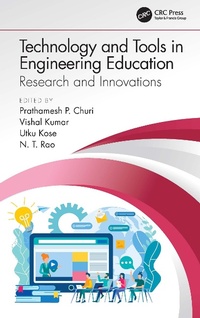
Technology and Tools in Engineering Education
Research and Innovations
1st Edition
Published on 27. October 2021
236 pages
978-1-000-46598-3 (ISBN)
Description

This book explores the innovative and research methods of the teaching-learning process in Engineering field. It focuses on the use of technology in the field of education. It also provides a platform to academicians and educationalists to share their ideas and best practices.
The book includes specific pedagogy used in engineering education. It offers case studies and classroom practices which also include those used in distance mode and during the COVID-19 pandemic. It provides comparisons of national and international accreditation bodies, directions on cost-effective technology, and it discusses advanced technologies such as VR and augmented reality used in education.
This book is intended for research scholars who are pursuing their masters and doctoral studies in the engineering education field as well as teachers who teach undergraduate and postgraduate courses to engineering students.
The book includes specific pedagogy used in engineering education. It offers case studies and classroom practices which also include those used in distance mode and during the COVID-19 pandemic. It provides comparisons of national and international accreditation bodies, directions on cost-effective technology, and it discusses advanced technologies such as VR and augmented reality used in education.
This book is intended for research scholars who are pursuing their masters and doctoral studies in the engineering education field as well as teachers who teach undergraduate and postgraduate courses to engineering students.
More details
Edition
1. Auflage
Language
English
Place of publication
London
United Kingdom
Publishing group
Taylor & Francis Ltd
Target group
Professional and scholarly
Illustrations
32 Tables, black and white; 51 Line drawings, black and white; 9 Halftones, black and white; 60 Illustrations, black and white
ISBN-13
978-1-000-46598-3 (9781000465983)
Copyright in bibliographic data and cover images is held by Nielsen Book Services Limited or by the publishers or by their respective licensors: all rights reserved.
Schweitzer Classification
Other editions
Additional editions
Prathamesh P. Churi | Vishal Kumar | Utku Kose
Technology and Tools in Engineering Education
Research and Innovations
Book
10/2024
1st Edition
CRC Press
€70.10
Shipment within 15-20 days
Prathamesh P. Churi | Vishal Kumar | Utku Kose
Technology and Tools in Engineering Education
Research and Innovations
Book
10/2021
1st Edition
CRC Press
€172.00
Shipment within 15-20 days
Persons
Prathamesh P. Churi (SMIEEE, MACM, LMCSI, LMISTE, MIGIP) is faculty member in Computer Engineering Department in School of Technology Management and Engineering, NMIMS University. India. He is Senior Member of IEEE. Currently. He is Serving as Associate editor of International Journal of Advances in Intelligent Informatics (Scopus Q4-Artificial Intelligence) and International Journal of Innovative Teaching and Learning in Higher Education. He is also the research mentor in Cerebranium. He is actively involved in peer review process of reputed IEEE and Springer journals such as IEEE Transactions on Education, Springer Education and Information Technologies and 17 other journals. He has 50+ research papers in National/International Conferences and Journals (Scopus, ESCI and SCI Indexed). He has 4 (Including 1 Australian patent) patents in the field of Wireless Sensor Networks, Machine Learning and Internet of Things. He has edited 3 international books (CRC Press Taylor and Francis publications) in the field of Data Privacy and Education Technology. He has been a keynote speaker, chair, convener in the international conferences including the flagship conferences like IEEE TALE 2017-2020, Springer ICACDS etc. He recently received "Best Young Researcher award" by GISR Foundation for his research contribution in the field of Data Privacy and Security, Education Technology. He has also got appreciation award for best faculty from NMIMS University. He is active leader, coach, mentor, volunteer in many non-profit organizations. He is also involved as board of study member in many universities for curriculum development and educational transformations.
Recognizing his passion for research and teaching at a young age, he started teaching to engineering students in core computer science branch right from the age of 23. He started his journey as a professor and researcher and has been working successfully in this field since past 4 years. His relaxation and change lies in pursuing his hobbies which mainly includes expressing views be it in public writing columns or blogging.
Vishal Kumar is working as an Assistant Professor in the Department of Computer Science & Engineering at Bipin Tripathi Kumaon Institute of Technology, Dwarahat, Almora, Uttarakhand, INDIA. He also holds additional administrative responsibility as Head, Central Computing Facility Centre & Head, Training & Placement Cell. He did his Bachelors from KEC Dwarahat, M. Tech from NIT, Hamirpur & PhD from Uttarakhand Technical University in Computer Science and Engineering respectively. He has edited 5 books and published 23 research papers in IEEE Conferences/ SCI/ Scopus indexed journals of repute. He is an advisor/core team member/auditor in the International Federation of Green ICT. He has trained more than 450 Police Officers in the area of Cyber Security in his state (Uttarakhand). He holds a patent and completed (01) funded project. He is also serving as regional editor (Asia Pacific) of International Journal of Forensic Software Engineering published by Inderscience. He has organized more than 30 conferences, and serves as the Chairman of the steering committee for ICACCE/ICCCS/ICBDCI/ISCICT conferences worldwide under the flagship of India Research Group. He is also a member of 5G Working Group, Telecommunication Engineering Center, Govt. of India.
Utku Kose received the B.S. degree in 2008 from computer education of Gazi University, Turkey as a faculty valedictorian. He received M.S. degree in 2010 from Afyon Kocatepe University, Turkey in the field of computer and D.S. / Ph. D. degree in 2017 from Selcuk University, Turkey in the field of computer engineering. Between 2009 and 2011, he has worked as a Research Assistant in Afyon Kocatepe University. Following, he has also worked as a Lecturer and Vocational School - Vice Director in Afyon Kocatepe University between 2011 and 2012, as a Lecturer and Research Center Director in Usak University between 2012 and 2017, and as an Assistant Professor in Suleyman Demirel University between 2017 and 2019. Currently, he is an Associate Professor in Suleyman Demirel University, Turkey. He has more than 100 publications including articles, authored and edited books, proceedings, and reports. He is also in editorial boards of many scientific journals and serves as one of the editors of the Biomedical and Robotics Healthcare book series by CRC Press. His research interest includes artificial intelligence, machine ethics, artificial intelligence safety, optimization, the chaos theory, distance education, e-learning, computer education, and computer science.
N. T. Rao is a Vice Chancellor of MIT WPU university, India. Dr. N. T. Rao has over three decades of result achieving experiences in the fields of education, training, strategic planning, accreditations, institutional governance and other areas. Before joining MIT WPU, he was the Dean, Mukesh Patel School of Technology Management & Engineering (MPSTME), NMIMS University. During his career progression, he was associated with several institutions as an educator and professional engineer. Some of the organizations that he worked with include Intercontinental Consultants and Technocrats, New Delhi as a Vice President; VIT University, Vellore as a Senior Professor, Director, International Relations & ABET Accreditation Officer; Government of Botswana as a Principal Roads Engineer; NIT, Kurukshetra as a Lecturer and an Assistant Professor. Dr Rao has introduced many initiatives during his stint at MPSTME resulting in the institution being ranked as the No 2 Best Emerging Engineering Education Institution in India Today annual rankings in addition to debuting in NIRF rankings. He has strengthened and further streamlined academic and examination processes. He played a significant role in launching the Engineering and Technology Review Journal of the university. The crowning glory of his achievements at NMIMS was his spearheading the efforts for five engineering programs from scratch and readying them for the prestigious ABET Accreditation of USA. At VIT University, Vellore, he made significant contributions towards many facets of education helping the institution to catapult to the position of the No 1 ranked private engineering college in India. As the Director of International Relations, he expanded internationalization of engineering education and visited several prestigious institutions around the world to promote bilateral academic collaborations. He served on the Advisory Committee, the highest decision-making body of the University. He was university's NAAC Coordinator during the second re accreditation process and helped university to achieve a score of 3.75 out of 4.0. Designing qualitative teaching-learning processes, he assumed the mantle of ABET Accreditation Officer and lead accreditation processes to make civil and mechanical engineering programs of VIT University as the first engineering programs in India to get the ABET accreditation.
Recognizing his passion for research and teaching at a young age, he started teaching to engineering students in core computer science branch right from the age of 23. He started his journey as a professor and researcher and has been working successfully in this field since past 4 years. His relaxation and change lies in pursuing his hobbies which mainly includes expressing views be it in public writing columns or blogging.
Vishal Kumar is working as an Assistant Professor in the Department of Computer Science & Engineering at Bipin Tripathi Kumaon Institute of Technology, Dwarahat, Almora, Uttarakhand, INDIA. He also holds additional administrative responsibility as Head, Central Computing Facility Centre & Head, Training & Placement Cell. He did his Bachelors from KEC Dwarahat, M. Tech from NIT, Hamirpur & PhD from Uttarakhand Technical University in Computer Science and Engineering respectively. He has edited 5 books and published 23 research papers in IEEE Conferences/ SCI/ Scopus indexed journals of repute. He is an advisor/core team member/auditor in the International Federation of Green ICT. He has trained more than 450 Police Officers in the area of Cyber Security in his state (Uttarakhand). He holds a patent and completed (01) funded project. He is also serving as regional editor (Asia Pacific) of International Journal of Forensic Software Engineering published by Inderscience. He has organized more than 30 conferences, and serves as the Chairman of the steering committee for ICACCE/ICCCS/ICBDCI/ISCICT conferences worldwide under the flagship of India Research Group. He is also a member of 5G Working Group, Telecommunication Engineering Center, Govt. of India.
Utku Kose received the B.S. degree in 2008 from computer education of Gazi University, Turkey as a faculty valedictorian. He received M.S. degree in 2010 from Afyon Kocatepe University, Turkey in the field of computer and D.S. / Ph. D. degree in 2017 from Selcuk University, Turkey in the field of computer engineering. Between 2009 and 2011, he has worked as a Research Assistant in Afyon Kocatepe University. Following, he has also worked as a Lecturer and Vocational School - Vice Director in Afyon Kocatepe University between 2011 and 2012, as a Lecturer and Research Center Director in Usak University between 2012 and 2017, and as an Assistant Professor in Suleyman Demirel University between 2017 and 2019. Currently, he is an Associate Professor in Suleyman Demirel University, Turkey. He has more than 100 publications including articles, authored and edited books, proceedings, and reports. He is also in editorial boards of many scientific journals and serves as one of the editors of the Biomedical and Robotics Healthcare book series by CRC Press. His research interest includes artificial intelligence, machine ethics, artificial intelligence safety, optimization, the chaos theory, distance education, e-learning, computer education, and computer science.
N. T. Rao is a Vice Chancellor of MIT WPU university, India. Dr. N. T. Rao has over three decades of result achieving experiences in the fields of education, training, strategic planning, accreditations, institutional governance and other areas. Before joining MIT WPU, he was the Dean, Mukesh Patel School of Technology Management & Engineering (MPSTME), NMIMS University. During his career progression, he was associated with several institutions as an educator and professional engineer. Some of the organizations that he worked with include Intercontinental Consultants and Technocrats, New Delhi as a Vice President; VIT University, Vellore as a Senior Professor, Director, International Relations & ABET Accreditation Officer; Government of Botswana as a Principal Roads Engineer; NIT, Kurukshetra as a Lecturer and an Assistant Professor. Dr Rao has introduced many initiatives during his stint at MPSTME resulting in the institution being ranked as the No 2 Best Emerging Engineering Education Institution in India Today annual rankings in addition to debuting in NIRF rankings. He has strengthened and further streamlined academic and examination processes. He played a significant role in launching the Engineering and Technology Review Journal of the university. The crowning glory of his achievements at NMIMS was his spearheading the efforts for five engineering programs from scratch and readying them for the prestigious ABET Accreditation of USA. At VIT University, Vellore, he made significant contributions towards many facets of education helping the institution to catapult to the position of the No 1 ranked private engineering college in India. As the Director of International Relations, he expanded internationalization of engineering education and visited several prestigious institutions around the world to promote bilateral academic collaborations. He served on the Advisory Committee, the highest decision-making body of the University. He was university's NAAC Coordinator during the second re accreditation process and helped university to achieve a score of 3.75 out of 4.0. Designing qualitative teaching-learning processes, he assumed the mantle of ABET Accreditation Officer and lead accreditation processes to make civil and mechanical engineering programs of VIT University as the first engineering programs in India to get the ABET accreditation.
Content
1.Virtual Experimentation: An Advanced Tool for Educational Technology. 2. Classroom Practices: Issues, Challenges and Solutions. 3. Leveraging Information and Communication Technology for Higher Education amidst the COVID-19 Pandemic. 4. Investigating Academic Transition during the DOVID-19 Pandemic: The Case of an Indian Private University 5. Adaptability of Computer-Based Assessment Among Engineering Students at Higher Educational Institutions. 6. Integration of Digital Technologies for Constructing Influential Learning during the COVID-19. 7. Applications of ICT: Pathway to Outcome-Based Education in Engineering and Technology Curriculum. 8. Academic Workers' Behaviors Toward Scientific Crowdsourcing: A Systematic Literature Review. 9. Tools and Technology Assisting Accredation in Engineering Education. 10. 4QS Predictive Model Based on Machine Learning for Continuous Student Learning Assessment.
