

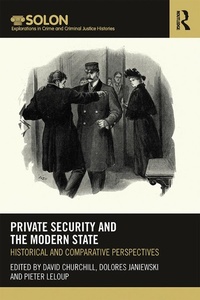
Private Security and the Modern State
Historical and Comparative Perspectives
1st Edition
Published on 11. March 2020
282 pages
978-0-429-59045-0 (ISBN)
Description

Based on extensive research in several international contexts, this volume provides a nuanced assessment of the historical evolution of private security and its fluid, contested and mutually constitutive relationship with state agencies, public policing and the criminal justice system.
This book provides an overview of the history of private security provision in its multiple forms including detective agencies, insurance companies, moral campaigners, employers' associations, paramilitary organizations, self-protection and vigilantism. It also explores the historical evolution of private policing and security provision in a diverse set of temporal, national and international contexts and compares the interactions between public and private security bodies, structures, strategies and practices in different countries, cultures and settings. In doing so, the volume fills the existing gaps in historical knowledge about the emergence of private and public security organizations and provides a more robust understanding of changes in the division of responsibility for security provision, law enforcement and punishment between public and private institutions.
This wide-ranging volume will be of great interest to scholars and students of history, criminology, sociology, political science, international relations, security studies, surveillance studies, policing, criminal justice and law.
This book provides an overview of the history of private security provision in its multiple forms including detective agencies, insurance companies, moral campaigners, employers' associations, paramilitary organizations, self-protection and vigilantism. It also explores the historical evolution of private policing and security provision in a diverse set of temporal, national and international contexts and compares the interactions between public and private security bodies, structures, strategies and practices in different countries, cultures and settings. In doing so, the volume fills the existing gaps in historical knowledge about the emergence of private and public security organizations and provides a more robust understanding of changes in the division of responsibility for security provision, law enforcement and punishment between public and private institutions.
This wide-ranging volume will be of great interest to scholars and students of history, criminology, sociology, political science, international relations, security studies, surveillance studies, policing, criminal justice and law.
More details
Series
Edition
1. Auflage
Language
English
Place of publication
London
United Kingdom
Publishing group
Taylor & Francis Ltd
Target group
College/higher education
Product notice
Reflowable
Illustrations
4 Line drawings, black and white; 4 Halftones, black and white
ISBN-13
978-0-429-59045-0 (9780429590450)
Copyright in bibliographic data and cover images is held by Nielsen Book Services Limited or by the publishers or by their respective licensors: all rights reserved.
Schweitzer Classification
Other editions
Additional editions
David Churchill | Dolores Janiewski | Pieter Leloup
Private Security and the Modern State
Historical and Comparative Perspectives
Book
12/2021
1st Edition
Routledge
€65.60
Shipment within 10-20 days
David Churchill | Dolores Janiewski | Pieter Leloup
Private Security and the Modern State
Historical and Comparative Perspectives
Book
03/2020
1st Edition
Routledge
€206.70
Shipment within 15-20 days
Private Security and the Modern State
Historical and Comparative Perspectives
Book
03/2020
Taylor & Francis
Unfortunately, price unknown
Available (delivery time upon request)
Persons
David Churchill is Associate Professor in Criminal Justice in the Centre for Criminal Justice Studies, School of Law, University of Leeds, UK.
Dolores Janiewski is Associate Professor in the School of History, Philosophy, Political Science and International Relations, Victoria University of Wellington, New Zealand.
Pieter Leloup is a postdoctoral researcher (FWO) in the Department of Criminology, Penal Law and Social Law, Institute for International Research on Criminal Policy (IRCP), Ghent University, Belgium.
Dolores Janiewski is Associate Professor in the School of History, Philosophy, Political Science and International Relations, Victoria University of Wellington, New Zealand.
Pieter Leloup is a postdoctoral researcher (FWO) in the Department of Criminology, Penal Law and Social Law, Institute for International Research on Criminal Policy (IRCP), Ghent University, Belgium.
Content
Foreword by Phillip Stenning.
Introduction. David Churchill, Dolores Janiewski & Pieter Leloup.
Part 1: Security Regimes in National Context
Chapter 1. Jacqueline E. Ross: Undercover Policing and State Power in the United States and France from the Nineteenth to the Early Twentieth Centuries.
Chapter 2. Wilbur Miller: The 'Right to Bear Arms' and Self-Defence in the United States: Individualized Private Policing.
Chapter 3. Pieter Leloup: Co-Operation or Competition? Discourses on the Role of the Private Security Sector in Belgium, 1934-1990.
Chapter 4. Adam White: Monopoly or Plurality? The Police and the Private Security Industry in Mid-Twentieth-Century Britain.
Part 2: Techniques & Cultures of Private Security
Chapter 5. David J. Cox & Yasmin Devi-McGleish: 'Pardon Asked': Printed Apologies as a Form of Private Security and Popular Justice in Nineteenth-Century Britain.
Chapter 6. Stephen Robertson: The Pinkertons and the Paperwork of Surveillance: Reporting Private Investigation in the United States, 1855-1940.
Chapter 7. Chad Pearson: 'The law or popular justice': Owen Wister and the Legitimation of Employer-Class Violence.
Chapter 8. Francis Dodsworth: Protection: Selling Self-Defence in Twentieth-Century Britain and the United States.
Part 3: Between Public & Private Security
Chapter 9. David Churchill: The Politics of Security in Liberal Society: Responsibility for Crime Prevention in Mid-Victorian Britain.
Chapter 10. Florian Altenhoener: No License to Know: Political Crisis and the Fragmentation and Privatisation of Surveillance in Germany, 1918-1920.
Chapter 11. Rhodri Jeffreys-Jones: What Burleson and Orwell Overlooked: Private Security Provision in the USA and the United Kingdom.
Chapter 12. Dolores Janiewski & Simon Judkins: Fluid Boundaries: The Evolution of a Private-Public Security Network in California, 1917-1952.
Conclusion. David Churchill, Dolores Janiewski & Pieter Leloup.
Introduction. David Churchill, Dolores Janiewski & Pieter Leloup.
Part 1: Security Regimes in National Context
Chapter 1. Jacqueline E. Ross: Undercover Policing and State Power in the United States and France from the Nineteenth to the Early Twentieth Centuries.
Chapter 2. Wilbur Miller: The 'Right to Bear Arms' and Self-Defence in the United States: Individualized Private Policing.
Chapter 3. Pieter Leloup: Co-Operation or Competition? Discourses on the Role of the Private Security Sector in Belgium, 1934-1990.
Chapter 4. Adam White: Monopoly or Plurality? The Police and the Private Security Industry in Mid-Twentieth-Century Britain.
Part 2: Techniques & Cultures of Private Security
Chapter 5. David J. Cox & Yasmin Devi-McGleish: 'Pardon Asked': Printed Apologies as a Form of Private Security and Popular Justice in Nineteenth-Century Britain.
Chapter 6. Stephen Robertson: The Pinkertons and the Paperwork of Surveillance: Reporting Private Investigation in the United States, 1855-1940.
Chapter 7. Chad Pearson: 'The law or popular justice': Owen Wister and the Legitimation of Employer-Class Violence.
Chapter 8. Francis Dodsworth: Protection: Selling Self-Defence in Twentieth-Century Britain and the United States.
Part 3: Between Public & Private Security
Chapter 9. David Churchill: The Politics of Security in Liberal Society: Responsibility for Crime Prevention in Mid-Victorian Britain.
Chapter 10. Florian Altenhoener: No License to Know: Political Crisis and the Fragmentation and Privatisation of Surveillance in Germany, 1918-1920.
Chapter 11. Rhodri Jeffreys-Jones: What Burleson and Orwell Overlooked: Private Security Provision in the USA and the United Kingdom.
Chapter 12. Dolores Janiewski & Simon Judkins: Fluid Boundaries: The Evolution of a Private-Public Security Network in California, 1917-1952.
Conclusion. David Churchill, Dolores Janiewski & Pieter Leloup.
