

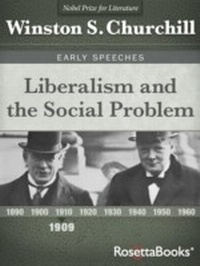
Liberalism and the Social Problem
Published on 1. October 2020
196 pages
978-0-7953-3772-7 (ISBN)
Description

This collection of speeches from 1906 to 1909 documents Churchill's early years as a Member of the Liberal Party in the House of Commons.
Sir Winston Churchill is admired as a brilliant Conservative politician and statesman-but he wasn't always a Conservative. In 1904, he crossed over to join the Liberal party, becoming Under-Secretary of State for the Colonies and later joining the Liberal Cabinet. This collection of his speeches reveals Churchill's dramatic shift toward a more progressive governing philosophy.
Here, the young MP's fervently argues his positions on some of the most important issues of the time, including the "People's Budget," a highly controversial new wealth distribution initiative. The resulting conflict between the House of Lords and the House of Commons led to the passage of the Parliament Act of 1911, asserting the House of Commons' legislative powers. This compilation of speeches is both an enlightening historical document and a fascinating display of the future Prime Minister's political insights and oratory skill.
Sir Winston Churchill is admired as a brilliant Conservative politician and statesman-but he wasn't always a Conservative. In 1904, he crossed over to join the Liberal party, becoming Under-Secretary of State for the Colonies and later joining the Liberal Cabinet. This collection of his speeches reveals Churchill's dramatic shift toward a more progressive governing philosophy.
Here, the young MP's fervently argues his positions on some of the most important issues of the time, including the "People's Budget," a highly controversial new wealth distribution initiative. The resulting conflict between the House of Lords and the House of Commons led to the passage of the Parliament Act of 1911, asserting the House of Commons' legislative powers. This compilation of speeches is both an enlightening historical document and a fascinating display of the future Prime Minister's political insights and oratory skill.
All prices
More details
Other editions
Additional editions
Winston Spencer Churchill
Liberalism and the Social Problem
A Collection of Early Speeches as a Member of Parliament
Book
01/2007
ARC Manor
€18.70
Shipment within 3-4 weeks
Person
Sir Winston S. Churchill was awarded the Nobel Prize in Literature in 1953 "for his mastery of historical and biographical description as well as for brilliant oratory in defending exalted human values." Over a 64-year span, Churchill published over 40 books, many multi-volume definitive accounts of historical events to which he was a witness and participant. All are beautifully written and as accessible and relevant today as when first published. During his fifty-year political career, Churchill served twice as Prime Minister in addition to other prominent positions--including President of the Board of Trade, First Lord of the Admiralty, Chancellor of the Exchequer, and Home Secretary. In the 1930s, Churchill was one of the first to recognize the danger of the rising Nazi power in Germany and to campaign for rearmament in Britain. His leadership and inspired broadcasts and speeches during World War II helped strengthen British resistance to Adolf Hitler--and played an important part in the Allies' eventual triumph. One of the most inspiring wartime leaders of modern history, Churchill was also an orator, a historian, a journalist, and an artist. All of these aspects of Churchill are fully represented in this collection of his works.
Content
- Intro
- Title Page
- Copyright
- Contents
- Introduction
- I
- The Conciliation of South Africa (April 5, 1906)
- The Transvaal Constitution (July 31, 1906)
- The Orange Free State Constitution (December 17, 1906)
- Liberalism and Socialism (October 11, 1906)
- Imperial Preference-I. (May 7, 1907)
- Imperial Preference-II. (July 15, 1907)
- The House of Lords (June 29, 1907)
- The Dundee Election (May 14, 1908)
- II
- The Second Reading of the Mines (Eight Hours) Bill (July 6, 1908)
- Unemployment (Oct. 10, 1908)
- The Social Field (Jan. 13, 1909)
- The Approaching Conflict (Jan. 30, 1909)
- The Second Reading of the Anti-Sweating Bill (April 28, 1909)
- Labour Exchanges and Unemployment Insurance (May 19, 1909)
- III
- The Budget Resolutions (May 4, 1909)
- The Budget and National Insurance (May 23, 1909)
- Land and Income Taxes in the Budget (July 17, 1909)
- The Budget and The Lords (July 26, 1909)
- The Spirit of The Budget (Sept. 5, 1909)
- The Budget and Property (Oct. 7, 1909)
- The Constitutional Menace (Oct. 9, 1909)
- Endnotes
