

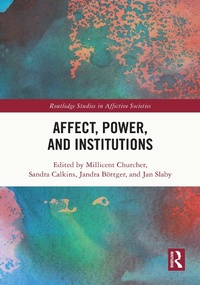
Affect, Power, and Institutions
1st Edition
Published on 30. December 2022
308 pages
978-1-000-82764-4 (ISBN)
Description

This volume advances a comprehensive transdisciplinary approach to the affective lives of institutions - theoretical, conceptual, empirical, and critical. With this approach, the volume foregrounds the role of affect in sustaining as well as transforming institutional arrangements that are deeply problematic.
As part of its analysis, this book develops a novel understanding of institutional affect. It explores how institutions produce, frame, and condition affective dynamics and emotional repertoires, in ways that engender conformance or resistance to institutional requirements.
This collection of works will be important for scholars and students of interdisciplinary affect and emotion studies from a wide range of disciplines, including social sciences, cultural studies, social and cultural anthropology, organizational and institution studies, media studies, social philosophy, aesthetics, and critical theory.
As part of its analysis, this book develops a novel understanding of institutional affect. It explores how institutions produce, frame, and condition affective dynamics and emotional repertoires, in ways that engender conformance or resistance to institutional requirements.
This collection of works will be important for scholars and students of interdisciplinary affect and emotion studies from a wide range of disciplines, including social sciences, cultural studies, social and cultural anthropology, organizational and institution studies, media studies, social philosophy, aesthetics, and critical theory.
More details
Series
Edition
1. Auflage
Language
English
Place of publication
London
United Kingdom
Publishing group
Taylor & Francis Ltd
Product notice
Reflowable
Illustrations
2 Line drawings, black and white; 7 Halftones, black and white; 9 Illustrations, black and white
ISBN-13
978-1-000-82764-4 (9781000827644)
Copyright in bibliographic data and cover images is held by Nielsen Book Services Limited or by the publishers or by their respective licensors: all rights reserved.
Schweitzer Classification
Other editions
Additional editions
Millicent Churcher | Sandra Calkins | Jandra Boettger
Affect, Power, and Institutions
Book
12/2022
1st Edition
Routledge
€60.70
Shipment within 10-20 days
Millicent Churcher | Sandra Calkins | Jandra Boettger
Affect, Power, and Institutions
Book
12/2022
1st Edition
Routledge
€207.98
Shipment within 10-20 days
Persons
Millicent Churcher is a Marie Sklodowska-Curie fellow at Freie Universitaet Berlin, and an honorary research affiliate of the University of Sydney. Millicent's research draws together insights from affect and social imaginary studies as well as institutional theory to explore how institutions, imaginaries, and affects intersect to support or obstruct social justice outcomes.
Sandra Calkins is Assistant Professor of Anthropology at Freie Universitaet Berlin. She conducted field research in Sudan, Uganda, Australia, and Germany and publishes on questions of uncertainty, multispecies relationships, infrastructure, and postcolonial science. Her current book project is an institutional ethnography of a Ugandan agricultural research institute and examines human-plant intimacies in the biological sciences.
Jandra Boettger is a PhD candidate in philosophy and research assistant at the Collaborative Research Center, Affective Societies (FU Berlin). Her main research areas are aesthetics, political theory, and contemporary history. Jandra's PhD focuses on the role of imagination for political action in the 1960s. She works as a curator for various projects and recently co-edited "The Vibration of Things" with Elke aus dem Moore (2022).
Jan Slaby is Professor of Philosophy at Freie Universitaet Berlin. His research areas include philosophy of mind, social philosophy, philosophy of science, and, in particular, affect and emotion theory with a focus on subject formation and social interaction. With Suparna Choudhury, he was co-editor of Critical Neuroscience (2012). With Christian von Scheve, he co-edited Affective Societies: Key Concepts (2019).
Sandra Calkins is Assistant Professor of Anthropology at Freie Universitaet Berlin. She conducted field research in Sudan, Uganda, Australia, and Germany and publishes on questions of uncertainty, multispecies relationships, infrastructure, and postcolonial science. Her current book project is an institutional ethnography of a Ugandan agricultural research institute and examines human-plant intimacies in the biological sciences.
Jandra Boettger is a PhD candidate in philosophy and research assistant at the Collaborative Research Center, Affective Societies (FU Berlin). Her main research areas are aesthetics, political theory, and contemporary history. Jandra's PhD focuses on the role of imagination for political action in the 1960s. She works as a curator for various projects and recently co-edited "The Vibration of Things" with Elke aus dem Moore (2022).
Jan Slaby is Professor of Philosophy at Freie Universitaet Berlin. His research areas include philosophy of mind, social philosophy, philosophy of science, and, in particular, affect and emotion theory with a focus on subject formation and social interaction. With Suparna Choudhury, he was co-editor of Critical Neuroscience (2012). With Christian von Scheve, he co-edited Affective Societies: Key Concepts (2019).
Content
1. General Introduction: The Many Lives of Institutions
PART 1: Politics, Publics, Corporate Power
2. Fabricated Feelings: Institutions, Organizations, and Emotion Repertoires
3. Affective Citizenship: Differential Regimes of Belonging in Plural Societies
4. Nationalism, affective recruitment and authoritarianism in post-coup Turkey
5. Under Pressure: Journalism as an Affective Institution
PART 2: Bodies, Materiality, Infrastructure
6. Digital Infrastructuring as Institutional Affect(ing) in German Migration Management
7. Botanical discipline: The senses and more-than-human affect
8. Conflicting Imaginaries in the International Academy
PART 3: Forms, Genres, Aesthetics
9. Genres as Imaginary Institutions
10. Rewriting Education: Genre and Affects of Social Mobility in Contemporary German Literature
11. Right Reading - Affective Institutionalisations and the Politics of Literature in the German New Right
12. Glitching as Institutional Critique
PART 4: Diversity, Care, Critique
13. Affective Diversity, or: Conceptualizing Institutional Change in Postmigrant Societies
14. Working through Affects: Transforming and Challenging Psychosocial Care for Vietnamese Migrants
15. Targeted Alienation: Reimagining the Labour of Abolition
Afterword
PART 1: Politics, Publics, Corporate Power
2. Fabricated Feelings: Institutions, Organizations, and Emotion Repertoires
3. Affective Citizenship: Differential Regimes of Belonging in Plural Societies
4. Nationalism, affective recruitment and authoritarianism in post-coup Turkey
5. Under Pressure: Journalism as an Affective Institution
PART 2: Bodies, Materiality, Infrastructure
6. Digital Infrastructuring as Institutional Affect(ing) in German Migration Management
7. Botanical discipline: The senses and more-than-human affect
8. Conflicting Imaginaries in the International Academy
PART 3: Forms, Genres, Aesthetics
9. Genres as Imaginary Institutions
10. Rewriting Education: Genre and Affects of Social Mobility in Contemporary German Literature
11. Right Reading - Affective Institutionalisations and the Politics of Literature in the German New Right
12. Glitching as Institutional Critique
PART 4: Diversity, Care, Critique
13. Affective Diversity, or: Conceptualizing Institutional Change in Postmigrant Societies
14. Working through Affects: Transforming and Challenging Psychosocial Care for Vietnamese Migrants
15. Targeted Alienation: Reimagining the Labour of Abolition
Afterword
