

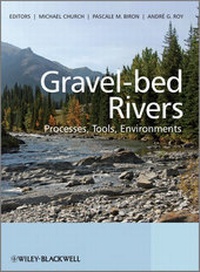
Gravel Bed Rivers
Description

Reviews / Votes
"I highly recommend the landmark and very accessible bookGravelBed Rivers: Processes, Tools, Environments edited byMichael Church, Pascale Biron, and André Roy, to any riverengineers, geomorphologists, environmental groups, policy makers,industry leaders, river managers, and advanced students who areseeking a complete overview of the latest knowledge in theprocesses, tools, and environments of gravel-bed rivers. This bookprovides the most comprehensive and authoritative collection ofinformation and research available, and is definitely a landmarkpublication." (Blog Business World, 7 February2012)More details
Other editions
Additional editions
Persons
Content
List of Contributing Authors ix
Preface xv
Secondary Flows in Rivers 1
1 Secondary Flows in Rivers: Theoretical Framework, Recent Advances, and Current Challenges, Vladimir Nikora and André G. Roy 3
2 Secondary Flows in Rivers: The Effect of Complex Geometry, Bruce MacVicar 23
3 Aspects of Secondary Flow in Open Channels: A Critical Literature Review, Athanasios (Thanos) N. Papanicolaou 31
Sediment Transport 37
4 Gravel Transport in Granular Perspective, Philippe Frey and Michael Church 39
5 On Gravel Exchange in Natural Channels, Judith K. Haschenburger 56
Modelling Morphodynamics 69
6 Morphodynamics of Bars in Gravel-bed Rivers: Bridging Analytical Models and Field Observations, Guido Zolezzi, Walter Bertoldi, and Marco Tubino 71
7 Field Observations of Gravel-bed River Morphodynamics: Perspectives and Critical Issues for Testing of Models, Nicola Surian 90
8 Morphodynamics of Bars in Gravel-bed Rivers: Coupling Hydraulic Geometry and Analytical Models, Robert G. Millar 96
9 Modelling Sediment Transport and Morphodynamics of Gravel-bed Rivers, Erik Mosselman 101
10 The Potential of using High-resolution Process Models to Inform Parameterizations of Morphodynamic Models, Richard J. Hardy 116
11 The Importance of Off-channel Sediment Storage in 1-D Morphodynamic Modelling, J. Wesley Lauer 123
River Restoration and Regulation 135
12 Stream Restoration in Gravel-bed Rivers, Peter R. Wilcock 137
13 River Restoration: Widening Perspectives, Nicholas J. Clifford 150
14 Restoring Geomorphic Resilience in Streams, Noah P. Snyder 160
15 The Geomorphic Response of Gravel-bed Rivers to Dams: Perspectives and Prospects, Gordon E. Grant 165
16 Mitigating Downstream Effects of Dams, David Gaeuman 182
Ecological Aspects of Gravel-bed Rivers 191
17 River Geomorphology and Salmonid Habitat: Some Examples Illustrating their Complex Association, from Redd to Riverscape Scales, Michel Lapointe 193
18 Incorporating Spatial Context into the Analysis of Salmonid-Habitat Relations, Christian E. Torgersen, Colden V. Baxter, Joseph L. Ebersole, and Robert E. Gresswell 216
19 Animals and the Geomorphology of Gravel-bed Rivers, Stephen P. Rice, Matthew F. Johnson, and Ian Reid 225
20 Geomorphology and Gravel-bed River Ecosystem Services: Workshop Outcomes, Normand Bergeron and Joanna Eyquem 242
Tools for Study 259
21 Remote Sensing of the Hydraulic Environment in Gravel-bed Rivers, W. Andrew Marcus 261
22 LiDAR and ADCP Use in Gravel-bed Rivers: Advances Since GBR6, David J. Milan and George L. Heritage 286
23 Remotely Sensed Topographic Change in Gravel Riverbeds with Flowing Channels, D. Murray Hicks 303
24 Modern Digital Instruments and Techniques for Hydrodynamic and Morphologic Characterization of River Channels, Marian Muste, Dongsu Kim, and Venkatesh Merwade 315
25 Mapping Water and Sediment Flux Distributions in Gravel-bed Rivers Using ADCPs, Colin D. Rennie 342
Steep Channels 351
26 Recent Advances in the Dynamics of Steep Channels, Francesco Comiti and Luca Mao 353
27 Examining Individual Step Stability within Step-pool Sequences, Joanna Crowe Curran. 378
28 Alluvial Steep Channels: Flow Resistance, Bedload Transport Prediction, and Transition to Debris Flows, Dieter Rickenmann 386
Semi-alluvial Channels 399
29 Semi-alluvial Channels and Sediment-Flux-Driven Bedrock Erosion, Jens M. Turowski 401
30 Transport Capacity, Bedrock Exposure, and Process Domains, Thomas E. Lisle 419
31 Nomenclature, Complexity, Semi-alluvial Channels and Sediment-flux-driven Bedrock Erosion, Lyubov V. Meshkova, Paul A. Carling, and Thomas Buffin-Bélanger 424
River Channel Change 433
32 Changes in Channel Morphology Over Human Time Scales, John M. Buffington 435
33 Channel Response and Recovery to Changes in Sediment Supply, Marwan A. Hassan and André E. Zimmermann 464
34 Alluvial Landscape Evolution: What Do We Know About Metamorphosis of Gravel-bed Meandering and Braided Streams?, François Métivier and Laurie Barrier 474
35 Differences in Sediment Supply to Braided and Single-Thread River Channels: What Do the Data Tell Us?, John Pitlick, Erich R. Mueller, and Catalina Segura 502
36 Can We Link Cause and Effect in Landscape Evolution?, Thomas J. Coulthard and Marco J. Van De Wiel 512
Ice in Gravel-bed Rivers 523
37 River-Ice Effects on Gravel-Bed Channels, Robert Ettema and Edward W. Kempema 525
38 Is There a Northern Signature on Fluvial Form?, James P. McNamara 541
39 Long-term and Large-scale River-ice Processes in Cold-region Watersheds, Etienne Boucher, Yves Bégin, Dominique Arseneault, and Taha B.M.J. Ouarda 546
Index 555
