

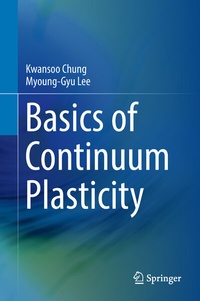
Basics of Continuum Plasticity
Description

This book describes the basic principles of plasticity for students and engineers who wish to perform plasticity analyses in their professional lives, and provides an introduction to the application of plasticity theories and basic continuum mechanics in metal forming processes.
This book consists of three parts. The first part deals with the characteristics of plasticity and instability under simple tension or compression and plasticity in beam bending and torsion. The second part is designed to provide the basic principles of continuum mechanics, and the last part presents an extension of one-dimensional plasticity to general three-dimensional laws based on the fundamentals of continuum mechanics. Though most parts of the book are written in the context of general plasticity, the last two chapters are specifically devoted to sheet metal forming applications. The homework problems included are designed to reinforce understanding of the concepts involved.
This bookmay be used as a textbook for a one semester course lasting fourteen weeks or longer. This book is intended to be self-sufficient such that readers can study it independently without taking another formal course. However, there are some prerequisites before starting this book, which include a course on engineering mathematics and an introductory course on solid mechanics.
More details
Other editions
Additional editions
Persons
Kwansoo Chung received his PhD from Stanford University, BS and MS from Seoul National University. He is a Professor of Materials Science and Engineering in Seoul National University. His research focuses on the area of Mechanics of materials and non-linear continuum/computational mechanics on thermo-mechanical problems based on plasticity, visco-elasticity, elasticity and heat transfer, and process design and analysis for sheet metals, glasses and fiber-reinforced composites. He has authored and coauthored more than 300 papers in peer-reviewed journals and cited over 5000 times, also holds 4 US patents.
Myoung-Gyu Lee recevied his PhD from Seoul National University. He is a Professor of Materials Science and Engineering in Seoul National University. His research interests focus on computational plasticity, mechanics of materials including finite element modeling of advanced structure materials, multi-scale modeling and experiment that reveal deformation mechanism of materials under complex strain path changes. He is co-authored for over 200 journal articles and 2 proceedings volumes, 3 book chapters in the areas of plasticity theory, advanced constitutive modeling and finite element simulations. He received the 2014 International Journal of Plasticity Award for excellent contribution to the field of plasticity.
Content
Part I: One-dimensional Plasticity.- Chapter 1: Introduction to Materials Mechanics.- Chapter 2: Plasticity Characteristics (in Simple Tension/Compression).- Chapter 3: Instability in Simple Tension Test.- Chapter 4: Physical Plasticity.- Chapter 5: Deformation of Heterogeneous Structures.- Chapter 6: Pure Bending and Beam Theory.- Chapter 7: Torsion.- Part II: Basics of Continuum Mechanics.- Chapter 8: Stress.- Chapter 9: Tensors.- Chapter 10: Gradient, Divergence and Curl.- Chapter 11: Kinematics (Strain).- Part III: Three-dimensional Plasticity.- Chapter 12: Yield Function.- Chapter 13: Normality Rule for Plastic Deformation.- Chapter 14: Plane Stress Problems for Sheets.- Chapter 15: Hardening Law for Evolution of Yield Surface.- Chapter 16: Stress Update Formulation.- Chapter 17: Formability and Springback of Sheets.- Appendix.- Index.
