

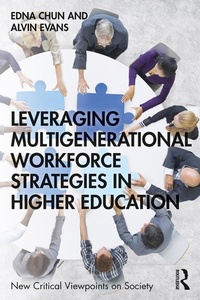
Leveraging Multigenerational Workforce Strategies in Higher Education
1st Edition
Published on 14. April 2021
188 pages
978-1-000-35843-8 (ISBN)
Description

The higher education literature on workplace diversity has overlooked the development of multigenerational workforce strategies as a key component of an inclusive talent proposition. While race, gender, sexual orientation, disability and other demographic attributes have gained considerable attention in diversity strategic planning, scant research pertains to building inclusive, multigenerational approaches within the culture and practices of higher education. Now more than ever, there is an urgent and unmet need to identify actionable strategies and approaches that optimize the contributions of multigenerational talent across the faculty, administrator, and staff ranks. With the goal of enhancing workforce capacity and creating more inclusive workplaces, Leveraging Multigenerational Workforce Strategies in Higher Education offers an in-depth look at multigenerational strategies that enhance institutional capacity and respond to educational needs.
This book is the first to address the creation of multigenerational strategies in the higher education workplace based upon substantial empirical studies and qualitative research. Drawing on in-depth interviews with faculty and administrators, the book examines the broad "framing" of generations that consists of stereotypes, narratives, images, and emotions. Through the lens of these narratives, it describes how ageist framing is magnified by other minoritized statuses including race/ethnicity, gender, and sexual orientation, and can result in structural inequality, process-based discrimination, and asymmetrical behavioral interactions in the higher education workplace. A major feature of the book is its focus on best-in-class HR and diversity policies and strategies that institutional leaders can deploy to overcome generational and ageist barriers and build an inclusive culture that values the contributions of all members.
Due to its practical and concrete emphasis in sharing leading-edge policies and practices that comprise a holistic multigenerational workforce strategy, the book will serve as a concrete resource to boards of trustees, presidents, provosts, deans, diversity officers, department chairs, faculty, academic and non-academic administrators, diversity and human resource leaders, and diversity taskforces in their efforts to create strategic, evidence-based multigenerational workforce approaches. In addition, the book will be utilized in upper division and graduate courses in higher education administration, diversity, human resource management, educational leadership, intergenerational issues, gerontology, social work, and organizational psychology.
This book is the first to address the creation of multigenerational strategies in the higher education workplace based upon substantial empirical studies and qualitative research. Drawing on in-depth interviews with faculty and administrators, the book examines the broad "framing" of generations that consists of stereotypes, narratives, images, and emotions. Through the lens of these narratives, it describes how ageist framing is magnified by other minoritized statuses including race/ethnicity, gender, and sexual orientation, and can result in structural inequality, process-based discrimination, and asymmetrical behavioral interactions in the higher education workplace. A major feature of the book is its focus on best-in-class HR and diversity policies and strategies that institutional leaders can deploy to overcome generational and ageist barriers and build an inclusive culture that values the contributions of all members.
Due to its practical and concrete emphasis in sharing leading-edge policies and practices that comprise a holistic multigenerational workforce strategy, the book will serve as a concrete resource to boards of trustees, presidents, provosts, deans, diversity officers, department chairs, faculty, academic and non-academic administrators, diversity and human resource leaders, and diversity taskforces in their efforts to create strategic, evidence-based multigenerational workforce approaches. In addition, the book will be utilized in upper division and graduate courses in higher education administration, diversity, human resource management, educational leadership, intergenerational issues, gerontology, social work, and organizational psychology.
Reviews / Votes
Issues of multigenerational relations have become increasingly important as the US population ages. These issues are likely to become even more pronounced by the impact of the current pandemic. Yet, at least from an applied social justice perspective within higher education, research has been somewhat infrequent and thin. I think the Chun and Evans book has the potential to be a seminal work in this field. Not only is it a superb review of what we currently know, it may help create a more robust surge of examination of these crucial issues.Charles Behling, Emeritus University of Michigan
University administrators frequently discuss issues of diversity, equity, and inclusion, yet ageism is largely overlooked in these conversations. Chun and Evans broaden our understanding of diversity with this comprehensive analysis of the multi-generational workforce. Most importantly, this book provides a powerful combination of detailed research and practical advice for creating an age-inclusive environment.
Peter Worthing, Associate Dean, AddRan College of Liberal Arts, Texas Christian University
As president of the No. 2-ranked university in the nation for conferring baccalaureate degrees to underrepresented students, I am a proponent of inclusive talent propositions that empower us to further diversify our educators to better serve our students. The arrival of Edna Chun and Alvin Evans' new book, Leveraging Multigenerational Workforce Strategies in Higher Education, fills a long-vacant hole in this area of study with innovative strategies that will support higher education institutions overcome ageist barriers and develop multigenerational workforces that both reflect inclusive excellence and bolster student success.
Fram Virjee, President, California State University, Fullerton
More details
Series
Edition
1. Auflage
Language
English
Place of publication
London
United Kingdom
Publishing group
Taylor & Francis Ltd
Target group
College/higher education
Professional and scholarly
Illustrations
2 Line drawings, black and white; 2 Illustrations, black and white
ISBN-13
978-1-000-35843-8 (9781000358438)
Copyright in bibliographic data and cover images is held by Nielsen Book Services Limited or by the publishers or by their respective licensors: all rights reserved.
Schweitzer Classification
Other editions
Additional editions
Edna Chun | Alvin Evans
Leveraging Multigenerational Workforce Strategies in Higher Education
Book
04/2021
1st Edition
Routledge
€59.90
Shipment within 15-20 days
Edna Chun | Alvin Evans
Leveraging Multigenerational Workforce Strategies in Higher Education
Book
04/2021
1st Edition
Routledge
€241.50
Shipment within 15-20 days
Persons
Edna Chun and Alvin Evans are award-winning authors and human resource and diversity thought-leaders with extensive experience in complex, multi-campus systems of higher-education. Two of their books, Are the Walls Really Down? Behavioral and Organizational Barriers to Faculty and Staff Diversity (2007) and Bridging the Diversity Divide: Globalization and Reciprocal Empowerment in Higher Education (2009) were the recipients of the prestigious Kathryn G. Hanson Publication Award by the national College and University Professional Association for Human Resources. They are also the authors of the first book appearing in Routledge's Critical Viewpoints book series, Diverse Administrators in Peril (2012). Their co-authored book, The New Talent Acquisition Frontier: Integrating HR and Diversity Strategy in the Private and Public Sectors and Higher Education (Stylus, 2014), received a silver medal in the 2014 Axiom Business Book Awards and is the first book to provide a concrete road map to the integration of HR and diversity strategy. Edna Chun is Chief Learning Officer and Alvin Evans is Higher Education Practice Leader for HigherEd Talent, a national diversity and human resources consulting firm. Edna Chun is also Lecturer in the Human Capital Management Department of the Columbia University School of Professional Studies.
Content
Acknowledgments
Foreword
Joe R. Feagin
Introduction: Forces and Fissures in The Higher Education Landscape
1. The Value of Intergenerational Diversity
2. The Looming Generational Crisis in Higher Education Employment
3. Behavioral and Process-Based Aspects of Ageism and Generational Status
4. Generational Status and Academic Realilties
5. Counteracting and Resisting Generational and Ageist Frames
6. Best-In-Class Multigenerational Human Resource and Diversity Policies and Programs
7. Looking Ahead: Opportunities and Recommendations
References
Foreword
Joe R. Feagin
Introduction: Forces and Fissures in The Higher Education Landscape
1. The Value of Intergenerational Diversity
2. The Looming Generational Crisis in Higher Education Employment
3. Behavioral and Process-Based Aspects of Ageism and Generational Status
4. Generational Status and Academic Realilties
5. Counteracting and Resisting Generational and Ageist Frames
6. Best-In-Class Multigenerational Human Resource and Diversity Policies and Programs
7. Looking Ahead: Opportunities and Recommendations
References
