

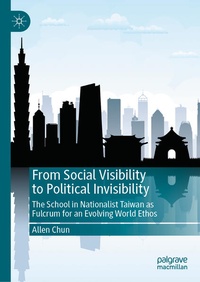
From Social Visibility to Political Invisibility
Description

This book began as a year-long ethnography of a school in Taiwan in 1991 then evolved more into a historical sociology of national formation and its cultural mindset. Cultural nationalism is a widely debated but poorly understood process. Contrary to prevailing perceptions, the Cold War may have given way to a more progressive open society, but the politicization of ethnicity hardened a more deeply entrenched cultural frame of mind. Instead of liberating an indigenous reality, Taiwanese consciousness has ironically polarized the political dead ends of reunification and independence. In the final analysis, the ethnography can serve as a paradigmatic case study for critical cultural studies. There are clear ramifications also for a comparative study of the cultural politics of other Chinese speaking or Asian societies and their histories.
Reviews / Votes
"This fascinating book offers a powerful corrective to the lazy generalities about 'hegemonic colonial Western modernity' that today dominate so much anthropological and educational scholarship. . his acute analysis of education and state formation in modern Taiwan means that those who stay the course will find their effort well rewarded." (Edward Vickers, The China Quarterly, November 3, 2023)More details
Other editions
Additional editions
Person
Allen Chun is Chair Professor in the Inter-Asia Cultural Studies Program, National Yang Ming Chiao Tung University, Taiwan. His interests involve cultural theory, nation-state formation, globalization and identity. His research focuses on Taiwan, Hong Kong and Singapore. His recent books include Forget Chineseness: On the Geopolitics of Cultural Identification (2017) and On the Geopragmatics of Anthropological Identification (2019).
Content
Chapter One: Ethnography as Cultural Geography.- Chapter Two: The Spaces of Nationalist Culture in Taiwan.- Chapter Three: Education and the Sociology of the Normal.- Chapter Four: School Routines in Time and Space.- Chapter Five: Socialization in the Longer View.- Chapter Six: Nationalist Ideology in the Politics of Normalization.- Chapter Seven: Anthropology as Writing Power.
