

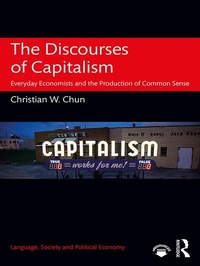
The Discourses of Capitalism
Everyday Economists and the Production of Common Sense
Published on 27. March 2017
168 pages
978-1-317-61472-2 (ISBN)
Description

Since the global economic crisis of 2007-2008, 'capitalism' has been the topic of widespread general discussion in both mainstream and social media. In this book, Christian W. Chun examines the discourses of capitalism taken up by people in their responses to a street art installation created by Steve Lambert, entitled Capitalism Works for Me! In doing so, he considers several key questions, including:
How do everyday people view and make sense of capitalism and its role in their work and personal lives?
What are the discourses they use in their common-sense understandings of the economy to defend or reject capitalism as a system?
Chun looks at how dominant discourses in social circulation operate to co-construct and support capitalism, and the accompanying counter-discourses that critique it. This is key reading for advanced students of discourse analysis, language and globalization/politics, media/communication studies, and related areas. A video lecture by the author can be accessed via the Routledge website (www.routledge.com/9781138807105) and the Routledge Language and Communication Portal (www.routledgetextbooks.com/textbooks/languageandcommunication).
How do everyday people view and make sense of capitalism and its role in their work and personal lives?
What are the discourses they use in their common-sense understandings of the economy to defend or reject capitalism as a system?
Chun looks at how dominant discourses in social circulation operate to co-construct and support capitalism, and the accompanying counter-discourses that critique it. This is key reading for advanced students of discourse analysis, language and globalization/politics, media/communication studies, and related areas. A video lecture by the author can be accessed via the Routledge website (www.routledge.com/9781138807105) and the Routledge Language and Communication Portal (www.routledgetextbooks.com/textbooks/languageandcommunication).
Reviews / Votes
"Based on his own life history and embodied praxis, Christian Chun offers us a rare authentic voice in this powerful yet sensitive study of how Americans discursively turn capitalism into common sense. Oscillating between Marxian theory and observations of contemporary events and employing innovative research tactics, this study can serve as a model for mature critical inquiry." Jan Blommaert, Tilburg University, The Netherlands"Christian Chun's work contributes significantly to growing criticism of the stale, ossified rationalization of the capitalist status-quo that comprises so much of contemporary economics and presents itself as a science above partisan ideologies. Important reading for any serious engagement with modern economics." Richard D. Wolff, University of Massachusetts, Amherst, USA "Based on his own life history and embodied praxis, Christian Chun offers us a rare authentic voice in this powerful yet sensitive study of how Americans discursively turn capitalism into common sense. Oscillating between Marxian theory and observations of contemporary events and employing innovative research tactics, this study can serve as a model for mature critical inquiry." Jan Blommaert, Tilburg University, The Netherlands
"Christian Chun's work contributes significantly to growing criticism of the stale, ossified rationalization of the capitalist status-quo that comprises so much of contemporary economics and presents itself as a science above partisan ideologies. Important reading for any serious engagement with modern economics." Richard D. Wolff, University of Massachusetts, Amherst, USA
More details
Series
Language
English
Place of publication
London
United Kingdom
Publishing group
Taylor & Francis Ltd
Target group
College/higher education
File size
3,40 MB
ISBN-13
978-1-317-61472-2 (9781317614722)
Copyright in bibliographic data and cover images is held by Nielsen Book Services Limited or by the publishers or by their respective licensors: all rights reserved.
Schweitzer Classification
Other editions
Additional editions
Christian W. Chun
The Discourses of Capitalism
Everyday Economists and the Production of Common Sense
Book
04/2017
1st Edition
Routledge
€231.20
Shipment within 10-20 days
Christian W. Chun
The Discourses of Capitalism
Everyday Economists and the Production of Common Sense
Book
04/2017
1st Edition
Routledge
€67.80
Shipment within 10-20 days
Person
Christian W. Chun is Assistant Professor of Culture, Identity, and Language Learning in the Applied Linguistics Department at the University of Massachusetts Boston, USA. He is the author of Power and Meaning Making in an EAP Classroom: Engaging with the Everyday (2015).
Content
Acknowledgments
Chapter One: The discourses of capitalism
Chapter Two: Ideology, common sense, and hegemony
Chapter Three: Discourse itineraries of economic representations
Chapter Four: Common-sense beliefs: "The only system that ever does work"
Chapter Five: Hegemonic discourses of capitalism: "Nothing is perfect"
Chapter Six: Counter-hegemonic discourses: "Who gets all the money?"
Chapter Seven: Public pedagogy engaging with the discourses of capitalism
References
Chapter One: The discourses of capitalism
Chapter Two: Ideology, common sense, and hegemony
Chapter Three: Discourse itineraries of economic representations
Chapter Four: Common-sense beliefs: "The only system that ever does work"
Chapter Five: Hegemonic discourses of capitalism: "Nothing is perfect"
Chapter Six: Counter-hegemonic discourses: "Who gets all the money?"
Chapter Seven: Public pedagogy engaging with the discourses of capitalism
References
