

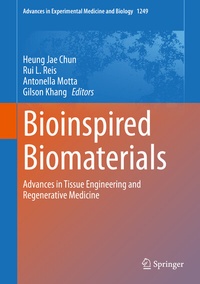
Bioinspired Biomaterials
Description

This book is the first of two volumes that together offer a comprehensive account of cutting-edge advances in the development of biomaterials for use within tissue engineering and regenerative medicine. Topics addressed in this volume, which is devoted to bioinspired biomaterials, range from novel biomaterials for regenerative medicine through to emerging enabling technologies with applications in, for example, drug delivery, maternal-fetal medicine, peripheral nerve repair and regeneration, and brain tumor therapy. New bioinspired hydrogels receive detailed attention in the book, and a further focus is the use of bioinspired biomaterials in the regulation of stem cell fate. Here the coverage includes the role of scaffolds in cartilage regeneration, the bioapplication of inorganic nanomaterials in tissue engineering, and guidance of cell migration to improve tissue regeneration. The authors are recognized experts in the interdisciplinary field of regenerative medicineand the book will be of value for all with an interest in regenerative medicine based on biomaterials.
More details
Other editions
Additional editions
Persons
Heung Jae Chun, Professor, Institute of Cell & Tissue Engineering, Department of Biomedical Sciences, The Catholic University of Korea, Republic of Korea
Rui Reis, Professor, University of Minho, Portugal
Antonella Motta, Professor, University Trento, Department of Industrial Engineering, BIOtech Research Center, Trento, Italy
Gilson Khang, Professor, Department of BIN Fusion Technology, Chonbuk National University, Republic of Korea
Content
Part I. Novel Bioinspired Biomaterials for Regenerative Medicine.- Chapter 1. Natural Sources and Applications of Demineralized Bone Matrix in the Field of Bone and Cartilage Tissue Engineering.- Chapter 2. Application of Gellan Gum-based Scaffold for Regenerative Medicine.- Chapter 3. Natural Fibrous Protein for Advanced Tissue Engineering Applications: Focusing on Silk Fibroin and Keratin.- Part II. Bioinspired 3D Bioprinting Hydrogel for Regenerative Medicine.- Chapter 4. Silk Fibroin Bioinks for Digital Light Processing (DLP) 3D Bioprinting.- Chapter 5. 3D-Bioprinting of Tissue Models with Customized Bioinks.- Chapter 6. Visible Light-curable Hydrogel Systems for Tissue Engineering and Drug Delivery.- Part III. Regulation of Stem Cell Fate by Bioinspired Biomaterials.- Chapter 7. Scaffolds for Cartilage Regeneration: To Use or Not to Use.- Chapter 8. Bio-application of Inorganic Nanomaterials in Tissue Engineering.- Chapter 9. Directional Cell Migration Guide for ImprovedTissue Regeneration.- Part IV. Cutting-Edge Enabling Technology for Regenerative Medicine.- Chapter 10. Extracellular Vesicles: The Next Frontier in Regenerative Medicine and Drug Delivery.- Chapter 11. Application of Tissue Engineering and Regenerative Medicine in Maternal-fetal Medicine.- Chapter 12. Fundamentals and Current Strategies for Peripheral Nerve Repair and Regeneration.- Chapter 13. Protein-based Drug Delivery in Brain Tumor Therapy.- Chapter 14. Human Hair: Scaffold Materials for Regenerative Medicine.
