

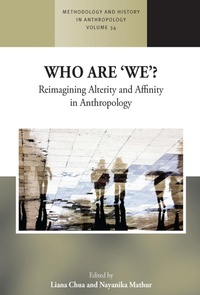
Who are 'We'?
Reimagining Alterity and Affinity in Anthropology
1st Edition
Published on 13. June 2018
264 pages
978-1-80539-903-2 (ISBN)
Description

Who do "we" anthropologists think "we" are? And how do forms and notions of collective disciplinary identity shape the way we think, write, and do anthropology? This volume explores how the anthropological "we" has been construed, transformed, and deployed across history and the global anthropological landscape. Drawing together both reflections and ethnographic case studies, it interrogates the critical-yet poorly studied-roles played by myriad anthropological "we" as in generating and influencing anthropological theory, method, and analysis. In the process, new spaces are opened for reimagining who "we" are - and what "we," and indeed anthropology, could become.
Reviews / Votes
"Who Are 'We'? does not provide a response to its own title. Rather, it pulls some of the historical, epistemic and political threads that have come to produce the intricate 'we' that we think we are... Importantly, this book is not a guide through pre-existing affinities and alterities, but an invitation to imagine new ways of reconnecting people - anthropologists and those who are not - in ever productive ways." * Social Anthropology"[This volume] raises awareness about existing inequalities in knowledge production, and at the same time contributes to the theoretical discussions on knowledge production in anthropology." * Michal Buchowski, Adam Mickiewicz University
More details
Series
Edition
1. Auflage
Language
English
Place of publication
Oxford
United Kingdom
Target group
College/higher education
Professional and scholarly
Illustrations
Bibliography; Index; 10 Illustrations
ISBN-13
978-1-80539-903-2 (9781805399032)
DOI
10.3167/9781785338885
Copyright in bibliographic data and cover images is held by Nielsen Book Services Limited or by the publishers or by their respective licensors: all rights reserved.
Schweitzer Classification
Other editions
Additional editions
Book
09/2024
Berghahn Books
€36.40
Shipment within 3-4 weeks
Book
06/2018
1st Edition
Berghahn Books
€148.10
Shipment within 3-4 weeks
Persons
Liana Chua is Tunku Abdul Rahman University Associate Professor in Malay World Studies at the Department of Social Anthropology, University of Cambridge. Her publications include The Christianity of Culture (Palgrave, 2012) and co-edited volumes on evidence, power in Southeast Asia and Alfred Gell's theory of art.
Content
List of Figures
Acknowledgements
Introduction: Who Are 'We'?
Liana Chua and Nayanika Mathur
PART I: REVISITING THE ANTHROPOLOGICAL 'WE'
Chapter 1. Anthropology at the Dawn of Apartheid: Radcliffe-Brown and Malinowski's South African Engagements, 1919-1934
Isak Niehaus
Chapter 2. The Savage Noble: Alterity and Aristocracy in Anthropology
David Sneath
PART II: ALTERITY AND AFFINITY IN ANTHROPOLOGY'S GLOBAL LANDSCAPE
Chapter 3. The Anthropological Imaginarium: Crafting Alterity, the Self, and an Ethnographic Film in Southwest China
Katherine Swancutt
Chapter 4. The Risks of Affinity: Indigeneity and Indigenous Film Production in Bolivia
Gabriela Zamorano Villarreal
Chapter 5. Shifting the 'We' in Oceania: Anthropology and Pacific Islanders Revisited
Ty P. Kawika Tengan
PART III: WHERE DO 'WE' GO FROM HERE?
Chapter 6. Crafting Anthropology Otherwise: Alterity, Affinity, and Performance
Gey Pin Ang and Caroline Gatt
Chapter 7. Towards an Ecumenical Anthropology
Joao de Pina-Cabral
Afterword
Mwenda Ntarangwi
Index
Acknowledgements
Introduction: Who Are 'We'?
Liana Chua and Nayanika Mathur
PART I: REVISITING THE ANTHROPOLOGICAL 'WE'
Chapter 1. Anthropology at the Dawn of Apartheid: Radcliffe-Brown and Malinowski's South African Engagements, 1919-1934
Isak Niehaus
Chapter 2. The Savage Noble: Alterity and Aristocracy in Anthropology
David Sneath
PART II: ALTERITY AND AFFINITY IN ANTHROPOLOGY'S GLOBAL LANDSCAPE
Chapter 3. The Anthropological Imaginarium: Crafting Alterity, the Self, and an Ethnographic Film in Southwest China
Katherine Swancutt
Chapter 4. The Risks of Affinity: Indigeneity and Indigenous Film Production in Bolivia
Gabriela Zamorano Villarreal
Chapter 5. Shifting the 'We' in Oceania: Anthropology and Pacific Islanders Revisited
Ty P. Kawika Tengan
PART III: WHERE DO 'WE' GO FROM HERE?
Chapter 6. Crafting Anthropology Otherwise: Alterity, Affinity, and Performance
Gey Pin Ang and Caroline Gatt
Chapter 7. Towards an Ecumenical Anthropology
Joao de Pina-Cabral
Afterword
Mwenda Ntarangwi
Index
