

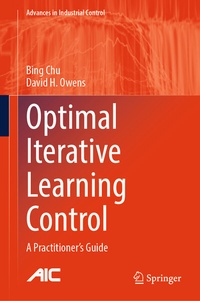
Optimal Iterative Learning Control
Description

This book introduces an optimal iterative learning control (ILC) design framework from the end user's point of view. Its central theme is the understanding of model dynamics, the construction of a procedure for systematic input updating and their contribution to successful algorithm design. The authors discuss the many applications of ILC in industrial systems, applications such as robotics and mechanical testing.
The text covers a number of optimal ILC design methods, including gradient-based and norm-optimal ILC. Their convergence properties are described and detailed design guidelines, including performance-improvement mechanisms, are presented. Readers are given a clear picture of the nature of ILC and the benefits of the optimization-based approach from the conceptual and mathematical foundations of the problem of algorithm construction to the impact of available parameters in making acceleration of algorithmic convergence possible. Three case studies on robotic platforms, an electro-mechanical machine, and robot-assisted stroke rehabilitation are included to demonstrate the application of these methods in the real-world.
With its emphasis on basic concepts, detailed design guidelines and examples of benefits, Optimal Iterative Learning Control will be of value to practising engineers and academic researchers alike.
More details
Other editions
Additional editions
Persons
Dr Bing Chu is an associate professor in Electronics and Computer Science at University of Southampton. Before joining University of Southampton in 2012, he was a postdoctoral researcher at University of Oxford (2010-2012). He teaches modules in the general physics, signals, systems and control area at undergraduate/postgraduate level. He has authored or co-authored 70 peer-reviewed scientific publications. He has been the recipient of many awards including the prestigious UKACC best paper prize and Certificate of Merit for IET Control and Automation Doctoral Dissertation Prize. He is a regular referee for a number of international journals and conferences. His current research interests include analysis and control of large scale networked systems, iterative and repetitive control, learning control, applied optimisation theory and their applications.
David H. Owens is a professor at University of Sheffield, UK and Zhengzhou University, China. He has 50 years of experience of Control Engineering theory and applications in areas including nuclear power, robotics and mechanical test. His research has included multivariable frequency domain theory and design, the theory of multivariable root loci, contributions to robust control theory, theoretical methods for controller design based on plant step data and involvement in aspects of adaptive control, model reduction and optimization-based design. His early experience of modelling and analysis of systems with repetitive dynamics originally arising in control of underground coal cutters led to substantial contributions (with collaborator E. Rogers and others) in the area of repetitive control systems (as part of 2D systems theory) but more specifically, since 1996, in the area of iterative learning control when he introduced the use of optimization to the ILC community in the form of "norm optimal iterative learning control". Since that time he has added considerable detail and depth to the approach and introducing the ideas of parameter optimal iterative learning to simplify the implementations. Applications have included industrial projects in automotive/mechanical tests and the development of data analysis tools for control of gantry robots and stroke rehabilitation equipment with collaborators at Southampton University. Professor Owens was elected a Fellow of the UK Royal Academy of Engineering for his contributions to knowledge in these and other areas.
Content
1. Introduction to Iterative Learning Control.- 2. Brief Review of Systems Control Theory.- 3. Parameter Optimal Iterative Learning Control.- 4. Inverse Based Iterative Learning Control.- 5. Gradient Based Iterative Learning Control.- 6. Norm Optimal Iterative Learning Control.- 7. Optimal Iterative Learning Control: Constraint Handling.- 8. Accelerating the Convergence.- 9. A Case Study on a Robotic Testing Platform.- 10. Summary and Future Research Directions.
