

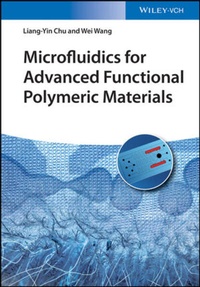
Microfluidics for Advanced Functional Polymeric Materials
1st Edition
Published on 13. March 2017
336 pages
978-3-527-80366-8 (ISBN)
Description

A comprehensive and systematic treatment of our current understanding of the microfluidic technique and its advantages in the controllable fabrication of advanced functional polymeric materials.
Introducing and summarizing recent advances and achievements in the field, the authors cover the design and fabrication of microfluidic devices, the fundamentals and strategies for controllable microfluidic generation of multiphase liquid systems, and the use of these liquid systems with an elaborate combination of their structures and compositions for generating novel polymer materials, such as microcapsules, microfibers, valves, and membranes. Clear diagrams and illustrations throughout the text make the relevant theory and technologies more readily accessible.
The result is a specialist reference for materials scientists, organic, polymer and physical chemists, and chemical engineers.
Introducing and summarizing recent advances and achievements in the field, the authors cover the design and fabrication of microfluidic devices, the fundamentals and strategies for controllable microfluidic generation of multiphase liquid systems, and the use of these liquid systems with an elaborate combination of their structures and compositions for generating novel polymer materials, such as microcapsules, microfibers, valves, and membranes. Clear diagrams and illustrations throughout the text make the relevant theory and technologies more readily accessible.
The result is a specialist reference for materials scientists, organic, polymer and physical chemists, and chemical engineers.
More details
Other editions
Additional editions
Liang-Yin Chu | Wei Wang
Microfluidics for Advanced Functional Polymeric Materials
Book
05/2017
1st Edition
Wiley-VCH
€159.00
Article exhausted; check different version
Liang-Yin Chu | Wei Wang
Microfluidics for Advanced Functional Polymeric Materials
Software
04/2017
Wiley-VCH
€198.26
No shipping information available
Persons
Professor Liang-Yin Chu is the School Dean of Chemical Engineering at Sichuan University in Chengdu, China. Professor Chu has received numerous honours and awards including the National Natural Science Award nominated by the Ministry of Education of China (2003), Distinguished Young Scholar issued by the National Natural Science Foundation of China (2008), Distinguished Professor of Chang Jiang Scholars Program issued by the Ministry of Education (2009), Te-Pang Hou Chemical Science and Technology Innovation Award issued by the Chemical Industry and Engineering Society of China (2013). He has authored/coauthored more than 400 papers, 37 patents, 14 book chapters and four books. Currently, Professor Chu directs a talented research group with a diverse and interdisciplinary focus on the development of advanced functional materials, microfluidics, membranes and biomaterials.
Dr. Wei Wang is an associate professor of School of Chemical Engineering at Sichuan University in Chengdu, China. His research mainly focuses on functional materials, microfluidics, and interfacial sciences. He has authored and co-authored 76 papers that published in peer-reviewed journals. He was awarded many honours and awards, including the Emerging Investigator 2014 of Lab on a Chip (The Royal Society of Chemistry), Materials Horizons Paper Prize at the 8th Global Chinese Chemical Engineers Symposium (2016), and the Excellent Paper Award issued by the Organization Committee of the 3rd Asian Conference on Colloids and Interface Science (2009).
Dr. Wei Wang is an associate professor of School of Chemical Engineering at Sichuan University in Chengdu, China. His research mainly focuses on functional materials, microfluidics, and interfacial sciences. He has authored and co-authored 76 papers that published in peer-reviewed journals. He was awarded many honours and awards, including the Emerging Investigator 2014 of Lab on a Chip (The Royal Society of Chemistry), Materials Horizons Paper Prize at the 8th Global Chinese Chemical Engineers Symposium (2016), and the Excellent Paper Award issued by the Organization Committee of the 3rd Asian Conference on Colloids and Interface Science (2009).
Content
1. Introduction
2. Shear-induced generation of controllable multiple emulsions in microfluidic devices
3. Wetting-induced generation of controllable multiple emulsions in microfluidic devices
4. Microfluidic fabrication of monodisperse solid microparticles
4.1 Stimuli-responsive microspheres for sensing and actuating
4.2 Smart microspheres for Pb2+ adsorption and separation
5. Microfluidic fabrication of monodisperse porous microparticles
5.1 Thermo-responsive porous microparticles with tunable response behaviors
5.2 Thermo-responsive microparticles with open-celled porous structure for fast response
6. Microfluidic fabrication of uniform hierarchical porous microparticles for separation
7. Microfluidic fabrication of monodisperse hollow microcapsules for controlled release
7.1 Glucose-responsive microcapsules for controlled release of insulin
7.2 Multi-stimuli-responsive microcapsules for adjustable controlled-release
8. Microfluidic fabrication of monodisperse core-shell microcapsules for burst release
8.1 Smart microcapsules for thermo-triggered burst release
8.2 Smart microcapsules for pH-responsive burst release
8.3 Smart microcapsules for K+-responsive burst release
9. Microfluidic fabrication of monodisperse hole-shell microparticles for controlled capture
10. Microfluidic fabrication of controllable multicompartmental microparticles
10.1 Multi-core/shell microparticles for co-encapsulation and synergistic release
10.2 Trojan-Horse-like microparticles for co-delivery and programmed release
11. Microfluidic fabrication of functional microfibers with controllable internals
11.1 Peapod-like microfibers for controllable encapsulation
11.2 Spider-silk-like microfibers for 3D assembly and water collection
12. Microfluidic fabrication of membrane-in-a-chip with self-regulated permeability for detection
13. Microfluidic fabrication of microvalve-in-a-chip
13.1 Smart microvalve-in-a-chip with thermostatic control for cell culture
13.2 Smart microvalve-in-a-chip with ultra-sensitivity for real-time detection
14. Conclusions and Perspective
Index
2. Shear-induced generation of controllable multiple emulsions in microfluidic devices
3. Wetting-induced generation of controllable multiple emulsions in microfluidic devices
4. Microfluidic fabrication of monodisperse solid microparticles
4.1 Stimuli-responsive microspheres for sensing and actuating
4.2 Smart microspheres for Pb2+ adsorption and separation
5. Microfluidic fabrication of monodisperse porous microparticles
5.1 Thermo-responsive porous microparticles with tunable response behaviors
5.2 Thermo-responsive microparticles with open-celled porous structure for fast response
6. Microfluidic fabrication of uniform hierarchical porous microparticles for separation
7. Microfluidic fabrication of monodisperse hollow microcapsules for controlled release
7.1 Glucose-responsive microcapsules for controlled release of insulin
7.2 Multi-stimuli-responsive microcapsules for adjustable controlled-release
8. Microfluidic fabrication of monodisperse core-shell microcapsules for burst release
8.1 Smart microcapsules for thermo-triggered burst release
8.2 Smart microcapsules for pH-responsive burst release
8.3 Smart microcapsules for K+-responsive burst release
9. Microfluidic fabrication of monodisperse hole-shell microparticles for controlled capture
10. Microfluidic fabrication of controllable multicompartmental microparticles
10.1 Multi-core/shell microparticles for co-encapsulation and synergistic release
10.2 Trojan-Horse-like microparticles for co-delivery and programmed release
11. Microfluidic fabrication of functional microfibers with controllable internals
11.1 Peapod-like microfibers for controllable encapsulation
11.2 Spider-silk-like microfibers for 3D assembly and water collection
12. Microfluidic fabrication of membrane-in-a-chip with self-regulated permeability for detection
13. Microfluidic fabrication of microvalve-in-a-chip
13.1 Smart microvalve-in-a-chip with thermostatic control for cell culture
13.2 Smart microvalve-in-a-chip with ultra-sensitivity for real-time detection
14. Conclusions and Perspective
Index
