

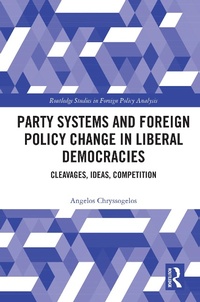
Party Systems and Foreign Policy Change in Liberal Democracies
Cleavages, Ideas, Competition
1st Edition
Published on 22. December 2020
208 pages
978-1-000-28736-3 (ISBN)
Description

How do political parties affect foreign policy? This book answers this question by exploring the role of party politics as source of foreign policy change in liberal democracies.
The book shifts the focus from individual political parties to party systems as the context in which parties' ideologies receive precise content and their preferences are formed. The central claim is that foreign policy change arises from within transformed discursive contexts of party competition, when a new language of politics that constitutes anew parties' self-understanding of what they stand for and compete over emerges in a party system. By comparing cases of contested foreign policy change, the book shows how such transformations in party competition determine whether and when international pressures on a state will translate into decisions to institute foreign policy change and what degree of change will be ultimately implemented.
With a novel framework which bridges concepts of international relations and comparative politics, the book will be of interest to researchers and students in the areas of international relations theory, foreign policy analysis and comparative politics, and generally to anyone wanting to understand how and when parties, elections and voters contribute to international change.
The book shifts the focus from individual political parties to party systems as the context in which parties' ideologies receive precise content and their preferences are formed. The central claim is that foreign policy change arises from within transformed discursive contexts of party competition, when a new language of politics that constitutes anew parties' self-understanding of what they stand for and compete over emerges in a party system. By comparing cases of contested foreign policy change, the book shows how such transformations in party competition determine whether and when international pressures on a state will translate into decisions to institute foreign policy change and what degree of change will be ultimately implemented.
With a novel framework which bridges concepts of international relations and comparative politics, the book will be of interest to researchers and students in the areas of international relations theory, foreign policy analysis and comparative politics, and generally to anyone wanting to understand how and when parties, elections and voters contribute to international change.
Reviews / Votes
"This book examines the importance of political parties to foreign policy given the surprising results of elections in liberal democracies in recent years. It advances our knowledge of party politics to account for the content, degree, timing and policy area of foreign policy change through a nuanced account of the nexus of international and domestic pressures on party competition. Our knowledge of party politics and foreign policy change are substantially enriched as a result of this timely and welcome contribution to the literature." - Cameron G. Thies, Professor of Political Science, School of Politics and Global Studies, Arizona State University, USA."Finally, a book dedicated to political parties and foreign policy. Chryssogelos upends the external/internal dichotomy, showing how the dynamics of party competition determine how states respond to structural pressures. The volume pushes the boundaries of the field, bringing society and the state back into the politics of foreign policy change, and weaving together a host of themes in electoral and party politics. Essential reading for anybody interested in the link between politics at home and abroad." - Benjamin Martill, Lecturer in Politics and International Relations, University of Edinburgh, UK. 'This book examines the importance of political parties to foreign policy given the surprising results of elections in liberal democracies in recent years. It advances our knowledge of party politics to account for the content, degree, timing and policy area of foreign policy change through a nuanced account of the nexus of international and domestic pressures on party competition. Our knowledge of party politics and foreign policy change are substantially enriched as a result of this timely and welcome contribution to the literature.' - Cameron G. Thies, Professor of Political Science, School of Politics and Global Studies, Arizona State University, USA
'Finally, a book dedicated to political parties and foreign policy. Chryssogelos upends the external/internal dichotomy, showing how the dynamics of party competition determine how states respond to structural pressures. The volume pushes the boundaries of the field, bringing society and the state back into the politics of foreign policy change, and weaving together a host of themes in electoral and party politics. Essential reading for anybody interested in the link between politics at home and abroad.' - Benjamin Martill, Lecturer in Politics and International Relations, University of Edinburgh, UK
More details
Series
Edition
1. Auflage
Language
English
Place of publication
London
United Kingdom
Publishing group
Taylor & Francis Ltd
Target group
College/higher education
Illustrations
7 Tables, black and white
ISBN-13
978-1-000-28736-3 (9781000287363)
Copyright in bibliographic data and cover images is held by Nielsen Book Services Limited or by the publishers or by their respective licensors: all rights reserved.
Schweitzer Classification
Other editions
Additional editions
Angelos Chryssogelos
Party Systems and Foreign Policy Change in Liberal Democracies
Cleavages, Ideas, Competition
Book
08/2022
1st Edition
Routledge
€65.10
Shipment within 15-20 days
Angelos Chryssogelos
Party Systems and Foreign Policy Change in Liberal Democracies
Cleavages, Ideas, Competition
Book
12/2020
1st Edition
Routledge
€185.20
Shipment within 15-20 days
Person
Angelos Chryssogelos is lecturer (assistant professor) in politics and international relations at the School of Social Sciences, London Metropolitan University and a Jean Monnet Fellow at the Robert Schuman Centre for Advanced Studies of the European University Institute.
Content
Introduction Chapter 1 - A New Framework for Understanding Party-Based Foreign Policy Change Chapter 2 - West Germany 1969-74: The Social-Liberal Coalition and Ostpolitik Chapter 3 - Canada 1984-1993: Revolt of The Peripheries and Free Trade with The US Chapter 4 - Greece 1993-2000: Rapprochement with Turkey and Renewal of a Two-Party System Chapter 5 - Empirical and Conceptual Implications of the Argument Conclusion
