

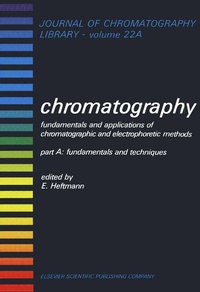
Chromatography
Fundamentals and Applications of Chromatographic and Electrophoretic Methods. Part A: Fundamentals and Techniques
Elsevier (Publisher)
Published on 26. August 2011
387 pages
978-0-08-085823-4 (ISBN)
Description

Chromatography
More details
Other editions
New editions
Ivor Smith
Chromatography
E-Book
10/2013
3rd Edition
Butterworth-Heinemann
€70.95
Available for download
Additional editions

Erich Heftmann
Chromatography: Fundamentals and Techniques Pt. A
Fundamentals and Applications of Chromatographic and Electrophoretic Methods
Book
03/1983
Elsevier
€93.77
Article exhausted; check different version
Persons
Content
- Front Cover
- chromatography
- Copyright Page
- Contents
- List of authors and coauthors
- List of abbreviations
- Foreword
- Preface
- Chapter 1. Survey of chromatography and electrophoresis
- 1.1. Classifications
- 1.2. Column chromatography
- 1.3. Planar chromatography
- 1.4. Gas chromatography
- 1.5. Electrophoresis
- 1.6. Conclusions
- References
- Chapter 2. History of chromatography and electrophoresis
- 2.1. Introduction
- 2.2. Early column chromatography
- 2.3. Middle period of liquid chromatography
- 2.4. Modern column chromatography
- 2.5. Gas chromatography
- 2.6. Electrophoresis
- References
- Chapter 3. Theory of chromatography
- 3.1. Introduction
- 3.2. The chromatogram
- 3.3. Measures of column efficiency
- 3.4. Relative retention and resolution
- 3.5. Thermodynamics of chromatographic retention
- 3.6. Linear free energy relationships
- 3.7. Flow through porous media
- 3.8. Bandspreading
- 3.9. Procedures in multicomponent elution chromatography
- 3.10. List of symbols
- 3.11. Acknowledgements
- References
- Chapter 4. Column chromatography
- 4.1. Introduction
- 4.2. Selectivity
- 4.3. Columns
- 4.4. Mobile-phase supply systems
- 4.5. Injection devices
- 4.6. Thermostats
- 4.7. Detectors
- 4.8. Qualitative analysis
- 4.9. Quantitative analysis
- 4.10. Combination of column chromatography with spectroscopic techniques
- References
- Chapter 5 . Planar chromatography
- 5.1. Introduction
- 5.2. Sample preparation
- 5.3. Sample application
- 5.4. Thin-layer chromatography
- 5.5. Paper chromatography
- 5.6. Identification of substances by thin-layer and paper chromatography
- 5.7. List of suppliers
- References
- Chapter 6. Gas chromatography
- 6.1. Introduction
- 6.2. Basic concepts
- 6.3. Components of gas chromatographic systems
- 6.4. Qualitative and quantitative analysis
- References
- Chapter 7. Ion-exchange chromatography
- 7.1. Historical introduction
- 7.2. Ion-exchanging materials
- 7.3. Physical properties of ion-exchange resins
- 7.4. Equilibrium and selectivity
- 7.5. Experimental methods
- 7.6. Metal separations through complex ions
- 7.7. Chromatography of organic compounds
- 7.8. Paired-ion chromatography
- References
- Chapter 8. Gel chromatography
- 8.1. Introduction
- 8.2. Packing materials for gel chromatography
- 8.3. Relation between solute structure and partitioningin chromatography
- 8.4. Solute partitioning and the structure of a dextran gel in water
- 8.5. Mechanisms of selectivity
- 8.6. Hydration of gels
- 8.7. Hydrophobic interactions in gels
- 8.8. Schardinger cycloamyloses
- 8.9. Affinity chromatography
- 8.10. Acknowledgement
- References
- Chapter 9. Electrophoresis
- 9.1. The physical basis of electrophoresis
- 9.2. Classification of electromigration methods
- 9.3. Isotachophoresis
- 9.4. List of symbols
- References
- Subject index
