

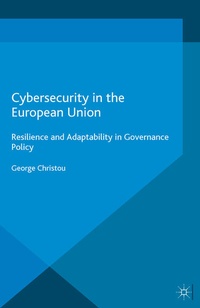
Cybersecurity in the European Union
Description

Reviews / Votes
"The book is well written and clear in its content and purposes. It is well suited for both academics and practitioners, including political and military personnel, presenting a clear overview of the development of the EU's cybersecurity framework. . it makes a useful contribution to the academic debate on the global role of the EU as a security actor, as well as on the idea of a 'civilian response' to cyber threats." (Simona Autolitano, The International Spectator, Vol. 52 (1), 2017)More details
Other editions
Additional editions
Person
George Christou is Associate Professor of European Politics in the Department of Politics and International Studies at the University of Warwick, UK. He has published widely on the European Union (EU) as a security actor; Cyprus and the EU; and on the EU approach to and influence on Internet governance. He has experience of working on European Commission funded Framework 7 projects, as well as projects funded by NATO Allied Command Transformation and the UK's Economic and Social Research Council and Defence Science and Technology Laboratory. He is also an active member of the EU's Network and Information Security (NIS) Public-Private Platform.
Content
- Intro
- Contents
- List of Tables, Boxes and Figures
- Foreword
- Preface
- Acknowledgements
- 1 Introduction
- The salience of cybersecurity in the European Union
- Central questions and objectives of the book
- The structure and organisation of the book
- 2 Conceptualising Security as Resilience in Cyberspace
- Introduction
- Approaches to analysing cybersecurity
- Understanding the European Union in cybersecurity
- Ecosystems and resilience
- Security and governance
- Conclusion: Security as resilience
- 3 Cybersecurity in the Global Ecosystem
- Introduction: The international context
- Internet governance and cybersecurity
- ICANN
- Internet Governance Forum
- Multilateral organisations and cybersecurity
- The G8 group of states
- The United Nations (UN)
- International Telecommunications Union (ITU)
- North Atlantic Treaty Organisation (NATO)
- Organisation for Economic Cooperation and Development (OECD)
- Council of Europe
- Organisation for Security and Cooperation in Europe (OSCE)
- Conclusion: Security as resilience in the international cyber ecosystem
- 4 National Cybersecurity Approaches in the European Union: The Case of the UK
- Introduction
- The UK's evolving narrative on cybersecurity
- The UK cybersecurity strategy: Building effective security as resilience?
- Cybercrime and making cyberspace safe for UK business: Institutional innovation and improved partnership?
- Securing cyberspace for business: Partnerships, information sharing and standards
- Cyber-attacks and resilience
- Shaping the international
- Knowledge, skills and capability
- Conclusion: UK security as resilience
- 5 The European Union and Cybercrime
- Introduction
- Governing cybercrime in the European Union
- Exploitation of the online world for the purposes of abusing children
- The cybersecurity strategy of the European Union: Cybercrime
- Legal
- Cooperation, collaboration and operational aspects
- Conclusion: Security as resilience and European Union cybercrime
- 6 Network and Information Security and Cyber Defencein the European Union
- Introduction
- Governing NIS in the European Union
- Network and information security in the cybersecurity strategy of the European Union: Achieving cyber resilience?
- European Union cyber defence: Under construction?
- Conclusions
- 7 Transatlantic Cooperation in Cybersecurity: Convergingon Security as Resilience?
- Introduction
- Governing cyberspace
- Security, data privacy and data protection
- EU and US logics and approaches
- Network and information security: Critical infrastructure protection
- Data privacy and protection
- EU-US platforms for cooperation and coordination on cybersecurity and cybercrime
- Conclusion: Converging on security as resilience?
- 8 Conclusions: Towards Effective Security as Resilience in the European Union?
- Introduction
- The emerging ecosystem in the EuropeanUnion: Security as resilience?
- Cybercrime
- Network and information security
- Cyber defence
- Reflections on the domestic and international
- Reflections and final thoughts
- Notes
- References
- Index
