

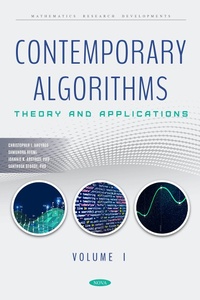
Contemporary Algorithms: Theory and Applications. Volume I
Published on 3. November 2022
447 pages
979-8-88697-425-6 (ISBN)
Description

This book provides different avenues to study algorithms. It also brings new techniques and methodologies to problem solving in computational sciences, engineering, scientific computing and medicine (imaging, radiation therapy) to mention a few. A plethora of algorithms which are universally applicable are presented in a sound, analytical way. The chapters are written independently of each other, so they can be understood without reading earlier chapters. But some knowledge of analysis, linear algebra, and some computing experience is required. The organization and content of this book cater to senior undergraduate, graduate students, researchers, practitioners, professionals, and academicians in the aforementioned disciplines. It can also be used as a reference book and includes numerous references and open problems.
More details
Other editions
Additional editions
Book
12/2022
Nova Science Publishers Inc
€303.05
Shipment within 15-20 days
Content
- Intro
- Mathematics Research Developments
- Contemporary AlgorithmsTheory and Applications
- Contents
- Glossary of Symbols
- Preface
- Chapter 1Ball Convergence for High OrderMethods
- 1. Introduction
- 2. Local Convergence Analysis
- 3. Numerical Examples
- 4. Conclusion
- References
- Chapter 2Continuous Analogs of Newton-TypeMethods
- 1. Introduction
- 2. Semi-local Convergence I
- 3. Semi-local Convergence II
- 4. Conclusion
- References
- Chapter 3Initial Points for Newton's Method
- 1. Introduction
- 2. Semi-local Convergence Result
- 3. Main Result
- 4. On the Convergence Region
- 5. A Priori Error Bounds and Quadratic Convergence of Newton'sMethod
- 6. Local Convergence
- 7. Numerical Examples
- 8. Conclusion
- References
- Chapter 4Seventh Order Methods
- 1. Introduction
- 2. Local Convergence Analysis
- 3. Numerical Example
- 4. Conclusion
- References
- Chapter 5Third Order Schemes
- 1. Introduction
- 2. Ball Convergence
- 3. Numerical Examples
- 4. Conclusion
- References
- Chapter 6Fifth and Sixth Order Methods
- 1. Introduction
- 2. Ball Convergence
- 3. Numerical Examples
- 4. Conclusion
- References
- Chapter 7Sixth Order Methods
- 1. Introduction
- 2. Ball Convergence
- 3. Conclusion
- References
- Chapter 8Extended Jarratt-Type Methods
- 1. Introduction
- 2. Convergence Analysis
- 3. Conclusion
- References
- Chapter 9Multipoint Point Schemes
- 1. Introduction
- 2. Local Convergence
- 3. Numerical Examples
- 4. Conclusion
- References
- Chapter 10Fourth Order Methods
- 1. Introduction
- 2. Convergence
- 3. Numerical Examples
- 4. Conclusion
- References
- Chapter 11Inexact Newton Algorithm
- 1. Introduction
- 2. Convergence of NA
- 3. Numerical Examples
- 4. Conclusion
- References
- Chapter 12Halley's Method
- 1. Introduction
- 2. Convergence of HA
- 3. Conclusion
- References
- Chapter 13Newton's Algorithm for SingularSystems
- 1. Introduction
- 2. Convergence of NA
- 3. Conclusion
- References
- Chapter 14Gauss-Newton-Algorithm
- 1. Introduction
- 2. Semi-Local Convergence
- 3. Local Convergence
- 4. Conclusion
- References
- Chapter 15Newton's Algorithm on RiemannianManifolds
- 1. Introduction
- 2. Convergence
- 3. Conclusion
- References
- Chapter 16Gauss-Newton-Kurchatov Algorithmfor Least Squares Problems
- 1. Introduction
- 2. Convergence of GNKA
- 3. Conclusion
- References
- Chapter 17Uniqueness of the Solution ofEquations in Banach Space: I
- 1. Introduction
- 2. Convergence
- 3. Conclusion
- References
- Chapter 18Uniqueness of the Solution ofEquations in Banach Space: II
- 1. Introduction
- 2. Convergence
- 3. Conclusion
- References
- Chapter 19Convergence of Newton's Algorithmfor Sections on RiemannianManifolds
- 1. Introduction
- 2. Convergence
- 3. Conclusion
- References
- Chapter 20Newton Algorithm on Lie Groups: I
- 1. Introduction
- 2. Two versions of NA
- 2.1. The Differential of the Map F
- 3. Conclusion
- References
- Chapter 21Newton Algorithm on Lie Groups: II
- 1. Introduction
- 2. Convergence Criteria
- 3. Conclusion
- References
- Chapter 22Two-Step Newton Method under L-Average Conditions
- 1. Introduction
- 2. Semi-Local Convergence of TSNM
- 3. Conclusion
- References
- Chapter 23Unified Methods for SolvingEquations
- 1. Introduction
- 2. Ball Convergence
- 3. Numerical Examples
- 4. Conclusion
- References
- Chapter 24Eighth Convergence OrderDerivative Free Method
- 1. Introduction
- 2. Ball Convergence
- 3. Conclusion
- References
- Chapter 25m-Step Methods
- 1. Introduction
- 2. Local Convergence
- 3. Numerical Examples
- 4. Conclusion
- References
- Chapter 26Third Order Schemes for SolvingEquations
- 1. Introduction
- 2. Ball Convergence
- 3. Numerical Examples
- 4. Conclusion
- References
- Chapter 27Deformed Newton Method forSolving Equations
- 1. Introduction
- 2. Local Convergence ofMethod (27.3)
- 3. Semi-local Convergence ofMethod (27.3)
- 4. Numerical Examples
- 5. Conclusion
- References
- Chapter 28On the Newton-KantorovichTheorem
- 1. Introduction
- 2. Convergence Analysis
- 3. Concluding Remarks and Applications
- 4. Conclusion
- References
- Chapter 29Kantorovich-Type Extensions forNewton Method
- 1. Introduction
- 2. Semi-Local Convergence for Newton-Like Methods
- 3. Numerical Examples
- 4. Conclusion
- References
- Chapter 30Improved Convergence for theKing-Werner Method
- 1. Introduction
- 2. Convergence Analysis of King-Werner-Type Methods (30.2)and (30.3)
- 3. Numerical Examples
- 4. Conclusion
- References
- Chapter 31Extending the Applicability ofKing-Werner-Type Methods
- 1. Introduction
- 2. Majorizing Sequences for King-Werner-TypeMethods (31.3)and (31.4)
- 3. Convergence Analysis of King-Werner-Type Methods (31.3)and (31.4)
- 4. Numerical Examples
- 5. Conclusion
- References
- Chapter 32Parametric Efficient Family ofIterative Methods
- 1. Introduction
- 2. Convergence Analysis of Method (32.2)
- 3. Numerical Examples
- 4. Conclusion
- References
- Chapter 33Fourth Order Derivative FreeScheme with Three Parameters
- 1. Introduction
- 2. Convergence
- 3. Numerical Examples
- 4. Conclusion
- References
- Chapter 34Jarratt-Type Methods
- 1. Introduction
- 2. Convergence Analysis
- 3. Conclusion
- References
- Chapter 35Convergence Radius of an EfficientIterative Method with FrozenDerivatives
- 1. Introduction
- 2. Convergence for Method (35.2)
- 3. Numerical Examples
- 4. Conclusion
- References
- Chapter 36Efficient Sixth Convergence OrderMethods under GeneralizedContinuity
- 1. Introduction
- 2. Local Convergence
- 3. Numerical Examples
- 4. Conclusion
- References
- Chapter 37Fifth Order Methods underGeneralized Conditions
- 1. Introduction
- 2. Local Analysis
- 3. Numerical Examples
- 4. Conclusion
- References
- Chapter 38Two Fourth Order Solvers forNonlinear Equations
- 1. Introduction
- 2. Convergence
- 3. Numerical Examples
- 4. Conclusion
- References
- Chapter 39Kou's Family of Schemes
- 1. Introduction
- 2. Local Analysis
- 3. Numerical Examples
- 4. Conclusion
- References
- Chapter 40Multi-Step Steffensen-Line Methods
- 1. Introduction
- 2. Semi-Local Convergence
- 3. Conclusion
- References
- Chapter 41Newton-Like Scheme for SolvingInclusion Problems
- 1. Introduction
- 2. Semi-Local Convergence
- 3. Conclusion
- References
- Chapter 42Extension of Newton-Secant-LikeMethod
- 1. Introduction
- 2. Majorizing Sequences
- 3. Convergence for Method (42.2)
- 4. Conclusion
- References
- Chapter 43Inexact Newton-Like Method forInclusion Problems
- 1. Introduction
- 2. Convergence of INLM
- 3. Conclusion
- References
- Chapter 44Semi-Smooth Newton-TypeAlgorithms for Solving VariationalInclusion Problems
- 1. Introduction
- 2. Preliminaries
- 3. Convergence
- 4. Conclusion
- References
- Chapter 45Extended Inexact Newton-LikeAlgorithm under KantorovichConvergence Criteria
- 1. Introduction
- 2. Convergence
- 3. Conclusion
- References
- Chapter 46Kantorovich-Type Results UsingNewton's Algorithms for GeneralizedEquations
- 1. Introduction
- 2. Convergence
- 3. Conclusion
- References
- Chapter 47Developments of Newton's Methodunder H¨older Conditions
- 1. Introduction
- 2. Convergence
- 3. Conclusion
- References
- Chapter 48Ham-Chun Fifth Convergence OrderSolver
- 1. Introduction
- 2. Ball Convergence
- 3. Numerical Examples
- 4. Conclusion
- References
- Chapter 49A Novel Method Free fromDerivatives of Convergence Order
- 1. Introduction
- 2. Convergence
- 3. Example
- 4. Conclusion
- References
- Chapter 50Newton-Kantorovich Scheme forSolving Generalized Equations
- 1. Introduction
- 2. Background
- 3. Convergence Analysis
- 4. Conclusion
- References
- About the Authors
- Christopher I. Argyros
- Samundra Regmi
- Ioannis K. Argyros
- Dr. Santhosh George
- Index
- Blank Page
