

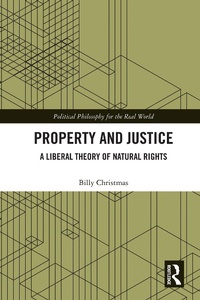
Property and Justice
A Liberal Theory of Natural Rights
1st Edition
Published on 29. March 2021
194 pages
978-1-000-37006-5 (ISBN)
Description

This book gives an account of a full spectrum of property rights and their relationship to individual liberty. It shows that a purely deontological approach to justice can deal with the most complex questions regarding the property system. Moreover, the author considers the economic, ecological, and technological complexities of our real-world property systems. The result is a more conceptually sound account of natural rights and the property system they demand.
If we think that liberty should be at the centre of justice, what does that mean for the property system? Economists and lawyers widely agree that a property system must be composed of many different types of property: the kind of private ownership one has over one's person and immediate possessions, as well as the kinds of common ownership we each have in our local streets, as well as many more. However, theories of property and justice have not given anything approaching an adequate account of the relationship between liberty and any other form of property other than private ownership. It is often thought that a basic commitment to liberty cannot really tell us how to arrange the major complexities of the property system, which diverge from simple private ownership.
Property and Justice demonstrates how philosophical rigour coupled with interdisciplinary engagement enables us to think clearly about how to deal with real-world problems. It will be of interest to political philosophers, political theorists, and legal theorists working on property rights and justice.
If we think that liberty should be at the centre of justice, what does that mean for the property system? Economists and lawyers widely agree that a property system must be composed of many different types of property: the kind of private ownership one has over one's person and immediate possessions, as well as the kinds of common ownership we each have in our local streets, as well as many more. However, theories of property and justice have not given anything approaching an adequate account of the relationship between liberty and any other form of property other than private ownership. It is often thought that a basic commitment to liberty cannot really tell us how to arrange the major complexities of the property system, which diverge from simple private ownership.
Property and Justice demonstrates how philosophical rigour coupled with interdisciplinary engagement enables us to think clearly about how to deal with real-world problems. It will be of interest to political philosophers, political theorists, and legal theorists working on property rights and justice.
Reviews / Votes
"Property is arguably the foundational issue in legal and political philosophy. Billy Christmas insightfully illuminates this foundational issue by elaborating a radical liberal-libertarian-theory of property. This provocative book will surely spur controversy and deepen understanding by showing how a libertarian account of property rights can address the perennial concerns of libertarianism's critics while grounding robust safeguards for autonomy and flourishing." - Gary Chartier, La Sierra University, USA"This book is the first serious attempt to combine a right-libertarian theory of individual private property with a solid theory of other forms of property, such as collective, public, and common property. It makes for a much more plausible and humane theory of property." - Karl Widerquist, Georgetown University-Qatar
More details
Series
Edition
1. Auflage
Language
English
Place of publication
London
United Kingdom
Publishing group
Taylor & Francis Ltd
Target group
College/higher education
ISBN-13
978-1-000-37006-5 (9781000370065)
Copyright in bibliographic data and cover images is held by Nielsen Book Services Limited or by the publishers or by their respective licensors: all rights reserved.
Schweitzer Classification
Other editions
Additional editions
Book
05/2023
1st Edition
Routledge
€62.70
Shipment within 15-20 days
Book
04/2021
Routledge
Unfortunately, price unknown
Available (delivery time upon request)
Book
03/2021
1st Edition
Routledge
€206.10
Shipment within 15-20 days
Person
Billy Christmas is a Lecturer in Political Theory at King's College London in the Department of Political Economy, where he is also the PPE Programme Director. As a philosopher his research interests lie in Rights, Property, and Political Authority. He has previously published articles in journals such as The Journal of Politics, Economics and Philosophy, and The Philosophical Quarterly
Content
Introduction 1
Property and Justice 1
Original Acquisition: Connecting Property to Personhood 3
Beyond Private Property 5
Natural Rights and Social Conventions 8
The Not-So-Minimum Content of Natural Rights 9
The Theory 11
1 The Form of Justice 16
Introduction 16
The Circumstances of Justice and Deontology 17
Individual Rights 22
Compossibility 24
Conclusion 32
2 The Substance of Justice 37
Introduction 37
The Right to Non-Interference in Our Non-Interfering Actions 37
The One and Only Right 43
Kinds of Interference 45
Self-Ownership 48
Necessity 51
Conclusion 54
3 Original Acquisition 59
Introduction 59
Use, Exclusion, and Ownership 60
Extended Activity 68
Contra Labour-Mixing 73
Abandonment and Transfer 77
Conclusion 81
4 The Commons 87
Introduction 87
Liberty and Property After Ostrom 88
Public Property 94
Collective Property 95
Conclusion 99
5 The Limits to Appropriation 103
Introduction 103
Necessity, Revisited 103
Against Engrossment 107
Against Intellectual Property 109
Intellectual Property as Ownership of Ideas 109
Intellectual Property as Usufruct 111
Conclusion 114
6 Against the Proviso 118
Introduction 118
Nozick's Proviso 119
The Egalitarian Proviso 126
Internal Accounts of the Provisos 129
Conclusion 131
7 Intentions and Conventions 135
Introduction 135
Intentions: Public and Private 136
Conventions: Constitutive and Regulative 145
Natural Rights and Social Change 152
Conclusion 155
Conclusion: Natural Rights and Liberal Politics 158
Property and Justice 1
Original Acquisition: Connecting Property to Personhood 3
Beyond Private Property 5
Natural Rights and Social Conventions 8
The Not-So-Minimum Content of Natural Rights 9
The Theory 11
1 The Form of Justice 16
Introduction 16
The Circumstances of Justice and Deontology 17
Individual Rights 22
Compossibility 24
Conclusion 32
2 The Substance of Justice 37
Introduction 37
The Right to Non-Interference in Our Non-Interfering Actions 37
The One and Only Right 43
Kinds of Interference 45
Self-Ownership 48
Necessity 51
Conclusion 54
3 Original Acquisition 59
Introduction 59
Use, Exclusion, and Ownership 60
Extended Activity 68
Contra Labour-Mixing 73
Abandonment and Transfer 77
Conclusion 81
4 The Commons 87
Introduction 87
Liberty and Property After Ostrom 88
Public Property 94
Collective Property 95
Conclusion 99
5 The Limits to Appropriation 103
Introduction 103
Necessity, Revisited 103
Against Engrossment 107
Against Intellectual Property 109
Intellectual Property as Ownership of Ideas 109
Intellectual Property as Usufruct 111
Conclusion 114
6 Against the Proviso 118
Introduction 118
Nozick's Proviso 119
The Egalitarian Proviso 126
Internal Accounts of the Provisos 129
Conclusion 131
7 Intentions and Conventions 135
Introduction 135
Intentions: Public and Private 136
Conventions: Constitutive and Regulative 145
Natural Rights and Social Change 152
Conclusion 155
Conclusion: Natural Rights and Liberal Politics 158
