

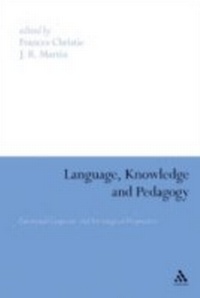
Language, Knowledge and Pedagogy
Functional Linguistic and Sociological Perspectives
1st Edition
Published on 1. February 2009
282 pages
978-1-4411-3119-5 (ISBN)
Description

This book explores the nature of knowledge, language and pedagogy from the perspective of two complementary theories: systemic functional linguistics, and Bernstein-inspired sociology. Bernstein's sociology of knowledge makes a distinction between horizontal and vertical discourses as ways in which knowledge is transmitted in institutional settings, with teachers as agents of symbolic control.
Systemic functional linguists have explored educational discourse according to similar hierarchies, and by bringing the two perspectives together this book shows the impact of language on knowledge and pedagogy. The contributors examine the different structures of knowledge and the flow of information within the school context, but also according to language in early childhood, literacy, English, the social sciences, science and mathematics. The result is a progressive and dynamic analysis of knowledge structures at work in educational institutions.
Language, Knowledge and Pedagogy makes a major contribution to linguistics, applied linguistics and educational theory. It will be of interest to researchers working in these areas.
Systemic functional linguists have explored educational discourse according to similar hierarchies, and by bringing the two perspectives together this book shows the impact of language on knowledge and pedagogy. The contributors examine the different structures of knowledge and the flow of information within the school context, but also according to language in early childhood, literacy, English, the social sciences, science and mathematics. The result is a progressive and dynamic analysis of knowledge structures at work in educational institutions.
Language, Knowledge and Pedagogy makes a major contribution to linguistics, applied linguistics and educational theory. It will be of interest to researchers working in these areas.
Reviews / Votes
"This volume is worthy of attention because its contributors are leading scholars in the traditions of SFL and Bernstein's sociology, developing the ideas and applications further, expanding their descriptive and explanatory potential. The resulting "assuredness" with which the book reads, and the dialogic structuring of the chapters (there is a strong sense of progression throughout), assist the reader with its quite complex ideas and arguments. So too does its emphasis on application of theory to the empirical issues. "The book makes a valuable contribution to the fields of education and applied linguistics. It undoes the oppositional tendencies of terms such as "everyday" and "commonsense", and offers instead more useful ways of thinking about different bodies of knowledge and the forms of discourse favoured by them. The applications to disciplinary knowledge make its international address clear. In the Australian educational context, this is a particularly timely volume for two reasons. It is critical preparatory reading for the reappraisal of official curriculum that must come with the move to national curriculum and national testing regimes. It also provides salutary warning of the problems of integrating curriculum currently evident in pedagogic trends such as "rich tasks" and "connected outcomes groups". "This book is a valuable resource for teacher educators, curriculum developers and policy makers concerned with rigorously informed curriculum and pedagogy. Researchers of language and education too will continue to reap benefits from what Jim Martin describes as "the negotiation of ideas initiated by Bernstein, Halliday and Hasan into a second generation of research" (p. 239)." - Australian Review of Applied Linguistics "The contributors to this collection, generally experts in either Bernstein's sociology of knowledge or Halliday's systemic functional linguistics achieve a commendable degree of coherence: the volume has the dynamic feel of a deep and genuine dialogue...the book is valuable and challenging. It helped me to think about much of my own work." Applied Linguistics 31/1: 156-168, 2009More details
Edition
1. Auflage
Language
English
Place of publication
New York
United States
Target group
Professional and scholarly
ISBN-13
978-1-4411-3119-5 (9781441131195)
Copyright in bibliographic data and cover images is held by Nielsen Book Services Limited or by the publishers or by their respective licensors: all rights reserved.
Schweitzer Classification
Other editions
Additional editions
Frances Christie | Frances Christie | J. R. Martin
Language, Knowledge and Pedagogy
Functional Linguistic and Sociological Perspectives
Book
02/2009
Continuum International Publishing Group Ltd.
€84.00
Shipment within 3-4 weeks
Persons
Frances Christie is Emeritus Professor of Language and Literacy Education at the University of Melbourne, Australia and Honorary Professor at the University of Sydney, Australia.
Frances Christie is Emeritus Professor of Language and Literacy Education at the University of Melbourne, Australia and Honorary Professor at the University of Sydney, Australia.
J. R. Martin is Professor of Linguistics at the University of Sydney, Australia. The Martin Centre for Appliable Linguistics was opened by Shanghai Jiao Tong University in 2014.
Frances Christie is Emeritus Professor of Language and Literacy Education at the University of Melbourne, Australia and Honorary Professor at the University of Sydney, Australia.
J. R. Martin is Professor of Linguistics at the University of Sydney, Australia. The Martin Centre for Appliable Linguistics was opened by Shanghai Jiao Tong University in 2014.
Content
Part I: Functional Linguistic and Sociological Perspectives on Education
1. The dialogue between functional linguistics and sociology, Frances Christie (University of Melbourne, University of Sydney, Australia)
Part II: Theoretical Foundations
2. Bernstein's codes, devices and knowledge structures, Karl Maton and Johan Muller (University of Wollongong, Australia and University of Cape Town, South Africa)
3. Kinds of knowledge: A functional linguistic perpsective, J. R. Martin, (University of Sydney, Australia)
Part III: Knowledge Structure: Horizontal and Vertical Discourse
4. The nub of knowledge, Johan Muller (University of Cape Town, South Africa)
5. Accessing knowledge structures , Karl Maton (University of Sydney, Australia)
6. Canons and the basis of hierarchical knowledge structures, Robert Moore (University of Cambridge, UK)
Part IV: Fields of Discourse - Disciplines of Discourse
7. Language for learning in early childhood, Claire Painter (University of New South Wales, Australia)
8. Literacy, segmented pedagogy and vertical discourse, Geoff Williams (University College London)
9. Forms of knowledge in subject English, Frances Christie and Mary Macken-Horarik (University of Canberra, Australia and University of Melbourne, University of Sydney, Australia
10. Vertical and horizontal discourse and the social sciences, Peter Wignell (Charles Darwin University, Australia)
11. Science, mathematics and multimodal grammaticality, Kay O'Halloran (National University, Singapore) Part IV: Research Prospects - Exploring Uncommon Sense
12. Future directions in research in knowledge structure, Frances Christie, J. R. Martin, Mary Maton and Johan Muller (University of Melbourne, University of Sydney, Australia and University of Cape Town, South Africa)
1. The dialogue between functional linguistics and sociology, Frances Christie (University of Melbourne, University of Sydney, Australia)
Part II: Theoretical Foundations
2. Bernstein's codes, devices and knowledge structures, Karl Maton and Johan Muller (University of Wollongong, Australia and University of Cape Town, South Africa)
3. Kinds of knowledge: A functional linguistic perpsective, J. R. Martin, (University of Sydney, Australia)
Part III: Knowledge Structure: Horizontal and Vertical Discourse
4. The nub of knowledge, Johan Muller (University of Cape Town, South Africa)
5. Accessing knowledge structures , Karl Maton (University of Sydney, Australia)
6. Canons and the basis of hierarchical knowledge structures, Robert Moore (University of Cambridge, UK)
Part IV: Fields of Discourse - Disciplines of Discourse
7. Language for learning in early childhood, Claire Painter (University of New South Wales, Australia)
8. Literacy, segmented pedagogy and vertical discourse, Geoff Williams (University College London)
9. Forms of knowledge in subject English, Frances Christie and Mary Macken-Horarik (University of Canberra, Australia and University of Melbourne, University of Sydney, Australia
10. Vertical and horizontal discourse and the social sciences, Peter Wignell (Charles Darwin University, Australia)
11. Science, mathematics and multimodal grammaticality, Kay O'Halloran (National University, Singapore) Part IV: Research Prospects - Exploring Uncommon Sense
12. Future directions in research in knowledge structure, Frances Christie, J. R. Martin, Mary Maton and Johan Muller (University of Melbourne, University of Sydney, Australia and University of Cape Town, South Africa)
