

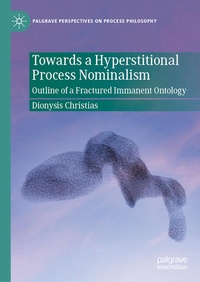
Towards a Hyperstitional Process Nominalism
Description

This book offers a new understanding of naturalism and normativity by integrating them within a process metaphysics framework. Rejecting all forms of transcendence, Dionysis Christias advances a conception of 'fractured immanence' in which mind and nature are not ontologically distinct regions of being (they are both ways of being processes) yet diverge in the order of understanding, a tension enabling their ongoing self-correcting interplay as concepts without presupposing transcendence or complete mutual transparency. Drawing on Deleuze, Sellars and Peirce, the book replaces substance metaphysics with an anti-representational, univocal process ontology which throws light on core problems in contemporary analytic metaphysics of powers and emergence. Normativity is embedded in this naturalistic process framework by being understood as an emergent intensive regime whose function is hyperstitional: it stabilizes and projects ideal possible worlds expressed by unactualized universals, and performatively makes them actual over time by collectively treating them as real.
Reviews / Votes
"Towards a Hyperstitional Process Nominalism is a striking work of philosophical synthesis, guided by a profound fidelity to Sellars's vision of a truly "stereoscopic view of man in the world." Drawing with equal fluency on themes from the analytic and continental traditions, Christias delivers not only a major contribution to Sellarsian scholarship but also a bold step toward bridging the long-entrenched divides within philosophy itself." (Daniel Sacilotto, Faculty, California Institute of the Arts, USA)
More details
Other editions
Additional editions
Person
Dionysis Christias is Research Associate Professor of Philosophy of Language at the Academy of Athens, Greece. He previously published the book entitled Normativity, Lifeworld and Science in Sellars' Synoptic Vision (2023, Palgrave Macmillan).
Content
Chapter 1. Introduction.- Part I Immanence, Metaphysics and Givenness.- Chapter 2. Part I Immanence, Metaphysics and Givenness.- Chapter 3. Immanence without Givenness.- Part II Outline of a Fractured Immanent Ontology.- Chaper 4. Toward a Process Nominalist Ontology.- Chapter 5. Nominalism, Emergence and Process.- Chapter 6. A Novel Account of Grounding.- Part III Normative Spaces, Hyperstition and Process.- Chapter 7. Norms and Facts as Fractured Projections of Processual Reality.- Chapter 8. Normativity as a Hyperstitional Dynamic Regime.- Part IV Freedom and Politics in an Immanently Fractured World.- Chapter 9. Fractured Freedom and the Emancipatory Force of Universals.- Chapter 10. The Politics of Fractured Immanence.
