

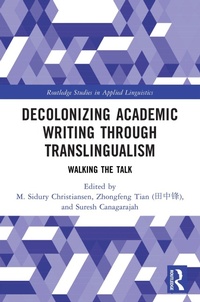
Decolonizing Academic Writing through Translingualism
Walking the Talk
Published on 30. September 2025
240 pages
978-1-040-39362-8 (ISBN)
Description

This collection explores innovative ways to embody translingual practices in academic writing, showcasing how multilingual authors can effectively leverage their linguistic resources in research and publication. Recognizing that traditional academic writing often suppresses multilingual voices, this book advocates for a decolonized approach that embraces diverse linguistic expressions and knowledge representations for social change.
This volume features perspectives from scholars across various disciplines and linguistic backgrounds presenting their unique visions of discursive, rhetorical, and linguistic diversity in academic writing. Each chapter showcases its respective author's critical reflections on their language choices. This book offers a counterpoint to existing literature by making the case for the register known as "academic English" as a form both open to change and possible for accommodating diversity, empowering scholars to negotiate the register's norms around their own languages and establish spaces for their own unique voices and identities.
This book serves as a valuable resource for graduate students, faculty, and scholars interested in academic writing, TESOL, composition studies, language teaching and learning, and applied linguistics.
This volume features perspectives from scholars across various disciplines and linguistic backgrounds presenting their unique visions of discursive, rhetorical, and linguistic diversity in academic writing. Each chapter showcases its respective author's critical reflections on their language choices. This book offers a counterpoint to existing literature by making the case for the register known as "academic English" as a form both open to change and possible for accommodating diversity, empowering scholars to negotiate the register's norms around their own languages and establish spaces for their own unique voices and identities.
This book serves as a valuable resource for graduate students, faculty, and scholars interested in academic writing, TESOL, composition studies, language teaching and learning, and applied linguistics.
More details
Series
Language
English
Place of publication
London
United Kingdom
Publishing group
Taylor & Francis Ltd
Target group
College/higher education
Illustrations
1 Tables, black and white; 13 Line drawings, black and white; 6 Halftones, black and white; 19 Illustrations, black and white
File size
3,70 MB
ISBN-13
978-1-040-39362-8 (9781040393628)
Copyright in bibliographic data and cover images is held by Nielsen Book Services Limited or by the publishers or by their respective licensors: all rights reserved.
Schweitzer Classification
Other editions
Additional editions
M. Sidury Christiansen | Zhongfeng Tian (???) | Suresh Canagarajah
Decolonizing Academic Writing through Translingualism
Walking the Talk
Book
09/2025
1st Edition
Routledge
€206.40
Shipment within 10-20 days
Persons
M. Sidury Christiansen is Professor of TESOL/Applied Linguistics at the University of Texas at San Antonio, USA.
Zhongfeng Tian (???) is Associate Professor of Bilingual Education at Rutgers University-Newark, USA.
Suresh Canagarajah is the Evan Pugh University Professor of Applied Linguistics, English, and Asian Studies at the Pennsylvania State University, USA.
Zhongfeng Tian (???) is Associate Professor of Bilingual Education at Rutgers University-Newark, USA.
Suresh Canagarajah is the Evan Pugh University Professor of Applied Linguistics, English, and Asian Studies at the Pennsylvania State University, USA.
Content
List of Contributors
Foreword (Angel Lin)
Introduction (M. Sidury Christiansen, Zhongfeng Tian, & Suresh Canagarajah)
Part 1: Introspections and Personal Insights
1. Catalyzing Academic Writing through the Poetics of Sensuality, Surrogacy, and Consumption: A Surrogate Eater autohistoria-teoria from a Chicana graduate student perspective (Jennifer Yanez-Alaniz)
2. Sa isip, sa salita, at sa gawa? A Plurilingual Graduate Student's De/Colonial Autoethnographic Pagninilay on Translingual Academic Writing (John Wayne N. dela Cruz)
3. Inosans Jan Nwe: Unmasking the Decolonizing Tensions of Translingualism (Patriann Smith)
Part 2: Conceptual and Theoretical Explorations
4. Translanguaging as a Hermeneutics of Empathy :????? (Amir Kalan)
5. Restoring Poetics to Scholarship by/Rendering it in Ancient Code-Meshed Poetry/Staves Fff the Tamil Thirst/for Homeland (Vyshali Manivannan)
6. Decolonizing Academic Production through Multimodal and Translinguistic Resources in Latin America (Lorena Cordova-Hernandez, Jorge Valtierra-Zamudio, Mario E. Lopez-Gopar, Vilma Huerta Cordova)
Part 3: Multilingual Narratives: Reporting Research beyond Academic Norms
7. Translingual Perspectives in Decolonizing Researcher Subjectivity: Reinterpreting Subjectivity Reconstitution of Chinese Immigrants in Canada (Qinghua Chen)
8. Creando Culturas de Paz: Language, Higher Education, and the Embajador Journey of a Displaced Syrian Student in Mexico (Brenda Sarmiento Quezada)
9. Decolonising Academic Writing through Mongolian Nomadic Cosmology: ????? ?????? ?????? ???? ????? (Sender Dovchin)
10. World Languages for Specific Purposes, Radical Kinship, and Translanguaging: Reflections on Teaching and Learning in Medical Spanish (Stephanie Brock Gonzalez, Glenn A. Martinez)
Index
Foreword (Angel Lin)
Introduction (M. Sidury Christiansen, Zhongfeng Tian, & Suresh Canagarajah)
Part 1: Introspections and Personal Insights
1. Catalyzing Academic Writing through the Poetics of Sensuality, Surrogacy, and Consumption: A Surrogate Eater autohistoria-teoria from a Chicana graduate student perspective (Jennifer Yanez-Alaniz)
2. Sa isip, sa salita, at sa gawa? A Plurilingual Graduate Student's De/Colonial Autoethnographic Pagninilay on Translingual Academic Writing (John Wayne N. dela Cruz)
3. Inosans Jan Nwe: Unmasking the Decolonizing Tensions of Translingualism (Patriann Smith)
Part 2: Conceptual and Theoretical Explorations
4. Translanguaging as a Hermeneutics of Empathy :????? (Amir Kalan)
5. Restoring Poetics to Scholarship by/Rendering it in Ancient Code-Meshed Poetry/Staves Fff the Tamil Thirst/for Homeland (Vyshali Manivannan)
6. Decolonizing Academic Production through Multimodal and Translinguistic Resources in Latin America (Lorena Cordova-Hernandez, Jorge Valtierra-Zamudio, Mario E. Lopez-Gopar, Vilma Huerta Cordova)
Part 3: Multilingual Narratives: Reporting Research beyond Academic Norms
7. Translingual Perspectives in Decolonizing Researcher Subjectivity: Reinterpreting Subjectivity Reconstitution of Chinese Immigrants in Canada (Qinghua Chen)
8. Creando Culturas de Paz: Language, Higher Education, and the Embajador Journey of a Displaced Syrian Student in Mexico (Brenda Sarmiento Quezada)
9. Decolonising Academic Writing through Mongolian Nomadic Cosmology: ????? ?????? ?????? ???? ????? (Sender Dovchin)
10. World Languages for Specific Purposes, Radical Kinship, and Translanguaging: Reflections on Teaching and Learning in Medical Spanish (Stephanie Brock Gonzalez, Glenn A. Martinez)
Index
