

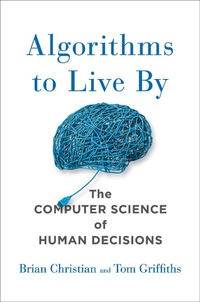
Algorithms to Live By
Description

An exploration of how computer algorithms can be applied to our everyday lives to solve common decision-making problems and illuminate the workings of the human mind.
What should we do, or leave undone, in a day or a lifetime? How much messiness should we accept? What balance of the new and familiar is the most fulfilling? These may seem like uniquely human quandaries, but they are not. Computers, like us, confront limited space and time, so computer scientists have been grappling with similar problems for decades. And the solutions they've found have much to teach us.
In a dazzlingly interdisciplinary work, Brian Christian and Tom Griffiths show how algorithms developed for computers also untangle very human questions. They explain how to have better hunches and when to leave things to chance, how to deal with overwhelming choices and how best to connect with others. From finding a spouse to finding a parking spot, from organizing one's inbox to peering into the future, Algorithms to Live By transforms the wisdom of computer science into strategies for human living.
More details
Other editions
Additional editions
Persons
Brian Christian is the author of The Most Human Human, a Wall Street Journal bestseller, New York Times editors' choice, and a New Yorker favorite book of the year. His writing has appeared in The New Yorker, The Atlantic, Wired, The Wall Street Journal, The Guardian, and The Paris Review, as well as in scientific journals such as Cognitive Science, and has been translated into eleven languages. He lives in San Francisco.
Tom Griffiths is a professor of psychology and cognitive science at UC Berkeley, where he directs the Computational Cognitive Science Lab. He has published more than 150 scientific papers on topics ranging from cognitive psychology to cultural evolution, and has received awards from the National Science Foundation, the Sloan Foundation, the American Psychological Association, and the Psychonomic Society, among others. He lives in Berkeley.
Content
Contents
Introduction
Algorithms to Live By
1 Optimal Stopping
When to Stop Looking
2 Explore/Exploit
Th e Latest vs. the Greatest
3 Sorting
Making Order
4 Caching
Forget About It
5 Scheduling
First Things First
6 Bayes's Rule
Predicting the Future
7 Overfitting
When to Think Less
8 Relaxation
Let It Slide
9 Randomness
When to Leave It to Chance
10 Networking
How We Connect
11 Game Theory
The Minds of Others
Conclusion
Computational Kindness
Notes
Bibliography
Acknowledgments
Index
