

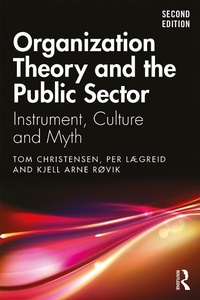
Organization Theory and the Public Sector
Instrument, Culture and Myth
2nd Edition
Published on 11. March 2020
220 pages
978-1-000-03995-5 (ISBN)
Description

Public-sector organizations are fundamentally different from their private-sector counterparts. They are part of the society's political organizations and are major political actors. They are multifunctional, follow a political leadership and the majority do not operate in an external market. In an era of rapid reform, reorganization and modernization of the public sector, this book offers a timely and illuminating introduction to the public-sector organization that recognizes its unique values, interests, knowledge and power base.
Drawing on both instrumental and institutional perspectives within organization theory, as well as democratic theory and empirical studies of decision-making, the book addresses five central aspects of the public-sector organization:
? goals, values and motivation
? leadership and steering
? reform and change
? effects, learning and implications
? understanding and design
The book challenges conventional economic analysis of the public sector, arguing instead for a political-democratic approach and a new prescriptive organization theory. A rich resource of both theory and practice, Organization Theory and the Public Sector: Instrument, Culture and Myth is essential reading for anybody studying the public sector.
This second edition of the book contains a range of new and updated themes, examples and references.
Drawing on both instrumental and institutional perspectives within organization theory, as well as democratic theory and empirical studies of decision-making, the book addresses five central aspects of the public-sector organization:
? goals, values and motivation
? leadership and steering
? reform and change
? effects, learning and implications
? understanding and design
The book challenges conventional economic analysis of the public sector, arguing instead for a political-democratic approach and a new prescriptive organization theory. A rich resource of both theory and practice, Organization Theory and the Public Sector: Instrument, Culture and Myth is essential reading for anybody studying the public sector.
This second edition of the book contains a range of new and updated themes, examples and references.
Reviews / Votes
"Students of the public sector often forget that governments are composed of organizations, and that to understand governing we also need to understand how organizations function. This book is a welcome antidote to thinking about government in only individualistic or economic terms. Christensen, Laegreid and Rovik help us understand better the complex and subtle interactions within and among organizations in the public sector, and provide very useful perspective on governing."Professor B. Guy Peters, Maurice Falk Professor of American Government, University of Pittsburgh
"Christensen, Laegreid and Rovik convincingly demonstrate that insights from organization theories provide an indispensable basis for understanding the complex organization of states. Furthermore, by their rich analysis of problems, dilemmas and solutions in public organizations, they illustrate that the study of state organization is vital for developing organization theory."
Professor Nils Brunsson, Professor of Management, Uppsala University and Score
"Complex societies require a complex set of organizations. This book unpacks the complexity and hybridity of organizations by looking at their instrumental, cultural, and mythical side. When public sector organizations become part of societal solutions, this book becomes part of how to understand and develop organizations that will solve our problems."
Professor Geert Bouckaert, KU Leuven Public Governance Institute
More details
Edition
2nd edition
Language
English
Place of publication
London
United Kingdom
Publishing group
Taylor & Francis Ltd
Target group
College/higher education
Professional and scholarly
Product notice
Reflowable
Illustrations
7 Tables, black and white
ISBN-13
978-1-000-03995-5 (9781000039955)
Copyright in bibliographic data and cover images is held by Nielsen Book Services Limited or by the publishers or by their respective licensors: all rights reserved.
Schweitzer Classification
Other editions
Additional editions
Tom Christensen | Per Laegreid | Kjell Arne Rovik
Organization Theory and the Public Sector
Instrument, Culture and Myth
Book
03/2020
2nd Edition
Routledge
€179.51
Shipment within 15-20 days
Tom Christensen | Per Laegreid | Kjell Arne Rovik
Organization Theory and the Public Sector
Instrument, Culture and Myth
Book
03/2020
2nd Edition
Routledge
€60.10
Shipment within 15-20 days
Persons
Tom Christensen is Professor of Public Administration and Policy in the Department of Political Science, University of Oslo, Norway. He is also Visiting Professor at the School of Public Administration and Policy, Renmin University of China, and Distinguished Visiting Professor at the School of Public Policy and Management at Tsinghua University.
Per Laegreid is Professor Emeritus in the Department of Administration and Organization Theory at the University of Bergen, Norway.
Kjell Arne Rovik is Professor of Organization Theory in the Department of Social Sciences, UiT The Arctic University of Norway.
Per Laegreid is Professor Emeritus in the Department of Administration and Organization Theory at the University of Bergen, Norway.
Kjell Arne Rovik is Professor of Organization Theory in the Department of Social Sciences, UiT The Arctic University of Norway.
Content
1 Organization theory for the public sector
2 An instrumental perspective
3 A cultural perspective
4 A myth perspective
5 Goals, values and motivation
6 Leadership and steering
7 Reform and change
8 Effects, learning and implications
9 Understanding and design
Index
2 An instrumental perspective
3 A cultural perspective
4 A myth perspective
5 Goals, values and motivation
6 Leadership and steering
7 Reform and change
8 Effects, learning and implications
9 Understanding and design
Index
