

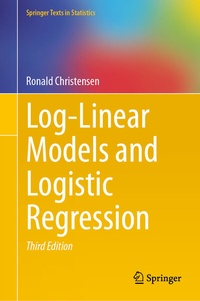
Log-Linear Models and Logistic Regression
Description

This book examines statistical models for frequency data. The primary focus is on log-linear models for contingency tables but also includes extensive discussion of logistic regression. Topics such as logistic discrimination, generalized linear models, and correspondence analysis are also explored.
The treatment is designed for readers with prior knowledge of analysis of variance and regression. It builds upon the relationships between these basic models for continuous data and the analogous log-linear and logistic regression models for discrete data. While emphasizing similarities between methods for discrete and continuous data, this book also carefully examines the differences in model interpretations and evaluation that occur due to the discrete nature of the data. Numerous data sets from fields as diverse as engineering, education, sociology, and medicine are used to illustrate procedures and provide exercises. A major addition to the third edition is the availability of a companion online manual providing R code for the procedures illustrated in the book .
The book begins with an extensive discussion of odds and odds ratios as well as concrete illustrations of basic independence models for contingency tables. After developing a sound applied and theoretical basis for frequency models analogous to ANOVA and regression, the book presents, for contingency tables, detailed discussions of the use of graphical models, of model selection procedures, and of models with quantitative factors. It then explores generalized linear models, after which all the fundamental results are reexamined using powerful matrix methods. The book then gives an extensive treatment of Bayesian procedures for analyzing logistic regression and other regression models for binomial data. Bayesian methods are conceptually simple and unlike traditional methods allow accurate conclusions to be drawn without requiring large sample sizes. The book concludes with two new chapters: one on exact conditional tests for small sample sizes and another on the graphical procedure known as correspondence analysis.
More details
Other editions
Additional editions
Person
Ronald Christensen is a Distinguished Professor of Statistics at the University of New Mexico.
He is well known for his work on the theory and application of statistical models having linear structure.
In addition to numerous technical articles, he is the author of Plane Answers to Complex Questions: The Theory of Linear Models ; Advanced Linear Modeling: Statistical Learning and Dependent Data ; Analysis of Variance, Design, and Regression: Linear Modeling for Unbalanced Data and coauthor of Bayesian Ideas and Data Analysis: An Introduction for Scientists and Statisticians .
Dr. Christensen is a fellow of the American Statistical Association (ASA) and the Institute of Mathematical Statistics. His is a past editor of The American Statistician and a past chair of the ASA's Section on Bayesian Statistical Science.
