

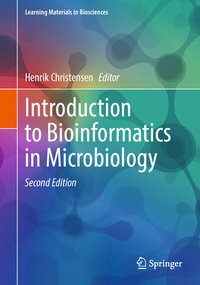
Introduction to Bioinformatics in Microbiology
Description

This updated and extended second edition of the textbook introduces the basic concepts of bioinformatics and enhances students' skills in the use of software and tools relevant to microbiology research. It discusses the most relevant methods for analysing data and teaches readers how to draw valid conclusions from the observations obtained. Free software and servers available on the Internet are presented in an updated version of 2023 and more advanced stand-alone software is proposed as a second option. In addition, new tools for microbial genome analysis and new flowcharts that complement the didactic elements have been added. Exercises and training questionnaires are included at the end of each chapter to facilitate learning.
The book is aimed at Ph.D. students and advanced undergraduate students in microbiology, biotechnology, and (veterinary) medicine with little or basic knowledge of bioinformatics.
More details
Other editions
Additional editions
Previous edition

Person
Henrik Christensen (MSc, Ph.D., DVSc) is an Associate Professor specializing in population genomics and bioinformatics at the Department of Veterinary Animal Science, University of Copenhagen. He investigates the transmission of opportunistic pathogens, including serotype prediction, and studies the taxonomy of members of Pasteurellaceae. He is in charge of a Ph.D. course in bioinformatics focusing on microbiology with ad hoc expertise in the analysis of avian pathogenic Escherichia coli.
Content
1. Introduction.- 2. DNA sequence asssembly and annotation of genes.- 3. Databases and protein structures.- 4. Pairwise alignment, multiple alignment and BLAST.- 5. Primer design.- 6. Introduction to phylogenetic analysis of molecular sequence data.- 7. Sequence based classification and identification.- 8. 16S rRNA amplicon sequencing.- 9. Full shot-gun DNA metagenomics.- 10. Transcriptomics.- 11. Sequenced based typing and prediction of function.
