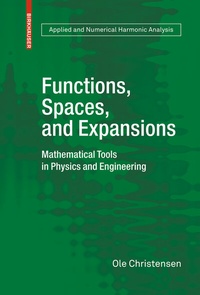
Functions, Spaces, and Expansions
Description

This graduate-level textbook is a detailed exposition of key mathematical tools in analysis aimed at students, researchers, and practitioners across science and engineering. Every topic covered has been specifically chosen because it plays a key role outside the field of pure mathematics. Although the treatment of each topic is mathematical in nature, and concrete applications are not delineated, the principles and tools presented are fundamental to exploring the computational aspects of physics and engineering. A central theme of the book is the structure of various vector spaces-most importantly, Hilbert spaces-and expansions of elements in these spaces in terms of bases.
Key topics and features include:
* More than 150 exercises
* Abstract and normed vector spaces
* Approximation in normed vector spaces
* Hilbert and Banach spaces
* General bases and orthonormal bases
* Linear operators on various normed spaces
* The Fourier transform, including the discrete Fourier transform
* Wavelets and multiresolution analysis
* B-splines
* Sturm-Liouville problems
As a textbook that provides a deep understanding of central issues in mathematical analysis, Functions, Spaces, and Expansions is intended for graduate students, researchers, and practitioners in applied mathematics, physics, and engineering. Readers are expected to have a solid understanding of linear algebra, in Rn and in general vector spaces. Familiarity with the basic concepts of calculus and real analysis, including Riemann integrals and infinite series of real or complex numbers, is also required.
Functions, Spaces, and Expansions is the main textbook for the e-course Mathematics 4: Real Analysis currently being taught at the Technical University of Denmark. Please click the "Course Materials" link on the right to access videos of the lectures, problem sheets, and solutions to selected exercises.
Reviews / Votes
From the reviews:
"This textbook presents basic mathematical tools of computational harmonic analysis for students of applied mathematics, physics and engineering and presupposes only mild knowledge from linear algebra, calculus and real analysis. . This book is carefully written and surely provides a rewarding read for the intended audience. It also contains a number of well selected exercises at the end of each chapter." (R. Steinbauer, Monatshefte für Mathematik, Vol. 169 (1), January, 2013)
"This textbook aims at representing the mathematical tools of computational harmonic and Fourier analysis in a form that is suitable for students in applied mathematics, physics and engineering. . The book is beautifully written. It contains also a lot of suitable exercises at the end of each section." (Gerlind Plonka-Hoch, Zentralblatt MATH, Vol. 1231, 2012)
"This book is . aimed at students of applied mathematics and engineering. . it is clearly written and it does providea useful summary of the basic properties of the tools it covers. It does a good job of explaining the difference in the various function spaces. It has detailed coverage of wavelets and the related subjects of B-splines and multiresolution analysis, although still without applications." (Allen Stenger, The Mathematical Association of America, December, 2010)
More details
Other editions
Additional editions