

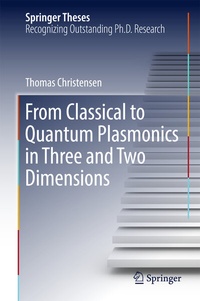
From Classical to Quantum Plasmonics in Three and Two Dimensions
Published on 11. January 2017
XX, 181 pages
978-3-319-48562-1 (ISBN)
Description

This thesis provides a comprehensive introduction to two active research directions within the field of plasmonics: (i) nonclassical, or quantum, aspects of the plasmonic response; and (ii) two-dimensional plasmonics, a recent innovation in the field stimulated by the advent of two-dimensional materials. It discusses the fundamentals of this field in detail, and explores several current research directions.
Nonclassical plasmonics has been spurred on in recent years by the tremendous technological progress in nanofabrication and optical characterization; today, it is possible to investigate the plasmonic features of nanostructures with characteristic features in the few nanometer range. The book describes and analyzes the breakdown of the classical theory under these conditions and explores several alternatives and extensions. The unique electronic and dimensional features of novel two-dimensional materials, such as graphene, lie at the coreof plasmonics' most rapidly developing subfield; two-dimensional plasmonics. This thesis provides a clear and comprehensive exposition of the central features for interested researchers looking for an entry point to this riveting area.
Nonclassical plasmonics has been spurred on in recent years by the tremendous technological progress in nanofabrication and optical characterization; today, it is possible to investigate the plasmonic features of nanostructures with characteristic features in the few nanometer range. The book describes and analyzes the breakdown of the classical theory under these conditions and explores several alternatives and extensions. The unique electronic and dimensional features of novel two-dimensional materials, such as graphene, lie at the coreof plasmonics' most rapidly developing subfield; two-dimensional plasmonics. This thesis provides a clear and comprehensive exposition of the central features for interested researchers looking for an entry point to this riveting area.
Reviews / Votes
"The thesis consists of two parts, six chapters and five appendices. . The contents of the thesis will be interesting for researches in several branches of modern physics, for university lecturers and postgraduate students." (Yulianna Perepelkina, zbMATH, Vol. 1366.82002, 2017)More details
Series
Edition
1st ed. 2017
Language
English
Place of publication
Cham
Switzerland
Publishing group
Springer International Publishing
Target group
Professional and scholarly
Product notice
Reflowable
Illustrations
XX, 181 p. 39 illus., 14 illus. in color.
File size
8,04 MB
ISBN-13
978-3-319-48562-1 (9783319485621)
DOI
10.1007/978-3-319-48562-1
Schweitzer Classification
Other editions
Additional editions
Thomas Christensen
From Classical to Quantum Plasmonics in Three and Two Dimensions
Book
01/2017
Springer
€106.99
Shipment within 10-15 days
Content
Introduction.- Fundamentals of Plasmonics.- Nonclassical Plasmonics.- Electronic Properties of Graphene.- Classical Graphene Plasmonics.- Nonclassical Graphene Plasmonics.- Outlook and Conclusions.
