

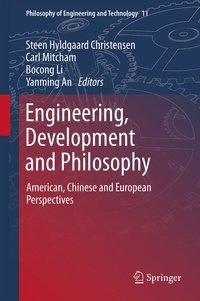
Engineering, Development and Philosophy
Description

More details
Other editions
Additional editions
Content
Part I. Rethinking Philosophy of Engineering and Development.- Introduction; Erich W. Schienke and Brent K. Jesiek.- Chapter 1. Turning Engineering Green: Sustainable Development and Engineering Education; Andrew Jamison.- Chapter 2. From a Micro-Macro Framework to a Micro-Meso-Macro Framework; Bocong Li.- Chapter 3. Traditional Chinese Thinking and Its Influence on Modern Engineering and Social Development; Qian Wang and Qin Zhu.- Chapter 4. Engineering and Development in Modern China: Challenges and Responses; Xiaonan Hong and Li Ma.- Chapter 5. "Ecocity China": An Ethos under Development; Erich W. Schienke.- Chapter 6. Negotiated Development: Rediscovering a Global Development Ethic; Peter McEvoy, Jane Grimson, and William Grimson.- Part II. Rethinking Engineering Education.- Introduction; Andrew Jamison and Yi Shen.- Chapter 7. The Challenge of Educating Engineers for a Close, Crowded and Creative World; Ela Krawczyk and Mike Murphy.- Chapter 8. Educating Chinese Engineers: The Case of Shanghai Jiao Tong University during 1896-1949; Brent K. Jesiek and Yi Shen.- Chapter 9. Academic Drift in European Professional Engineering Education: The End of Alternatives to the University?; Steen Hyldgaard Christensen.- Chapter 10. Governing Engineering; Anders Buch.- Chapter 11. Historical Tensions in Engineering Education: European Perspectives; Andrew Jamison and Matthias Heymann.- Chapter 12. Socio-technical integration in Engineering Education: A Never Ending Story; Steen Hyldgaard Christensen and Erik Ernø Kjølhede.- Chapter 13. Tensions in Developing Engineering Design Competencies; Ulrik Jørgensen.- Chapter 14. The Local Engineer: Normative Holism in Engineering Formation; Gary Lee Downey.- Chapter 15. Eyes Wide Shut? Loyalty and Practical Morality in Engineering Education; Martine Buser and Christian Koch.- Part III. Rethinking Perspectives on Engineering, Nature andSociety.- Introduction; Martin Meganck and Yanming An.- Chapter 16. Ex-students engaged in "Engineers without Borders": What Have They Become?; Christelle Didier.- Chapter 17. Socio-technical Integration: Research Policies in the United States, European Union, and China; Hannot Rodríguez, Hu Mingyan and Erik Fisher.- Chapter 18. Inheritance Ethics in Engineering Development: Comparison Between Shenyang and Ruhr on Industrial Heritage Conservation; Jian Wang and Jia Chen.- Chapter 19. Dam Construction Ethics in China; Zhihui Zhang.- Chapter 20. The Development of Railroads in the United States and China; Nan Wang.- Chapter 21. Engineering Leadership; Mike Murphy and Eugene Coyle.- Chapter 22. Harmonization with Nature: Ancient Chinese Views and Technological Development.- Chapter 23. Lynn White Revisited: Religious and Cultural Backgrounds for Technological Development; Martin Meganck.- Author Biographies.- Index.
