

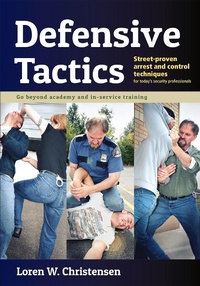
Defensive Tactics
Description

Whether you are a law enforcement officer seeking to improve your edge or a martial artist wanting to expand your knowledge of street-proven techniques, you will find Defensive Tactics: Street-Proven Arrest and Control Techniques is filled with invaluable information to prepare you for even the most difficult scenarios.
Highlights include:
- Joint manipulation that works
- Leverage control vs. pain control
- Striking with the hands, feet, forearms, and elbows
- Safely and quickly crossing the gap
- Blocking an assailant's strikes
- Using vulnerable points to gain compliance
- Head disorientation
- Safe application of carotid constriction or "sleeper" holds
- Controlling a suspect on the ground
- Arresting big guys
- Fighting concepts to take on patrol
- Weapon retention in close quarters and on the ground
Loren W. Christensen is a retired cop and high-ranking martial artist who survived everything the mean streets threw at him, working patrol, gang enforcement, and dignitary protection. Defensive Tactics goes beyond what is taught in the academy, during an officer's in-service training, and what is allowed by the administration.
This book also includes a chapter on proven ways to control a suspect on the ground, written by LAPD officer Mark Mireles, an MMA coach, police academy trainer, and champion wrestler.
More details
Other editions
Additional editions
Person
Loren W. Christensen began his law enforcement career in 1967 as a Military Policeman (Army). He joined the Portland (Oregon) Police Bureau in 1972, retiring in 1997. During his years on PPB, he worked street patrol, child abuse, dignitary protection, Intelligence, street gangs, and in the training unit.
Christensen began training in the martial arts in 1965. Over the years he has earned a total of 11 black belts, eight in karate, two in jujitsu and one in arnis.
As a professional writer since 1978, he has written 45 books, dozens of magazine articles, and edited a police newspaper for eight years. He has written about martial arts, missing children, street gangs, school shootings, workplace violence, police-involved shootings, nutrition, exercise, prostitution, and various street subcultures.
Loren was inducted into the martial arts Masters Hall of Fame in 2011.
Loren W. Christensen resides near Portland Oregon.
Content
- Front Cover
- Back Cover
- Title Page
- Copyright Information
- Table of Contents
- Acknowledgements
- About the Author
- Introduction
- Author's Note
- Section 1: The Foundation: Nuts and Bolts
- Chapter 1: Thinking Ahead
- Adrenaline Response
- The Power Of Combat Breathing
- How to do it
- The Importance Of Visualizing
- Visualize the confrontation
- Chapter 2: The Value of Reps
- It's All About Reps
- Line Drill: Attack And Response
- Monkey Line Drill
- Chapter 3: The Elements of Balance
- The Tripod Concept
- The invisible third leg
- Be cognizant of your position
- Using the tripod to your advantage
- Kuzushi
- Handcuffing
- Mental Kuzushi
- Developing self-awareness
- Chapter 4: Crossing the Gap
- Moving into Range
- A potentially dangerous moment
- His body language
- Your stance
- Timing the move
- Where to move
- How to grab
- Chapter 5: Blocking
- Blocking and Shielding
- Shielding
- Chapter 6: Weight Training and Aerobics
- Fast-twitch muscle fibers
- Aerobic and anaerobic
- Section 2: Joint Manipulation and Leverage Control
- Chapter 7: Finger Techniques
- Elements of Applying Finger Techniques
- Applications
- Chapter 8: The Versatile Wristlock
- Elements of the Wristlock
- Standing Suspect
- Downed Suspect
- Wristlock takedowns
- When the suspect resists your grab
- Wristlock Pickups
- Elements of the Wrist Twist
- Applications
- Inverted Wrist Flex
- Elements of inverted wrist flex
- Applications
- Chapter 9: Wrist Crank
- Elements of the Wrist Crank
- Applications
- Handcuffing from the wrist crank position
- Chapter 10: Elbow Techniques
- Armbar
- Elements of the Armbar
- Applications
- Chapter 11: Shoulder Locks
- Elements of the Shoulder Lock
- The steps
- Applications
- Chapter 12: Bent-Arm Shoulder Torque
- Elements of the Bent-arm Shoulder Torque
- Applications
- As a Control Hold
- Chin pull
- Handcuffing Position
- Takedowns
- Section 3: Hitting
- Chapter 13: Hands
- Elements of Hand Striking
- When to hit
- Fist and Palm-heel Targets
- Applications
- Chapter 14: Forearm Slams
- Elements of the Outside Forearm
- Applications
- Elements of Inside Forearm Strike
- Applications
- Chapter 15: Elbow Strikes
- Elements of Elbow Striking
- Applications
- Chapter 16: Kicking
- Elements of Kicking
- Targets
- Applications
- Section 4: Vulnerable Points
- Chapter 17: Get the Point
- Elements of Pressing Vulnerable Points
- Applications
- Section 5: Head and Neck
- Chapter 18: Head Disorientation
- Defense/Offense
- Chapter 19: Carotid Constraint: Sleeper Holds
- Sleeper hold
- Choke hold
- Elements of Getting Behind the Suspect
- Elements of the Sleeper
- Applications
- Basic constriction when standing
- On the Ground
- Handcuffing
- Section 6: Ground Fighting
- Chapter 20: Ground Grappling
- The Learning Curve
- Three Types of Suspects
- Elements of Ground Fighting
- The mount
- Knee onto stomach and roll over
- North-south control
- Worst-case Scenarios
- The hip escape
- The Guard
- Rolls
- Simple sweep
- Chapter 21: Ground Kicking and Trapping
- Trapping
- Kicking
- Section 7: Baton
- Chapter 22: Body Mechanics
- Common errors
- Increase Your Hitting Impact
- Drawing
- Section 8: Arresting Big Guys
- Chapter 23: Facing a Big Suspect
- Does Size Matter?
- What about pepper spray?
- Mental preparation
- Preparation
- Some almost nevers
- Using your baton - targets
- A psychological ploy
- Section 9: Training and Fighting Concepts
- Chapter 24: Concepts
- Survival Concepts
- Training Concepts
- Fighting Concepts
- Concepts to take on patrol
- Index
- Books from YMAA
- DVDs from YMAA
