

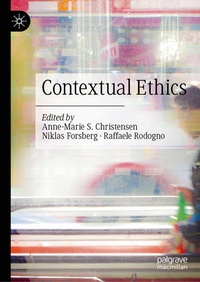
Contextual Ethics
Description

Moral philosophy has traditionally strived towards abstraction and universalization, its claims tending to leave behind the specificity of bodies, individuals' lives, situations, culture, and history. Yet there are ways of thinking and doing moral philosophy that do not leave context behind but make it their. This makes it a point , never to lose sight of context, to place it at the centre of ethical investigations. To present and defend the richness and validity of this approach to ethics his is , at any rate, the claim and the ambition of this volume.
Placed in the new field of
contextual ethics
, the anthology presents articles that focus on issues ranging from the theoretical and the methodological - Does taking context into account imply relativism? Can the normative and the descriptive in ethics be separated? How does moral change occur in the thick of everyday life? - to applied issues in biomedical, animal, and environmental ethics. The volume opens with a programmatic chapter on
contextual ethics
that traces its historical roots, its most central themes and methodological issues, and its relation to different traditions in contemporary ethics.
More details
Other editions
Additional editions
Persons
Anne-Marie S. Christensen is Professor of Ethics at Philosophy, Department of Design, Media and Educational Science, University of Southern, Denmark.
Niklas Forsberg is head of research in the Centre for Ethics as Study in Human Value, Department of Philosophy, University of Pardubice, Czech Republic.
Raffaele Rodogno Associate Professor in the Department of Philosophy, University of Lausanne and The Swiss Federal Institute of Technology Lausanne, SHS Porogramme, Switzerland.
Content
1. Editors: 'Introduction'.- Part One: The Importance and Implications of Context in Ethics.- 2. Nora Hämäläinen: 'Working Values into Practice and Transforming Them Along the Way: Some Examples from Environmental Ethics'.- 3. Raffaele Rodogno: 'Well-Being, Context, and Normativity'.- 4. Camilla Kronqvist: 'Listening to Who is Talking: The Speakers as Context'.- 5. Anne-Marie S. Christensen: 'Thinking About the New. Practical Ethics as Contextual Ethics'.- Part Two: How to do Context? Theories, Methodologies and Fieldtrips.- 6. Duncan Richter: 'The Ethics of Description'.- 7. Sverker Finnström: 'When the World isnot Directly Given to Us: On Death, Murder, and Participant Reflection in a Ugandan Warzone'.- 8. Cecilie Eriksen: 'Bias, Blind Spots and Cherry-picking. Methodological Challenges in Contextual Ethics'.- 9. Ondrej Beran: 'The (Im)possibilities of Philosophical Advice'.- 10. Ylva Gustafsson: 'Reflections on Illness Narratives and the Missing Voices'.- Part Three: Trying it Out - Examples of Contextualised Moral Philosophy.- 11. Hannah Winther: 'Contextual Animal Ethics'.- 12. Salla Aldrin Salskov: 'The Queer Ethics of Alison Bechdel's Are You're my Mother ? and Judith Butler's Giving an Account of Oneself '.- 13. Lisa Aaltola: 'Universal or Contextual Love?'.- 14. Jonna Bornemark: 'Asymmetrical Lessons: Pregnancy, Horses and BDSM'.
