

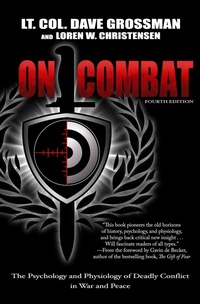
On Combat
The Psychology and Physiology of Deadly Conflict in War and Peace
4th Edition
Published on 9. August 2022
528 pages
978-1-5040-7743-9 (ISBN)
Description

The director of the Killology Research Group shares "a thorough examination of the emotional and physical effects of deadly conflict" (
Kirkus Reviews).
On Combat examines the stress resulting from engaging in deadly battle and its effects on the human body, from the heart and the nervous system to visual and auditory perception to memory. The historical perspective on the evolution of combat provided in this text further deepens our understanding of the brave men and women who train their minds and bodies to go to that place from which others flee.
Lt. Col. Dave Grossman, a war veteran and former West Point psychology professor, presents combat coping strategies, demonstrating how one can train the mind to be inoculated against stress, fear, and even pain. This fresh and informative look at post-traumatic stress disorder (PTSD) details how to prevent it, how to survive it, how to come out of it stronger, and how to help others who are experiencing it.
Grossman underscores the importance of post-combat debriefing, when warriors gather to share, learn from each other, and begin to heal from the horror. Based on extensive new research, Grossman's findings are supported by revealing quotes and anecdotes from combat veterans and other leaders in the warrior community.
On Combat examines the stress resulting from engaging in deadly battle and its effects on the human body, from the heart and the nervous system to visual and auditory perception to memory. The historical perspective on the evolution of combat provided in this text further deepens our understanding of the brave men and women who train their minds and bodies to go to that place from which others flee.
Lt. Col. Dave Grossman, a war veteran and former West Point psychology professor, presents combat coping strategies, demonstrating how one can train the mind to be inoculated against stress, fear, and even pain. This fresh and informative look at post-traumatic stress disorder (PTSD) details how to prevent it, how to survive it, how to come out of it stronger, and how to help others who are experiencing it.
Grossman underscores the importance of post-combat debriefing, when warriors gather to share, learn from each other, and begin to heal from the horror. Based on extensive new research, Grossman's findings are supported by revealing quotes and anecdotes from combat veterans and other leaders in the warrior community.
More details
Persons
A former army Ranger and paratrooper, Lt. Col. Dave Grossman taught psychology at West Point and was a Professor of Military Science at Arkansas State University.
The author's website, Grossman On Truth, amplifies and extends the material covered in his books and is regularly updated with new, topical information on the subject.
The author's website, Grossman On Truth, amplifies and extends the material covered in his books and is regularly updated with new, topical information on the subject.
Content
- Cover
- Title
- Contents
- Foreword by Gavin de Becker
- Introduction: The New Warriors, the New Paladins
- Section I: The Physiology of Combat: The Anatomy of the Human Body in Battle
- One: Combat: The Universal Human Phobia
- Two: The Harsh Reality of Combat: What You Don't Hear at the VFW
- Three: Sympathetic and Parasympathetic Nervous System: The Body's Combat and Maintenance Troops
- Four: Fear, Physiological Arousal and Performance: Conditions White, Yellow, Red, Gray and Black
- Section II: Perceptual Distortions in Combat: An Altered State of Consciousness
- One
- The Eyes and the Ears: Auditory Exclusion, Intensified Sound, and Tunnel Vision
- Two: Autopilot: "You Honestly Don't Know You're Doing It"
- Three: A Grab Bag of Effects: Visual Clarity, Slow Motion Time, Temporary Paralysis, Memory Loss, Dissociation and Intrusive Thoughts
- Four: Memory Loss, Memory Distortions, and the Role of Videotaping: You Are Absolutely Convinced It Happened
- Five: The Klinger Study: A Parallel Study in Perceptual Distortions
- Section III: The Call to Combat: Where Do We Get Such Men?
- One: Killing Machines: The Impact of a Handful of True Warriors
- Two: Stress Inoculation and Fear: Practicing to be Miserable
- Three: Sucking Up Bullets and Continuing to Fight: You've Never Lived Until You've Almost Died
- Four: Making the Decision to Kill: "I Killed But Someone Lived"
- Five: Modern Paladins Bearing the Shield: "Go Tell the Spartans ."
- Six: The Evolution of Combat: The Physical and Psychological Leverage that Enables Killing, in War and Peace
- Seven: The Evolution of Combat and Domestic Violent Crime
- Section IV: The Price of Combat: After the Smoke Clears
- One: Relief, Self-Blame and Other Emotions: "My World was Turned Inside Out."
- Two: Stress, Uncertainty, and the "Four Fs": Forewarned is Forearmed
- Three: PTSD: Reexperiencing the Event, and Fleeing from the Puppy
- Four: A Time to Heal: The Role of Critical Incident Debriefings in Preventing PTSD
- Five: Tactical Breathing and the Mechanics of the Debriefing: Separating the Memory from the Emotions
- Six: What to Say to a Returning Veteran, and What to Say to a Survivor
- Seven: Thou Shalt Not Kill? The Judeo/Christian View of Killing
- Eight: Survivor Guilt: Life not Death, and Justice not Vengeance
- Conclusion
- Appendix A: Erasmus' Twenty-Two Principles on How to Be Strong While Remaining Virtuous in a Dangerous World
- Appendix B: Board of Advisors for On Combat
- Bibliography
- Index
- Acknowledgments
- About the Author
- Copyright
