

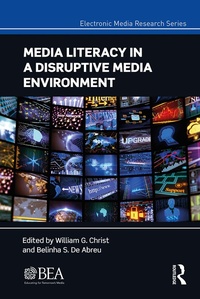
Media Literacy in a Disruptive Media Environment
1st Edition
Published on 4. March 2020
338 pages
978-1-000-05081-3 (ISBN)
Description

This book, part of the BEA Electronic Media Research Series, brings together top scholars researching media literacy and lays out the current state of the field in areas such as propaganda, news, participatory culture, representation, education, social/environmental justice, and civic engagement.
The field of media literacy continues to undergo changes and challenges as audiences are reconceptualized and reconfigured, media industries are transformed and replaced, and the production of media texts is available to anyone with a smartphone. The book provides an overview of these. It offers readers specific examples and recommendations to help others as they develop their own teaching and research agendas.
Media Literacy in a Disruptive Media Environment will be of great interest to scholars and graduate students studying media literacy through the lens of broadcasting, communication studies, media and cultural studies, film, and digital media studies.
The field of media literacy continues to undergo changes and challenges as audiences are reconceptualized and reconfigured, media industries are transformed and replaced, and the production of media texts is available to anyone with a smartphone. The book provides an overview of these. It offers readers specific examples and recommendations to help others as they develop their own teaching and research agendas.
Media Literacy in a Disruptive Media Environment will be of great interest to scholars and graduate students studying media literacy through the lens of broadcasting, communication studies, media and cultural studies, film, and digital media studies.
More details
Series
Edition
1. Auflage
Language
English
Place of publication
London
United Kingdom
Publishing group
Taylor & Francis Ltd
Target group
College/higher education
Illustrations
10 Tables, black and white; 1 Line drawings, black and white; 1 Illustrations, black and white
File size
4,11 MB
ISBN-13
978-1-000-05081-3 (9781000050813)
Copyright in bibliographic data and cover images is held by Nielsen Book Services Limited or by the publishers or by their respective licensors: all rights reserved.
Schweitzer Classification
Other editions
Additional editions
William G. Christ | Belinha S. de Abreu
Media Literacy in a Disruptive Media Environment
Book
08/2022
1st Edition
Routledge
€68.00
Shipment within 10-20 days
William G. Christ | Belinha S. de Abreu
Media Literacy in a Disruptive Media Environment
Book
03/2020
1st Edition
Routledge
€207.10
Shipment within 15-20 days
Persons
William G. Christ is Professor Emeritus at Trinity University. He has been writing about media education for over forty years. He has edited or co-authored six books and over 65 articles and book chapters. His interests lie in bridging the gap between the liberal arts and professional education, and the challenges of assessing student learning.
Belinha S. De Abreu is an International Media Literacy Educator in the United States. Her research interests include media and information literacy education, educational technology, global perspectives, critical thinking, privacy and big data. She is the author/editor of several papers/books including: Teaching Media Literacy (ALA: Neal-Schuman, 2019) and The International Handbook for Media Literacy Education (Routledge, 2017). She serves as the Vice President for the National Telemedia Council (NTC) and is the founder of the International Media Literacy Research Symposium.
Belinha S. De Abreu is an International Media Literacy Educator in the United States. Her research interests include media and information literacy education, educational technology, global perspectives, critical thinking, privacy and big data. She is the author/editor of several papers/books including: Teaching Media Literacy (ALA: Neal-Schuman, 2019) and The International Handbook for Media Literacy Education (Routledge, 2017). She serves as the Vice President for the National Telemedia Council (NTC) and is the founder of the International Media Literacy Research Symposium.
Content
Part One: OVERVIEW
Global Perspectives on Media Literacy
Belinha S. De Abreu, Sacred Heart University/UNESCO---The Global Alliance for Partnerships on Media and Information Literacy (GAPMIL)
A Snapshot: The State of Media Literacy Education in the U.S.
Michelle Ciulla Lipkin, Executive Director, National Association for Media Literacy Education (NAMLE)
Sherri Hope Culver, Associate Professor and Director of the Center for Media and Information Literacy, Temple University
Theresa Redmond, Appalachian State University
Media Literacy in the Age of Big Data
Kathleen Tyner, University of Texas-Austin
Four Fundamental Challenges in Designing Media Literacy Interventions
W. James Potter, University of California-Santa Barbara
Part Two: MEDIA LITERACY, NEWS AND PROPAGANDA
Focusing on Facts: Media and News Literacy Education in the Age of Misinformation
Jennifer Fleming and Christopher Karadjov, California State University, Long Beach
Propaganda Critic, Russian Disinformation, and Media Literacy: A Case Study
Aaron Delwiche and Mary Margaret Herring, Trinity University
The Imperative of Latino-Oriented News & Media Literacy
Federico Subervi-Velez, Honorary Latin-American Professor,
University of Wisconsin-Madison
Tania Cantrell Rosas-Moreno, Loyola University
Blame Attribution, Warrants and Critical Thinking:
South Africa's Overvaal Debacle as a Case Study
Marthinus Conradie, University of the Free State
Media Literacy and a Typology of Political Deceptions
Robert N. Spicer, Millersville University
Part Three: MEDIA LITERACY AND EDUCATION
Professional Education and Media Literacy: Oil and Water?
William G. Christ, Trinity University
News Media Literacy in the Digital Age: A Measure of Need and Usefulness of a University Curriculum in Egypt
Rasha Allam and Salma El Ghetany, American University in Cairo
The MOOC for Media Literacy: Examining Media Literacy Practices in a Massive Open Online Course
Kristy Roschke, Arizona State University
A Model for Media Literacy Across a Lifespan: Wisdom from Pedagogical Pilots
George L. Daniels, University of Alabama
Part Four: MEDIA LITERACY AND SOCIAL ACTION
Civic Standpoint and the pursuit of Media Literacies
Paul Mihailidis, Moses Shumow, Emerson College and Christopher Harris, Nevada State College
The Colombian Freedom of Information Act: Using Media Literacy to Understand and Implement the Law
Paula Perez, Jairo Becerra, Universidad Catolica de Colombia, and Julian Rodriguez, University of Texas-Arlington
The Literacies of Participatory Cultures
Jennifer J. Henderson, Trinity University
Civic Engagement, Social Justice, and Media Literacy
Srividya "Srivi" Ramasubramanian and Ramin Chaboki Darzabi, Texas A&M University
Critical Media Literacy and Environmental Justice
Jeff Share, University of California-Los Angeles
Global Perspectives on Media Literacy
Belinha S. De Abreu, Sacred Heart University/UNESCO---The Global Alliance for Partnerships on Media and Information Literacy (GAPMIL)
A Snapshot: The State of Media Literacy Education in the U.S.
Michelle Ciulla Lipkin, Executive Director, National Association for Media Literacy Education (NAMLE)
Sherri Hope Culver, Associate Professor and Director of the Center for Media and Information Literacy, Temple University
Theresa Redmond, Appalachian State University
Media Literacy in the Age of Big Data
Kathleen Tyner, University of Texas-Austin
Four Fundamental Challenges in Designing Media Literacy Interventions
W. James Potter, University of California-Santa Barbara
Part Two: MEDIA LITERACY, NEWS AND PROPAGANDA
Focusing on Facts: Media and News Literacy Education in the Age of Misinformation
Jennifer Fleming and Christopher Karadjov, California State University, Long Beach
Propaganda Critic, Russian Disinformation, and Media Literacy: A Case Study
Aaron Delwiche and Mary Margaret Herring, Trinity University
The Imperative of Latino-Oriented News & Media Literacy
Federico Subervi-Velez, Honorary Latin-American Professor,
University of Wisconsin-Madison
Tania Cantrell Rosas-Moreno, Loyola University
Blame Attribution, Warrants and Critical Thinking:
South Africa's Overvaal Debacle as a Case Study
Marthinus Conradie, University of the Free State
Media Literacy and a Typology of Political Deceptions
Robert N. Spicer, Millersville University
Part Three: MEDIA LITERACY AND EDUCATION
Professional Education and Media Literacy: Oil and Water?
William G. Christ, Trinity University
News Media Literacy in the Digital Age: A Measure of Need and Usefulness of a University Curriculum in Egypt
Rasha Allam and Salma El Ghetany, American University in Cairo
The MOOC for Media Literacy: Examining Media Literacy Practices in a Massive Open Online Course
Kristy Roschke, Arizona State University
A Model for Media Literacy Across a Lifespan: Wisdom from Pedagogical Pilots
George L. Daniels, University of Alabama
Part Four: MEDIA LITERACY AND SOCIAL ACTION
Civic Standpoint and the pursuit of Media Literacies
Paul Mihailidis, Moses Shumow, Emerson College and Christopher Harris, Nevada State College
The Colombian Freedom of Information Act: Using Media Literacy to Understand and Implement the Law
Paula Perez, Jairo Becerra, Universidad Catolica de Colombia, and Julian Rodriguez, University of Texas-Arlington
The Literacies of Participatory Cultures
Jennifer J. Henderson, Trinity University
Civic Engagement, Social Justice, and Media Literacy
Srividya "Srivi" Ramasubramanian and Ramin Chaboki Darzabi, Texas A&M University
Critical Media Literacy and Environmental Justice
Jeff Share, University of California-Los Angeles
