

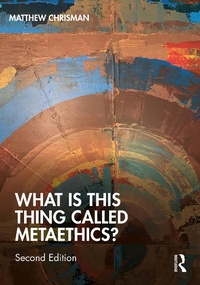
What is this thing called Metaethics?
2nd Edition
Published on 20. June 2023
186 pages
978-1-000-88942-0 (ISBN)
Description

What makes something morally right? Where do our ethical standards come from? Are they relative to cultures or timeless and universal? Are there any objective moral facts? What is goodness? If there are moral facts, how do we learn about them? What do we mean when we say someone ought to do something? These are all questions in metaethics, the branch of ethics that investigates the status of morality, the nature of ethical value, the possibility of ethical knowledge, and the meaning of ethical statements. To the uninitiated it can appear abstract and far removed from its two more concrete cousins, ethical theory and applied ethics, yet it is one of the fastest-growing and most exciting areas of ethics.
What is this thing called Metaethics? demystifies this important subject and is ideal for students coming to it for the first time. Beginning with a brief overview of metaethics and the development of a "conceptual toolkit," Matthew Chrisman introduces and assesses the following key topics:
ethical reality: including questions about naturalism and non-naturalism, moral facts, and the distinction between realism and antirealism
ethical language: does language represent reality? What mental states are expressed by moral statements?
moral psychology: the theory of motivation and the connection between moral judgement and motivation
moral knowledge: intuitionist and coherentist moral epistemologies, and theories of objectivity and relativism in metaethics
prominent metaethical theories: naturalism, nonnaturalism, error-theory, and expressivism
new directions in metaethics, including non-traditional theories, thick ethical concepts, and extensions to metaepistemology and metanormative theory
The Second Edition has been completely revised and updated throughout. This includes a new thematic organization of the core chapters, many new examples, a newly written final chapter including discussion of thick ethical concepts and all-things-considered normativity, updated references to recent scholarly literature, improved learning resources, an expanded glossary of terms, and much more.
Additional features such as chapter summaries, questions of understanding, and suggestions for further reading make What is this thing called Metaethics? an ideal introduction to metaethics.
What is this thing called Metaethics? demystifies this important subject and is ideal for students coming to it for the first time. Beginning with a brief overview of metaethics and the development of a "conceptual toolkit," Matthew Chrisman introduces and assesses the following key topics:
ethical reality: including questions about naturalism and non-naturalism, moral facts, and the distinction between realism and antirealism
ethical language: does language represent reality? What mental states are expressed by moral statements?
moral psychology: the theory of motivation and the connection between moral judgement and motivation
moral knowledge: intuitionist and coherentist moral epistemologies, and theories of objectivity and relativism in metaethics
prominent metaethical theories: naturalism, nonnaturalism, error-theory, and expressivism
new directions in metaethics, including non-traditional theories, thick ethical concepts, and extensions to metaepistemology and metanormative theory
The Second Edition has been completely revised and updated throughout. This includes a new thematic organization of the core chapters, many new examples, a newly written final chapter including discussion of thick ethical concepts and all-things-considered normativity, updated references to recent scholarly literature, improved learning resources, an expanded glossary of terms, and much more.
Additional features such as chapter summaries, questions of understanding, and suggestions for further reading make What is this thing called Metaethics? an ideal introduction to metaethics.
Reviews / Votes
Praise for the First Edition:'This is an outstanding introductory text that combines clear, concise, and detailed coverage of all of the traditional metaethical positions, with original and distinctive treatments of new developments in metaethics, and with a fascinating discussion of how metaethical thinking relates to more broadly normative issues. It will be an excellent resource for students and their teachers alike.' - Michael Brady, University of Glasgow, UK
More details
Series
Edition
2nd edition
Language
English
Place of publication
London
United Kingdom
Publishing group
Taylor & Francis Ltd
Target group
College/higher education
Illustrations
4 Tables, black and white; 6 Line drawings, black and white; 6 Illustrations, black and white
ISBN-13
978-1-000-88942-0 (9781000889420)
Copyright in bibliographic data and cover images is held by Nielsen Book Services Limited or by the publishers or by their respective licensors: all rights reserved.
Schweitzer Classification
Other editions
Additional editions
Matthew Chrisman
What is this thing called Metaethics?
Book
06/2023
2nd Edition
Routledge
€60.90
Shipment within 10-20 days
Matthew Chrisman
What is this thing called Metaethics?
Book
06/2023
2nd Edition
Routledge
€207.30
Shipment within 10-20 days
Person
Matthew Chrisman is a Professor in the Department of Philosophy at the University of Edinburgh, UK. He teaches and researches in social-ethical-political theory, epistemology, and philosophy of language. He is the author of Belief, Agency, and Knowledge: Essays on Epistemic Normativity (2022), and The Meaning of 'Ought' (2016).
Content
Preface to the Second Edition Introduction 1. Four Key Issues 2. Naturalism 3. Nonnaturalism 4. Error Theory and Fictionalism 5. Expressivism 6. Summary and Chart 7. Theories That Are Hard to Classify in Traditional Terms 8. Refocusing Metaethics? Glossary of Terms Index
