

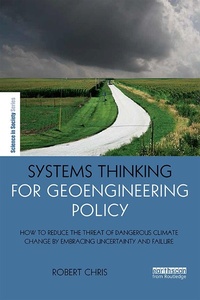
Systems Thinking for Geoengineering Policy
How to reduce the threat of dangerous climate change by embracing uncertainty and failure
Published on 19. November 2015
228 pages
978-1-317-55488-2 (ISBN)
Description

Even by the scientists most closely associated with it, geoengineering - the deliberate intervention in the climate at global scale to mitigate the effects of climate change - is perceived to be risky. For all its potential benefits, there are robust differences of opinion over the wisdom of such an intervention.
Systems Thinking for Geoengineering Policy is the first book to theorise geoengineering in terms of complex adaptive systems theory and to argue for the theoretical imperative of adaptive management as the default methodology for an effective low risk means of confronting the inescapable uncertainty and surprise that characterise potential climate futures. The book illustrates how a shift from the conventional Enlightenment paradigm of linear reductionist thinking, in favour of systems thinking, would promote policies that are robust against the widest range of plausible futures rather than optimal only for the most likely, and also unlock the policy paralysis caused by making long term predictions of policy outcomes a prior condition for policy formulation. It also offers some systems driven reflections on a global governance network for geoengineering.
This book is a valuable resource for all those with an interest in climate change policy, geoengineering, and CAS theory, including academics, under- and postgraduate students and policymakers.
Systems Thinking for Geoengineering Policy is the first book to theorise geoengineering in terms of complex adaptive systems theory and to argue for the theoretical imperative of adaptive management as the default methodology for an effective low risk means of confronting the inescapable uncertainty and surprise that characterise potential climate futures. The book illustrates how a shift from the conventional Enlightenment paradigm of linear reductionist thinking, in favour of systems thinking, would promote policies that are robust against the widest range of plausible futures rather than optimal only for the most likely, and also unlock the policy paralysis caused by making long term predictions of policy outcomes a prior condition for policy formulation. It also offers some systems driven reflections on a global governance network for geoengineering.
This book is a valuable resource for all those with an interest in climate change policy, geoengineering, and CAS theory, including academics, under- and postgraduate students and policymakers.
Reviews / Votes
"Robert Chris convincingly describes the limitations of reductionist thinking when facing the complex challenge of developing appropriate policy for geoengineering research. By charting a way for geoengineering research policy that appreciates the features of complex adaptive systems, Chris moves beyond critique and opens our imagination to alternative courses of action." - Stefan Schaefer, Institute for Advanced Sustainability Studies (IASS), Potsdam"This book brings a welcome dose of fresh and constructive thinking to the debate about managing geoengineering technologies with a welcome focus on governing early innovation to manage risk without stifling creativity." - David Keith, Gordon McKay Professor of Applied Physics and Professor of Public Policy, Harvard University
"Radical measures to combat climate change are almost certainly necessary. This book is timely. It identifies the need for empirical research if policy decisions are to be based on knowledge and experience rather than ignorance and conjecture. The proposed "bottom-up" research governance regime would work with the grain of long-term uncertainty and unpredictability, thereby greatly reducing climate risks for future generations." - Hugh Hunt, Department of Engineering and Fellow of Trinity College Cambridge
"In this bold critique of the 'predict-and-control' paradigm of policy-making the world has hitherto been relying on to deal with climate change, Robert Chris breaks new ground by deploying complex adaptive systems theory to the excruciating dilemmas of geoengineering. The implications for climate policy - and policy making in general - are potentially vast." - Olaf Corry, Associate Professor, Department of Political Science, University of Copenhagen
"In Systems Thinking for Geoengineering Policy, Robert Chris proposes a pragmatic approach for researching geoengineering as part of a comprehensive strategy for dealing with climate change that contrasts with the present unproductive approach of delaying any consideration indefinitely while all uncertainties are reduced and a top-down international governance system is established." - Mike MacCracken, Chief Scientist for Climate Change Programs with the Climate Institute in Washington DC "Robert Chris convincingly describes the limitations of reductionist thinking when facing the complex challenge of developing appropriate policy for geoengineering research. By charting a way for geoengineering research policy that appreciates the features of complex adaptive systems, Chris moves beyond critique and opens our imagination to alternative courses of action." - Stefan Schaefer, Institute for Advanced Sustainability Studies (IASS), Potsdam
"This book brings a welcome dose of fresh and constructive thinking to the debate on taming geoengineering technologies." - David Keith, Gordon McKay Professor of Applied Physics and Professor of Public Policy, Harvard University
"Radical measures to combat climate change are almost certainly necessary. This book is timely. It identifies the need for empirical research if policy decisions are to be based on knowledge and experience rather than ignorance and conjecture. The proposed "bottom-up" research governance regime would work with the grain of long-term uncertainty and unpredictability, thereby greatly reducing climate risks for future generations." - Hugh Hunt, Department of Engineering and Fellow of Trinity College Cambridge
"In this bold critique of the 'predict-and-control' paradigm of policy-making the world has hitherto been relying on to deal with climate change, Robert Chris breaks new ground by deploying complex adaptive systems theory to the excruciating dilemmas of geoengineering. The implications for climate policy - and policy making in general - are potentially vast." - Olaf Corry, Associate Professor, Department of Political Science, University of Copenhagen
More details
Series
Language
English
Place of publication
London
United Kingdom
Publishing group
Taylor & Francis Ltd
Target group
College/higher education
Illustrations
10 s/w Abbildungen, 1 s/w Tabelle, 10 s/w Zeichnungen
1 Tables, black and white; 10 Line drawings, black and white; 10 Illustrations, black and white
File size
3,81 MB
ISBN-13
978-1-317-55488-2 (9781317554882)
Copyright in bibliographic data and cover images is held by Nielsen Book Services Limited or by the publishers or by their respective licensors: all rights reserved.
Schweitzer Classification
Other editions
Additional editions
Robert Chris
Systems Thinking for Geoengineering Policy
How to reduce the threat of dangerous climate change by embracing uncertainty and failure
Book
03/2019
1st Edition
Routledge
€78.40
Shipment within 15-20 days
Robert Chris
Systems Thinking for Geoengineering Policy
How to reduce the threat of dangerous climate change by embracing uncertainty and failure
Book
11/2015
1st Edition
Routledge
€233.10
Shipment within 10-20 days
Person
Robert Chris is a Visiting Fellow at the Department of Geography, The Open University, UK.
Content
1. Contextualising Geoengineering 2. Geoengineering - the technologies and their 'times' 3. The Limits of Reductionism 4. Systems thinking 5. Geoengineering and uncertainty 6. Geoengineering: complexity in policymaking 7. Downgrading geoengineering from solution to contribution 8. Geoengineering governance network (GGN) 9. Drawing the threads together
