

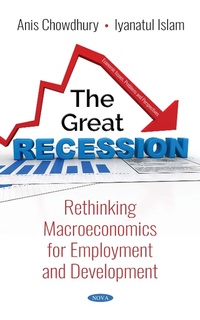
The Great Recession: Rethinking Macroeconomics for Employment and Development
Rethinking Macroeconomics for Employment and Development
Published on 1. May 2018
319 pages
978-1-5361-3657-9 (ISBN)
Description

The chapters in this volume were written as commentaries between mid-2008 and early-2016 in the wake of the Great Recession of 2008-2009. The primary topics around which the various essays are compiled are: (a) crisis and response, (b) fiscal policy, (c) monetary and capital account policy, (d) employment, and (e) development. The chapters not only provide a critique of mainstream macroeconomics, but also suggest a way forward.This volume contains an extensive introduction to synthesise the debate on macroeconomic orthodoxy and to assess the attempts at its reconstruction in light of its dismal failure in predicting the crisis and responding to it. As a background, it briefly traces the retreat of post-Great Depression Keynesian macroeconomics (with it, full employment as the primary policy goal) and the rise of new orthodoxy (concerned with a single target, inflation) that came to dominate major international financial institutions, notably the International Monetary Fund and the World Bank. It also highlights contrasting analyses of the global macroeconomic issues by the Bretton Woods Institutions (BWIs) vis-à-vis the United Nations, and their contributions to macroeconomics-development discourse.Two main conclusions about the various attempts at reconstructing macroeconomics are that they: (1) suffer from an advanced country bias, and (2) do not pay sufficient attention to employment even in developed countries. The benign neglect of developing countries in reconstructing macroeconomics is not at all surprising, as both post-Great Depression macroeconomics and its orthodox replacement evolved without paying due regard to the particular circumstances and problems of developing countries. The neglect of employment in rethinking macroeconomics shows how deeply orthodoxy still remains embedded in the major institutions, as well as among professional economists and policymakers.There is no sign of any significant shift even when a good deal of research within the BWIs themselves report findings that are contrary to conventional wisdom. Thus, unfortunately, whatever is likely to emerge as post-Great Recession macroeconomics does not seem very encouraging for employment and development.The essays compiled in this volume suggest how macroeconomics can serve the dual objectives of short-term stabilisation and long-term inclusive sustainable development goals with decent and productive employment featuring prominently for both developed and developing countries.
More details
Other editions
Additional editions
Anis Chowdhury | Iyanatul Islam
The Great Recession
Rethinking Macroeconomics for Employment and Development
Book
07/2018
Nova Science Publishers Inc
€362.47
Shipment within 15-20 days
Content
- Intro
- Contents
- List of Figures
- List of Tables
- Preface
- Introduction: Rethinking Macroeconomics - Relevance for Development and Employment
- Setting the Context
- The Evolution of Pre-Crisis Macroeconomics
- Keynesian Activism Misses Developing Countries
- Monetarist Counter Revolution and Forsaking of Full-Employment in Developed Countries
- The Triumph, Consensus and Complacency
- Pre-Crisis Macroeconomics and Developing Countries
- Era of Structural Adjustment and the Washington Consensus
- Asian Financial Crisis and the Demise of Washington Consensus
- but Orthodoxy Survives
- Rethinking Macroeconomics in the Post-Crisis Era
- Advanced Country Bias
- Modest Reconstruction Even for Industrialised Countries
- Rethinking Macroeconomics: The Role of the UN
- Stabilisation and Development
- Stagflation: Set-Back for Development, and the UN's Call for International Policy Coordination and Heterodox Policies
- Debt Crisis: The UN Proposes Adjustment with a Human Face
- The Great Recession and the UN
- Conclusion
- References
- Part I: Crisis and Response
- Chapter 1
- From Optimism to Pessimism
- Chapter 2
- The Confidence Game
- Chapter 3
- The G20 Declaration at the London Summit: A Global New Deal?
- Introduction
- Evaluation
- References
- Chapter 4
- The 'Green Shoots' of Recovery: Pitfalls and Perils of a Premature Exit Strategy
- References
- Chapter 5
- The Fallacy of Austerity Based Fiscal Consolidation
- How Does Austerity-Based Fiscal Consolidation Work?
- Growth-Based Fiscal Consolidation
- Clinton Success
- Danish and Irish Story
- Conclusion
- References
- Chapter 6
- Revisiting the Evidence on Expansionary Fiscal Austerity: Alesina's Hour?
- References
- Chapter 7
- Latvia: Going Beyond the Fiscal Austerity Debate
- References
- Chapter 8
- Europe Needs Course Correction
- Persistent High Youth and Rising Long-Term Unemployment
- Course Correction Required
- Fiscal Policy Needs to Play a More Active Role
- 'Golden' and 'Silver' Rules of Public Investment
- References
- Part II: Deficit and Debt
- Chapter 9
- Why Worry Too Much about Fiscal Deficits?
- References
- Chapter 10
- Fiscal Rules: Help or Hindrance?
- References
- Chapter 11
- Is There an Optimal Debt-to-GDP Ratio?
- References
- Chapter 12
- The Political Economy of Sovereign External Debt Workout
- Developing Country Solidarity
- Crack in the Developed Country Camp
- Sovereign Debt Restructuring and the IMF
- Is UN the Right Forum?
- Challenges for the Crucial Next Steps
- References
- Part III: Inflation, Finance and Capital Flows
- Chapter 13
- Inflation Targeting: Some Anomalies Reconsidered
- References
- Chapter 14
- Inflation Targeting in Developing Countries Revisited
- Inflation-Growth Relationship
- Sources of Inflation Matter
- IT Beyond Growth
- Conclusion
- References
- Chapter 15
- Financial Sector Reforms: Which Way Now?
- Financial Sector Regulation
- Deregulation and Crisis
- Glass-Steagall Act: What Were the Concerns?
- How Much of the above was in the Asian Financial Crisis?
- Lessons from the Crisis for the Financial Sector in Developing Countries
- Preventing System-Wide Failure
- Segregation and Restraint
- Ownership Matters
- Meeting Development needs
- Government owned Specialised Banks
- Financial Restraint
- Conclusion
- References
- Chapter 16
- Revisiting Capital Account Liberalisation
- References
- Part IV: Employment
- Chapter 17
- Full Employment and the Global Development Agenda: Going Beyond Lip Service
- Full Employment in Traditional Development Economics
- Structural Adjustment and the Demise of Traditional Development Economics
- The Demise of Structural Adjustment and the Emergence of the MDGs
- MDGs and Full Employment: Which Way Now?
- References
- Chapter 18
- Growth and Jobs in Europe: Which Way Now?
- Which Way Now?
- A Differentiated Approach to Fiscal Policy
- An Ambitious Approach to Public Investment or a 'Marshall Plan 2.0' as Part of an 'Investment New Deal' for Europe.
- Long-Term Policy Innovations in Monetary and Fiscal Policy
- Income Support for the Unemployed and Living Wages for Low-Paid Workers to Boost Consumer Demand
- Conclusion
- References
- Chapter 19
- Fiscal Austerity and the Youth Unemployment Crisis
- References
- Chapter 20
- Fiscal Consolidation, Growth and Employment: What Do We Know?
- Introduction
- Fiscal Consolidation: How Much and with What Consequences?
- Conclusion
- References
- Chapter 21
- Labour Market Flexibility: Which Way Now?
- References
- Chapter 22
- Labour Market Regulations and the Perceptions of the Business Community
- References
- Part V: Development
- Chapter 23
- The Limits of Conventional Macroeconomics for Development
- References
- Chapter 24
- Rethinking Macroeconomics from the Perspective of the MDGs
- Current State of Rethinking
- Monetary and Exchange Rate Policies
- Be Prepared to be Flexible When Setting Inflation Targets
- Take Account of Asset Price Inflation
- Take Account of 'Supply-Side' Sources of Inflation
- Focus on Real Exchange Rate Stability
- Actively Manage the Capital Account
- Monetary and Exchange Rate Policies Should Play a Supportive Role for Development Activities and Counter-Cyclical Measures
- Fiscal Policy
- Fiscal Policy Must Be Dominant at All Times, Not Just When Monetary Policy Loses Its Effectiveness
- Public Expenditure Must Give Priority to Primary Health-Care, Universal Basic Education and Infrastructure
- Create and Expand Fiscal Space
- The Government Must Assume Responsibility as an 'Employer of Last Resort'
- Conclusion
- References
- Chapter 25
- Managing Macroeconomic Risks and Protecting the Vulnerable
- Prudential Measures to Mitigate Risks
- Protective Measures against Macroeconomic Risks
- Conclusion
- References
- Chapter 26
- How to Enhance Fiscal and Policy Space in Developing Countries
- Introduction
- Policy Space: Two Interpretations
- Fiscal Space: Two Interpretations
- Coping with the Problem
- References
- Chapter 27
- A Dual Mandate for Developing Country Macroeconomic Policy Managers
- Introduction
- Macroeconomic Stability and Structural Transformation
- Exchange Rate Policy and Capital Account Management
- Monetary and Financial Policies
- Fiscal Policy: Reinforcing the Capacity of the State
- Conclusion
- References
- Chapter 28
- Global Economic Crisis and Indonesia
- Chapter 29
- How Vulnerable Is Bangladesh?
- Chapter 30
- Developmental Macroeconomics
- Fiscal Policy
- Monetary Policy
- Exchange Rate Policy
- Managing Capital Flows
- References
- About the Authors
- Index
- Blank Page
