

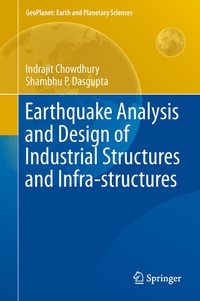
Earthquake Analysis and Design of Industrial Structures and Infra-structures
Published on 6. October 2018
XXII, 1050 pages
978-3-319-90832-8 (ISBN)
Description

Despite significant development in earthquake analysis and design in the last 50 years or more, different structures related to industry, infra structure and human habitats get destroyed with monotonic regularity under strong motion earthquake. Even the recent earthquake in Mexico in September 2017 killed a number of people and destroyed national assets amounting to hundreds of millions of dollars.
Careful evaluation of the technology reveals that, despite significant development in earthquake engineering, most of the books that are available on the market for reference are primarily focused towards buildings and framed type structures. It is accepted that during an earthquake it is buildings that get destroyed most and has been the biggest killers of human life. Yet, there are a number of structures like retaining walls, water tanks, Bunkers, silos, tall chimneys, bridge piers etc that are equally susceptible to earthquake, and if damaged can cause serious trouble and great economic distress. Unfortunately, many of these systems are analyzed by techniques that are too simplified, unrealistic/obsolete or nothing is done about them, ignoring completely the seismic effects, as no guidelines exist for their analysis/design (like seismic analysis of counterfort retaining walls or dynamic pressures on bunker walls etc.).
This highly informative book addresses many of these items for which there exists a significant gap in technology and yet remain an important life line of considerable commercial significance.The book is an outcome of authors' academic research and practice across the four continents (USA, Europe, Africa and Asia) in the last thirty two years, where many of these technologies have been put in practice, that got tested against real time earthquakes. All methods presented herein have been published previously in peer reviewed research journals and international conferences of repute before being put to practice.
Professionals working in international EPC and consulting engineering firms, graduates taking advanced courses in earthquake engineering, doctoral scholars pursuing research in earthquake engineering in the area of dynamic soil structure interaction (DSSI) and advanced under graduates wanting to self-learn and update themselves on earthquake analysis and design are greatly benefited from this book.
Careful evaluation of the technology reveals that, despite significant development in earthquake engineering, most of the books that are available on the market for reference are primarily focused towards buildings and framed type structures. It is accepted that during an earthquake it is buildings that get destroyed most and has been the biggest killers of human life. Yet, there are a number of structures like retaining walls, water tanks, Bunkers, silos, tall chimneys, bridge piers etc that are equally susceptible to earthquake, and if damaged can cause serious trouble and great economic distress. Unfortunately, many of these systems are analyzed by techniques that are too simplified, unrealistic/obsolete or nothing is done about them, ignoring completely the seismic effects, as no guidelines exist for their analysis/design (like seismic analysis of counterfort retaining walls or dynamic pressures on bunker walls etc.).
This highly informative book addresses many of these items for which there exists a significant gap in technology and yet remain an important life line of considerable commercial significance.The book is an outcome of authors' academic research and practice across the four continents (USA, Europe, Africa and Asia) in the last thirty two years, where many of these technologies have been put in practice, that got tested against real time earthquakes. All methods presented herein have been published previously in peer reviewed research journals and international conferences of repute before being put to practice.
Professionals working in international EPC and consulting engineering firms, graduates taking advanced courses in earthquake engineering, doctoral scholars pursuing research in earthquake engineering in the area of dynamic soil structure interaction (DSSI) and advanced under graduates wanting to self-learn and update themselves on earthquake analysis and design are greatly benefited from this book.
Reviews / Votes
"This book is a thorough examination of all of the engineering considerations that are required. It is not for the casual reader but intended as a graduate-level textbook and reference for researchers and Practicing engineers. . this is a major work on an important subject. The book should be considered an essential addition to the library of any organization involved in geotechnical or structural engineering projects in earthquake zones." (William R. Green, The Leading Edge, Vol. 38 (10), October, 2019)More details
Series
Edition
1st ed. 2019
Language
English
Place of publication
Cham
Switzerland
Publishing group
Springer International Publishing
Illustrations
XXII, 1050 p. 424 illus., 142 illus. in color.
File size
25,93 MB
ISBN-13
978-3-319-90832-8 (9783319908328)
DOI
10.1007/978-3-319-90832-8
Schweitzer Classification
Other editions
Additional editions
Indrajit Chowdhury | Shambhu P. Dasgupta
Earthquake Analysis and Design of Industrial Structures and Infra-structures
Book
10/2018
Springer
€213.99
Shipment within 10-15 days
Content
Global Seismicity and History of Earthquake Occurrence in India.- Basic Mechanics of Earthquake Resistant Design.- Soil Dynamics and Earthquake Engineering.- Earthquake Analysis of Earth Retaining Structures.- Dynamic Analysis of Earth Dams Under Earthquake.- Seismic Design of Shallow and Deep Foundations.- Dynamic Soil Structure Interaction in Earthquake Analysis.- Geo-technical Considerations for Seismic analysis.- Earthquake Resistant Design and Analysis of Buildings.- Earthquake Analysis of Tall Chimneys and Stack Like Structure.- Earthquake Analysis of Concrete Gravity Dam.- Earthquake Response of Bridge Piers and their Foundations.- Dynamic Response of Bunkers and Circular Silos under Earthquake Force.- Analysis of Water Tanks under Earthquake Force.
