

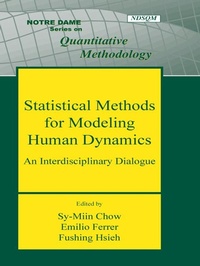
Statistical Methods for Modeling Human Dynamics
An Interdisciplinary Dialogue
1st Edition
Published on 25. February 2011
444 pages
978-1-135-26259-4 (ISBN)
Description

This interdisciplinary volume features contributions from researchers in the fields of psychology, neuroscience, statistics, computer science, and physics. State-of-the-art techniques and applications used to analyze data obtained from studies in cognition, emotion, and electrophysiology are reviewed along with techniques for modeling in real time and for examining lifespan cognitive changes, for conceptualizing change using item response, nonparametric and hierarchical models, and control theory-inspired techniques for deriving diagnoses in medical and psychotherapeutic settings. The syntax for running the analyses presented in the book is provided on the Psychology Press site. Most of the programs are written in R while others are for Matlab, SAS, Win-BUGS, and DyFA.
Readers will appreciate a review of the latest methodological techniques developed in the last few years. Highlights include an examination of:
Statistical and mathematical modeling techniques for the analysis of brain imaging such as EEGs, fMRIs, and other neuroscience data
Dynamic modeling techniques for intensive repeated measurement data
Panel modeling techniques for fewer time points data
State-space modeling techniques for psychological data
Techniques used to analyze reaction time data.
Each chapter features an introductory overview of the techniques needed to understand the chapter, a summary, and numerous examples. Each self-contained chapter can be read on its own and in any order. Divided into three major sections, the book examines techniques for examining within-person derivations in change patterns, intra-individual change, and inter-individual differences in change and interpersonal dynamics. Intended for advanced students and researchers, this book will appeal to those interested in applying state-of-the-art dynamic modeling techniques to the the study of neurological, developmental, cognitive, and social/personality psychology, as well as neuroscience, computer science, and engineering.
Readers will appreciate a review of the latest methodological techniques developed in the last few years. Highlights include an examination of:
Statistical and mathematical modeling techniques for the analysis of brain imaging such as EEGs, fMRIs, and other neuroscience data
Dynamic modeling techniques for intensive repeated measurement data
Panel modeling techniques for fewer time points data
State-space modeling techniques for psychological data
Techniques used to analyze reaction time data.
Each chapter features an introductory overview of the techniques needed to understand the chapter, a summary, and numerous examples. Each self-contained chapter can be read on its own and in any order. Divided into three major sections, the book examines techniques for examining within-person derivations in change patterns, intra-individual change, and inter-individual differences in change and interpersonal dynamics. Intended for advanced students and researchers, this book will appeal to those interested in applying state-of-the-art dynamic modeling techniques to the the study of neurological, developmental, cognitive, and social/personality psychology, as well as neuroscience, computer science, and engineering.
Reviews / Votes
"This is a timely and important book that addresses an integrated set of topics that will be of great interest to a broad audience of researchers studying human dynamics. The contributors are among the leaders in their respective fields and jointly represent a truly interdisciplinary perspective on these issues. The material is presented in both an accessible and technically rigorous manner, and real data examples help clarify key points throughout. Importantly, this text offers a collection of papers that challenge many traditional beliefs held about the "typical" analysis of repeated measures data. I recommend this book highly." - Patrick J. Curran, University of North Carolina, Chapel Hill, USA"Dynamical modeling of intraindividual change and variability obtained from many sources and in a wide range of time scales is the promising future of behavioral science research and the availability of this outstanding volume will accelerate our progress in that direction. Take it home, take it to the office, take it to class and, whatever you do, take it seriously!" - John R. Nesselroade, University of Virginia, USA
"Intensive longitudinal designs will be providing cutting edge insights into psychological, neuroscience and biomedical processes during the next decades, and researchers using these designs will want to study the useful approaches described in this volume. I consider this book to be required reading!" - Patrick E. Shrout, New York University, USA
"I am delighted to see this outstanding volume containing contributions connecting mathematics, classical and Bayesian statistics, signal processing and psychology. .. Other subject matter areas could well take this volume as a model for presenting the results of collaborative research in their own fields."-Robert H. Shumway, University of California, Davis, USA "This is a timely and important book that addresses an integrated set of topics that will be of great interest to a broad audience of researchers studying human dynamics. The contributors are among the leaders in their respective fields and jointly represent a truly interdisciplinary perspective on these issues. The material is presented in both an accessible and technically rigorous manner, and real data examples help clarify key points throughout. Importantly, this text offers a collection of papers that challenge many traditional beliefs held about the "typical" analysis of repeated measures data. I recommend this book highly." - Patrick J. Curran, University of North Carolina, Chapel Hill
"Dynamical modeling of intraindividual change and variability obtained from many sources and in a wide range of time scales is the promising future of behavioral science research and the availability of this outstanding volume will accelerate our progress in that direction. Take it home, take it to the office, take it to class and, whatever you do, take it seriously!" - John R. Nesselroade, University of Virginia
"Intensive longitudinal designs will be providing cutting edge insights into psychological, neuroscience and biomedical processes during the next decades, and researchers using these designs will want to study the useful approaches described in this volume. I consider this book to be required reading!" - Patrick E. Shrout, New York University
"I am delighted to see this outstanding volume containing contributions connecting mathematics, classical and Bayesian statistics, signal processing and psychology. .. Other subject matter areas could well take this volume as a model for presenting the results of collaborative research in their own fields."-Robert H. Shumway, University of California, Davis
More details
Series
Language
English
Place of publication
London
United Kingdom
Publishing group
Taylor & Francis Ltd
Target group
College/higher education
File size
6,89 MB
ISBN-13
978-1-135-26259-4 (9781135262594)
Copyright in bibliographic data and cover images is held by Nielsen Book Services Limited or by the publishers or by their respective licensors: all rights reserved.
Schweitzer Classification
Other editions
Additional editions

Chow Sy-Miin | Sy-Miin Chow | Emilio Ferrer
Statistical Methods for Modeling Human Dynamics
Book
02/2010
Routledge
€41.58
No shipping information available
Sy-Miin Chow | Emilio Ferrer | Fushing Hsieh
Statistical Methods for Modeling Human Dynamics
Book
12/2009
1st Edition
Routledge Academic
€49.70
The article will not be published
Sy-Miin Chow | Emilio Ferrer | Fushing Hsieh
Statistical Methods for Modeling Human Dynamics
An Interdisciplinary Dialogue
Book
12/2009
1st Edition
Routledge
€233.10
Shipment within 3-4 weeks
Persons
Sy-Miin Chow is Assistant Professor of Psychology at the University of North Carolina at Chapel Hill. She received her Ph.D. in Quantitative Psychology from the University of Virginia. Her research focuses on the development and adaptation of modeling and analysis tools for evaluating linear and nonlinear dynamical systems models. Dr. Chow received the prestigious Dissertation Award from the Society of Multivariate Experimental Psychology in 2004.
Emilio Ferrer is Associate Professor of Psychology at the University of California, Davis. He received his Ph.D. in Quantitative Psychology from the University of Virginia. His research focuses on methods techniques for studying change and intra-individual variability in developmental processes. Dr. Ferrer received the prestigious Dissertation Award from the Society of Multivariate Experimental Psychology in 2002.
Fushing Hsieh is Professor of Statistics at the University of California, Davis. He received his Ph.D. in Statistics from Cornell University. Dr. Hsieh's research focuses on survival analysis, modeling in biomedical dynamic systems and in animal behavior, evolutionary ecology and aging, and the analysis of cognitive processing. A frequent contributor to Biometrika and the Journal of the Royal Statistical Society Series B, Dr. Hsieh served as an Associate Editor of Statistica Sinica from 1998 until 2005.
Emilio Ferrer is Associate Professor of Psychology at the University of California, Davis. He received his Ph.D. in Quantitative Psychology from the University of Virginia. His research focuses on methods techniques for studying change and intra-individual variability in developmental processes. Dr. Ferrer received the prestigious Dissertation Award from the Society of Multivariate Experimental Psychology in 2002.
Fushing Hsieh is Professor of Statistics at the University of California, Davis. He received his Ph.D. in Statistics from Cornell University. Dr. Hsieh's research focuses on survival analysis, modeling in biomedical dynamic systems and in animal behavior, evolutionary ecology and aging, and the analysis of cognitive processing. A frequent contributor to Biometrika and the Journal of the Royal Statistical Society Series B, Dr. Hsieh served as an Associate Editor of Statistica Sinica from 1998 until 2005.
Content
Introduction and Section Overview. Part 1. Parametric and Exploratory Approaches for Extracting Within-Person Nonstationarities. P.C.M. Molenaar, N. Ram, Dynamic Modeling and Optimal Control of Intra-Individual Variation: A Computational Paradigm for Non-Ergodic Psychological Processes. M. Tarvainen, Dynamic Spectral Analysis of Biomedical Signals with Application to EEG and Heart Rate Variability. B. Gao, H. Ombao, M.R. Ho, Cluster Analysis for Non-Stationary Time Series. R. Prado, Characterizing Latent Structure in Brain Signals. H. Ombao, R. Prado, A Closer Look at Two Approaches for Analysis and Classification of Non-Stationary Time Series. Part 2. Representing and Extracting Intraindividual Change. S. Boker, P.R. Deboeck, C. Edler, P. Keep, Generalized Local Linear Approximation of Derivatives from Time Series. P.R. Doebeck, S.M. Boker, Unbiased, Smoothing-Corrected Estimation of Oscillators in Psychology. P.F. Craigmile, M. Peruggia, T. Van Zandt, Detrending Response Times Series. G. Zhang, M.W. Browne, Dynamic Factor Analysis with Ordinal Manifest Variables. R.P. Bowles, Measuring Intraindividual Variability with Intratask Change Using Item Response Models. Part 3. Modeling Interindividual Differences in Chang and Interpersonal Dynamics. R. Cudeck, J. Harring, Developing a Random Coefficient Model for Nonlinear Repeated Measures Data. F. Hamagami, Z.J. Zhang, J. McArdle, A Bayesian Discrete Dynamic System by Latent Difference Score Structural Equations Models for Multivariate Repeated Measures Data. L. Wang, Z. Zhang, R. Estabrook, Longitudinal Mediation Analysis of Training Intervention Effects. F. Hsieh, S. Chen, S. Chow, E. Ferrer, Exploring Intra-Individual, Inter-Individual and Inter-Variable Dynamics in Dyadic Interactions.
