

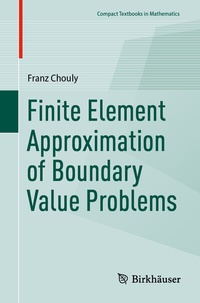
Finite Element Approximation of Boundary Value Problems
Description

This textbook provides an accessible introduction to the mathematical foundations of the finite element method for a broad audience. The author accomplishes this, in part, by including numerous exercises and illustrations. Each chapter begins with a clear outline to help make complex concepts more approachable without sacrificing depth. Structurally, the book begins with the simplest type of finite element method: low order, piecewise continuous, Lagrange finite elements. With this, crucial questions about the stability and approximation errors are answered. Of particular note is the author's coverage of two specific topics that often go overlooked in introductory material. The first is the numerical treatment of boundary conditions, especially the Nitsche technique. The second is a detailed explanation of the discretization error using specific techniques of a posteriori error estimation. With the book's compact yet thorough treatment of these areas, readers will have a clear understanding of how mathematical analysis tools can be used in practice. Finite Element Approximation of Boundary Value Problems will be suitable as a supplementary textbook in applied mathematics courses for graduate students, and may also be used for self-study.
More details
Other editions
Additional editions
Person
Franz Chouly is professor at the Center of Mathematics of the University of the Republic. His research is on mathematical modeling and numerical analysis of partial differential equations, with emphasis on finite element methods and variational inequalities.
Content
.- Introduction.
.- A simple mathematical model.
.- Low order Lagrange Finite Elements.
.- The standard Finite Element Method.
.- Nitsche Finite Element Method.
.- Nitsche for Signorini.
.- About meshing and discretization error.
